BOOKS
Published

Read Time

9 min read

Reader rating

3.9

· 491 Amazon ratings
reader ratings, not a LuvemBooks score
Curated & edited by

LuvemBooks Editorial

How we create our reviews →
Share This Review

Our review

May We Feed the King by Rebecca Perry Review: A Dazzling Debut Bridging Past and Present

May We Feed the King is Rebecca Perry's debut novel, published by Transit Books, in which a reserved museum curator who reconstructs medieval rooms collides with the world of a reluctant monarch — a dual-timeline meditation on history, devotion, and what survives time. A finalist for the 2026 Booker Prize and winner of the 2026 Waterstones Debut Fiction Prize, it arrives as one of the most decorated debut novels of its year.

LuvemBooks Verdict

Best for

Readers who relish literary, dual-timeline historical fiction — in the vein of A. S. Byatt or Hilary Mantel — and who are drawn to novels that interrogate how history is constructed, preserved, and quietly distorted, sentence by careful sentence.

Worth it if

You welcome fiction that prizes intellectual provocation and poetic precision over plot momentum, and want a debut that genuinely unsettles assumptions about historical truth, memory, and what museums choose to keep or erase.

Skip if

You're looking for a propulsive, event-driven historical narrative — Perry's meditative, poet's pacing and deliberately witheld names and dates demand active patience that will frustrate readers expecting a conventional story arc.

The Guardian calls it "a highly wrought puzzle-box of a book which deliberately wrongfoots the reader at every turn," concluding it "richly rewards those who approach it with curiosity." The New York Times frames the curator as functioning "like a novelist" in her reconstruction of the past, while Bookmarks Reviews notes the novel is "a work of historical fiction that is about fiction, and storytelling." Publishers Weekly (via transitbooks.org and bookshop.org) awards it a starred review calling it "masterful," and Kirkus Reviews (same sources) praises it as "astonishingly layered, quietly witty and compassionate," predicting readers "may find themselves drawn to rereading right away."

“A highly wrought puzzle-box of a book which deliberately wrongfoots the reader at every turn — the intrigued will find it richly rewards curiosity.”

— The Guardian

“Like a novelist, the curator reconstructs a past whose narrator can never be certain what really happened.”

— The New York Times
Sources: The Guardian, The New York Times, Bookmarks Reviews, Transit Books, Bookshop.org, The Booker Prizes, Lonesome Reader, Books of Brilliance
3.9from 491 Amazon ratings— reader ratings, not a LuvemBooks score
Buy on Amazon

Age & Reading Level

Recommended age

Adult

Reading level

Adult

Skip if you want a plot-driven historical narrative with momentum and action rather than a meditative, poetic inquiry into history and memory.

In This Review
  • What Works & What Doesn't
  • What the Novel Actually Is
  • Significance and Recognition
  • Craft and Strengths
  • Thematic Ambition and Intellectual Stakes
  • Who This Novel Is For

What Works & What Doesn't

What Works
  • Shortlisted for the 2026 Booker Prize and winner of the 2026 Waterstones Debut Fiction Prize — exceptional recognition for a debut novel
  • Dual-timeline structure — a present-day museum curator and a reluctant medieval king — is praised by the Times Literary Supplement as 'a love story between the present and the past'
  • The Observer commends Perry's ability to 'stage a rich feast of images and ideas,' reflecting her celebrated background as a poet
  • Booker Prize judges praise the novel's genuine intellectual challenge to the idea of a singular historical truth, giving it rare conceptual heft
  • Publisher describes the prose as 'laced with desire and longing' — a literary texture that sets it apart from conventional historical fiction
What Doesn't
  • Its meditative, poetic pacing — rooted in Perry's background as a poet — may frustrate readers seeking a plot-driven historical narrative
  • The novel's philosophical inquiry into the nature of historical truth and memory demands active, patient engagement that won't suit all tastes
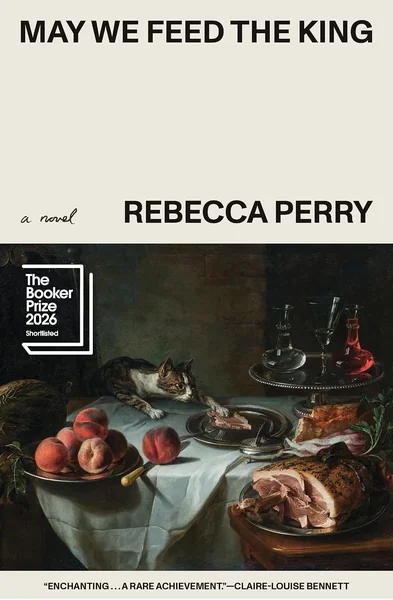
A Booker-shortlisted debut that moves fluently between centuries, May We Feed the King announces Rebecca Perry as a novelist of rare and distinctive ambition.
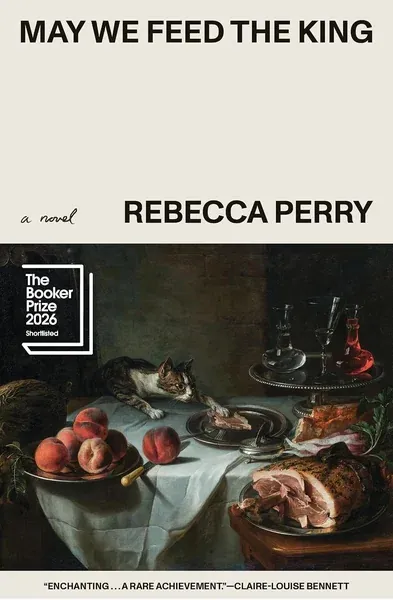
May We Feed the King (Booker Prize Finalist) by Rebecca Perry front cover

What the Novel Actually Is

At its core, May We Feed the King runs on two parallel tracks. In the present-day strand, a reserved museum curator spends her days reconstructing the past — selecting and arranging furniture, fabrics, and replica food, including careful arrays of fake pies and pomegranates, to bring medieval rooms back to life. In the historical strand, the novel enters the world of a reluctant medieval monarch, a king who, as one passage quoted by the Booker Prize judges captures it, "wears the face of a man who has been dropped in the middle of the ocean without warning." Perry weaves these threads into what the publisher describes as a searing meditation on what becomes lost over time and what devotion can reanimate — exploring, simultaneously, two kinds of resurrection: the curator's and the novelist's own.
“captures the players of the court and the chain of gossip so successfully it feels as though we are observing history as it plays out.”

Significance and Recognition

Perry is already an established poet — author of the collections Beauty/Beauty (Bloodaxe Books, 2015), which won the Michael Murphy Memorial Prize and was shortlisted for the T.S. Eliot Prize, and Stone Fruit — and her transition to long-form fiction has been met with exceptional recognition. May We Feed the King was shortlisted for the 2026 Booker Prize and won the 2026 Waterstones Debut Fiction Prize. The Booker judges framed its central provocation as asking whether history is ever truly a safe place to escape the present, and whether the line between historical fiction and historical fact can hold. These are not modest questions for a first novel to take on, and the scale of critical attention suggests Perry took them seriously.

Craft and Strengths

Critical response to the novel's construction has been strong. The Times Literary Supplement described it as "a love story between the present and the past," noting how Perry brings "two kinds of resurrection" vividly to life through both the art of fiction and the art of curation. The Observer wrote that Perry "stages a rich feast of images and ideas." The Booker Prize site notes that Perry "captures the players of the court and the chain of gossip so successfully it feels as though we are observing history as it plays out." For a writer whose background is in poetry, this precision — the accumulation of observed detail in service of a larger argument about time and memory — appears to be one of the novel's defining qualities. One blurb from the Booker Prize materials calls it "sheer magic," urging readers to "let it bewitch you into roaming the King's inner chambers, fever burning in your heart." The publisher characterises the novel as "laced with desire and longing" and as "a playful, stirring meditation on history and storytelling."

Thematic Ambition and Intellectual Stakes

Beyond its dual narrative, May We Feed the King is designed as a genuine inquiry into how history is constructed and who controls its shape. The Booker judges noted its challenge to the notion that there is ever "one universal historical truth," raising questions about bias and whitewashing in the records that survive. The novel asks what makes a king "Great" and what makes a life meaningful — questions that, in the hands of a poet turned novelist, are as much about language and form as they are about the past. Perry's background in wordplay, highlighted by the Booker Prize materials, gives the novel a verbal texture that reviewers suggest runs throughout: the prose is purposeful, not merely decorative. A blurb describes the thematic combination as "wonderfully enticing," woven together "with a delicacy of touch," and notes that the novel makes the "fragile boundary between the present and the past" impossible to ignore.

Who This Novel Is For

Readers drawn to dual-timeline historical fiction with literary ambitions — in the territory of, say, A. S. Byatt or Hilary Mantel — will find May We Feed the King a natural fit. Its pleasures are intellectual as much as narrative: Perry is interested in epistemology and loss as much as plot, and readers who want a propulsive page-turner may find its meditative pace demanding. The novel's roots in poetry mean its rewards are often at the level of the sentence rather than the chapter. But for those who welcome fiction that genuinely unsettles received ideas — about history, about what museums preserve and what they quietly erase, about the relationship between the present and the medieval world it curates — this debut offers something uncommon. As the Observer and TLS coverage confirms, it has already found serious readers; its Booker shortlisting ensures it will find many more.

Sources & Further Reading

The key facts and claims in this review are grounded in the retrieved, verified sources listed below.

  1. Cited in this review
  2. 1

    en.wikipedia.org

  3. 2
  4. 3
  5. Further reading
  6. 4
  7. 5
  8. 6