
BOOKS
Published

Read Time

9 min read

Reader rating

4.1

· 20,747 Amazon ratings
reader ratings, not a LuvemBooks score
Curated & edited by

LuvemBooks Editorial

How we create our reviews →
Share This Review

Orbital by Samantha Harvey Review: A Meditative Booker Winner in Orbit

Samantha Harvey's Orbital follows six astronauts through a single day aboard a space station — sixteen sunrises, little plot, and a sustained meditation on Earth. It won the 2024 Booker Prize, the first space-set novel to do so.

LuvemBooks Verdict

Best for

Readers of contemplative literary fiction who want a Woolfian, essay-in-motion meditation on Earth and consciousness — ideally consumed in a single sitting — rather than a story with conventional plot momentum.

Worth it if

Worth it if you value luminous, near-poetic prose and big philosophical scope — faith, grief, art, progress — compressed into a compact book whose orbital structure rewards rereading.

Skip if

Skip it if you need plot, stakes, or fully inhabited characters — even a death and a gathering typhoon are deliberately absorbed into meditation rather than developed into drama.

Kirkus Reviews called the novel "elegiac and elliptical... A sobering read," while Literary Review observed that "at times, Orbital feels almost like a long poem" — praise echoed by book-blog readers like Whispering Gums, who prized its "calm beauty and quiet provocations." The same stillness divides opinion: Writing at Large dismissed it as "a book about nothing" and questioned its Booker win, a dissenting view reflected in its mixed-to-positive 4.1/5 average from over 20,000 Amazon ratings.

Elegiac and elliptical, this slim novel is a sobering read.

Kirkus Reviews
Sources: Kirkus Reviews, Literary Review, Whispering Gums, Writing at Large
4.1from 20,747 Amazon ratings— reader ratings, not a LuvemBooks score
Buy on Amazon

Age & Reading Level

Recommended age

Adult

Reading level

Adult

Content to know about

death of a parent (occurs on Earth, absorbed as reflection rather than drama)

Skip if you want a plot-driven space story with stakes, tension, and fully developed characters — Orbital deliberately refuses all three.

Trending Now
Trending

Orbital: A Novel by Samantha Harvey is Trending

Updated Sep 24, 2026
In This Review
  • What Works & What Doesn't
  • What Orbital Actually Is
  • A Prize-Winning Outlier
  • What It Does Well
  • Where It Will Frustrate
  • Who It Is For

What Works & What Doesn't

What Works
  • Winner of the 2024 Booker Prize — the first space-set novel ever to win it
  • Lyrical, near-poetic prose; Literary Review likened it to a long poem
  • Convincingly researched portrait of daily life aboard an orbiting station
  • Compact length with an outsized philosophical scope: faith, grief, art, progress
  • Also won the 2024 Hawthornden Prize; shortlisted for the Orwell and Ursula K. Le Guin prizes
What Doesn't
  • Deliberately resists plot: even a death and a gathering typhoon never develop into narrative drama
  • The six crew members' backstories are gestural — sketched to serve the themes rather than fully developed
  • Readers expecting conventional space-fiction stakes or character study will find it static by design
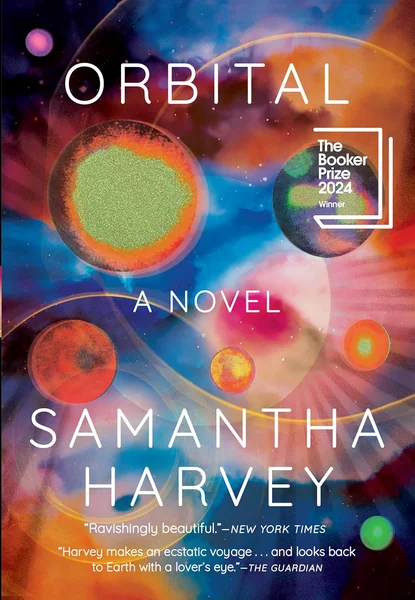
A slim, luminous meditation on Earth as seen from orbit, Orbital earns its 2024 Booker Prize on prose and philosophical ambition — readers who need plot should look elsewhere.
Orbital: A Novel (Booker Prize Winner) by Samantha Harvey front cover

What Orbital Actually Is

Orbital is the fifth novel by English writer Samantha Harvey, first published by Jonathan Cape in the UK in 2023 and released in the US by Grove Atlantic, with this Grove Press paperback edition dated October 29, 2024. It blends elements of science fiction, literary fiction, and philosophical fiction, though it is best understood as the latter two wearing the setting of the first. The premise is exactingly simple: six astronauts and cosmonauts — an international crew that includes the Japanese astronaut Chie and the Italian Pietro — go about a single 24-hour day aboard an orbiting space station. In that day the station circles the Earth sixteen times, giving the crew sixteen sunrises and sixteen sunsets, and the novel loops with them.
Our unanimity about Orbital recognises its beauty and ambition
What fills those loops is work and thought. Per Literary Review's account of the book, the crew monitor microbes and protein crystals and document their own vital signs, while Harvey gestures at backstory for each of the six. Two events puncture the routine: Chie's mother dies suddenly back on Earth, and a typhoon gathers and spreads from the western Pacific, watched from above. Neither detonates into conventional drama — and that refusal is the novel's defining choice.

A Prize-Winning Outlier

Orbital won the 2024 Booker Prize, announced in November of that year, and it is a historically unusual winner: according to the Booker Prizes' own coverage, it is the first space-set novel to take the award, and Harvey is the first woman to win it since 2019. At 136 pages in its UK edition it is also among the shortest Booker winners ever, though not as short as Penelope Fitzgerald's Offshore. The judges were emphatic about the decision: "Our unanimity about Orbital recognises its beauty and ambition," the panel wrote, praising Harvey's intensity of attention to "the precious and precarious world we share." Beyond the Booker, the novel won the 2024 Hawthornden Prize and was shortlisted for both the Orwell Prize for Political Fiction and the Ursula K. Le Guin Prize — an unusually broad spread that reflects its straddle of the literary and speculative shelves.
Harvey arrived at this win with a long pedigree. Born in Kent in 1975, she studied philosophy at the universities of York and Sheffield, and her debut, The Wilderness — about an architect with Alzheimer's — was longlisted for the 2009 Booker and won the Betty Trask Prize. Her work, often compared to Virginia Woolf's, is known for changing shape from book to book: her previous novel, The Western Wind, concerned a priest in fifteenth-century Somerset.

What It Does Well

The consistent thread in critical response is the quality of the writing itself. Literary Review observed that "at times, Orbital feels almost like a long poem," and that phrasing captures the consensus: this is a novel of cadence and accumulation rather than incident. Harvey uses the orbital structure as form — the book circles its subjects (faith, art, grief, and, less familiarly for her, human progress and technology) the way the station circles the planet, returning to each with every pass. Literary Review singles out a moment in which Pietro reflects that only from far enough away could Earth finally be understood — a neat condensation, that review notes, of the novel's governing idea.
The research underneath the lyricism also draws praise. Readers with an eye for aerospace detail have noted that Harvey has no space background and built her portrait of station life entirely from research, and that the result is convincing enough to send them to reference sources to check the history she touches on. For a book whose pleasures are atmospheric rather than narrative, that factual ballast matters — it keeps the meditation tethered.

Where It Will Frustrate

The same choice that makes Orbital distinctive makes it inert for some readers. Literary Review's assessment is direct: whenever an event threatens to generate plot — a death, a gathering storm — Harvey declines to follow through. A character's mother dies and the book absorbs it as one more orbit; the typhoon swells as spectacle and meditation rather than crisis. The six crew members' backstories are, in that review's word, gestural — sketched to support the existential themes rather than to build fully inhabited lives. Readers who come expecting the dramatic machinery of space fiction, or even a conventional character study, will find a book that actively refuses both routes. Its 136 UK pages can feel either perfectly judged or underpressured depending entirely on what the reader wanted.

Who It Is For

Orbital is for readers of contemplative literary fiction — those who value a Woolfian attentiveness to consciousness and are happy for a novel to be an essay in motion. Its portrait of Earth as a fragile, borderless whole gives it an obvious resonance in the climate era, which is part of why the Booker judges framed it as a book of the moment. It suits a single sitting and rewards a second. This review's assessment is drawn from the published record — the synopsis, prize citations, and critical coverage — rather than an independent page-by-page reading, but the shape of the verdict across those sources is remarkably consistent: a small book with an unusually large field of view.

Sources & Further Reading

The key facts and claims in this review are grounded in the retrieved, verified sources listed below.

  1. Cited in this review
  2. 1
  3. 2
  4. 3
  5. Further reading
  6. 4
  7. 5
  8. 6
  9. 7
  10. 8
  11. 9
  12. 10