Skip to content
Reviewed

Read Time

10 min read

Our age bandAdult
Reader rating
4.3 · 4,207 Amazon ratings, as of Nov 2026
reader ratings, not a LuvemBooks score
Curated & edited by

LuvemBooks Editorial

How we create our reviews →
Share This Review
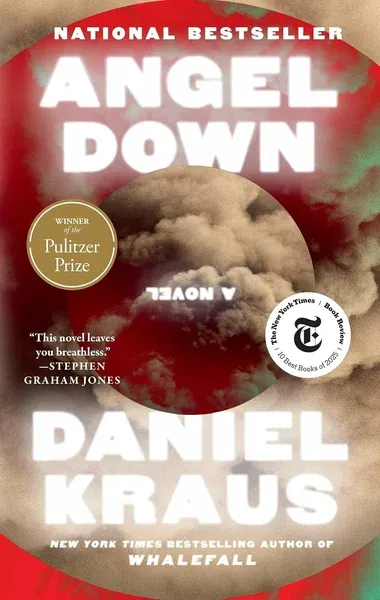
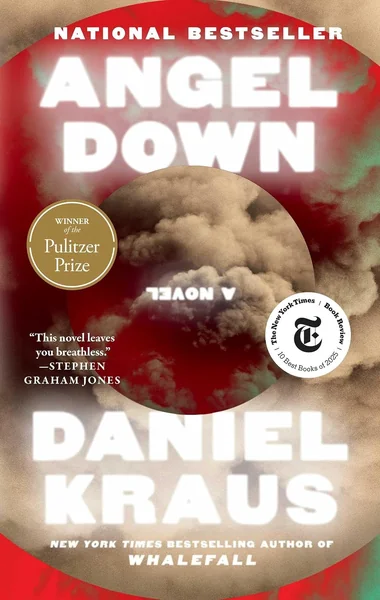
Angel Down (Pulitzer Prize Winner): A Novel by Daniel Kraus front cover

Our review

Angel Down

Angel Down by Daniel Kraus Review: A Pulitzer-Winning WWI Novel

Daniel Kraus’s Angel Down delivers a stylistically audacious war novel that rewards readers with its relentless pacing. The book may frustrate audiences seeking traditional narrative closure or grounded character development.

Our age band: Adultgraphic trench warfare · psychological unraveling

LuvemBooks Verdict

Best for

For readers who crave immersive, experimental war fiction that trades traditional character arcs for visceral, breathless momentum.

Worth it if

Worth reading if you enjoy unflinching, stylistically bold narratives that prioritize atmospheric intensity and structural innovation over conventional resolution.

Skip if

Skip it if you prefer grounded character development and clear narrative closure, as the experimental form and abstracted emotional beats may feel exhausting.

Where reviewers agree and split

Readers rate it 4.3 on Amazon. The reviews we read that discuss it in depth split on some points:

  • Positive

    Kirkus Reviews · Press review: an impressive and surprising take on war-story tropes overall

  • Mixed

    BookBrowse · Magazine: unforgettable yet uneven, with verbose passages alongside vivid moments

  • Positive

    Books Bones & Buffy · Book blog: A powerful, visceral experience that explores war and angels movingly

  • Negative

    Strange Horizons · Book blog: A thin novel riddled with clichés that fails to achieve its ambitions

Of the 2 reviews we read that discuss its prose, 1 praises the visceral, death-focused imagery, but 1 calls the experimental form a gimmick.

  • Prose

    1 praises the visceral, death-focused imagery · 1 calls the experimental form a gimmick

Prose

Praise

“Kraus’s prose comes most to life when he’s writing about death”

— nytimes.com · Press review
Criticism

“The style is not enough: Long before we reach the final pages it has come to feel like a gimmick”

— Strange Horizons · Book blog
Overall verdicts are our summary of each review we read, from its headline, rating and conclusion. Topic counts use only words we can quote (2 reviews: 1 press review, 1 book blog).

The 2026 Pulitzer Prize-winning novel has drawn praise for its relentless pacing and visceral, additive prose, with The New York Times highlighting its technical mastery and breathless momentum. However, a Strange Horizons reviewer found the experimental style can overshadow character depth, calling the novel 'thin' and the style a 'gimmick' that fails to reveal new insights about war.

“An impressive and surprising take on war-story tropes.”

— Kirkus Reviews

“Kraus’s prose comes most to life when he’s writing about death”

— The New York Times
Sources: Pulitzer Prize, Kirkus Reviews, The New York Times, Strange Horizons
4.3from 4,207 Amazon ratings, as of Nov 2026— reader ratings, not a LuvemBooks score

Ask LuvemBooks

Was this helpful?

Daniel Kraus’s Angel Down is a stylistically audacious World War I novel that follows Private First Class Cyril Bagger and his squad as they desert their post to carry a fallen angel through hostile territory, only for the celestial being to expose their deepest flaws. Critics praise its relentless, continuous-sentence structure and immersive momentum, though some find the experimental form a gimmick that overshadows character development. It is a visceral, atmospheric read best suited for those who prioritize innovation and breathless pacing.
Is it worth reading?
It delivers a highly immersive, breathless experience for readers who enjoy avant-garde literary fiction and unflinching war narratives. However, the experimental structure may feel exhausting to those seeking conventional resolution.
Similar books
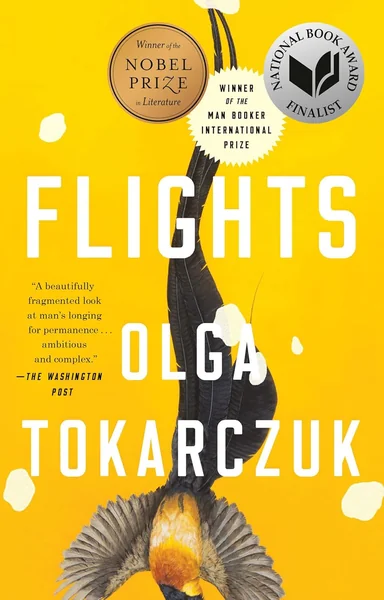
Readers who appreciate its blend of historical setting, surreal allegory, and experimental prose will likely connect with Primo Levi’s The Wrench, Viet Thanh Nguyen’s The Sympathizer, and Olga Tokarczuk’s Flights. For those drawn to its cinematic, high-concept military thriller elements, Emily St. John Mandel’s Exit Party offers a comparable structural boldness.
Who should read this?
It is written for adult readers who crave immersive, experimental war fiction that trades traditional character arcs for visceral, breathless momentum.
What age is it for?
The book is written for adults due to its intense depictions of trench warfare, psychological unraveling, and mature thematic content. While no explicit minimum age is mandated, the complex themes and demanding structure make it unsuitable for younger readers.
What are the main themes?
The novel explores the corrosive effects of war on the human psyche, focusing on how isolation and supernatural temptation fracture group loyalty. It delves into themes of moral corruption, the loss of innocence (embodied by the soldier Arno), and the brutal machinery of military ambition driven by figures like Major General Reis.
Tell me about the adaptation
A film adaptation is currently in development at Imagine Entertainment, with rights secured by the studio behind Whalefall. The announcement in January 2026 highlights the novel's strong cinematic appeal and industry interest, though no release date or cast has been confirmed.
Summarize this book

Summarize this book

The novel follows PFC Cyril Bagger and four fellow soldiers who desert their post on the Meuse-Argonne front to transport a fallen angel tangled in barbed wire. As they navigate No Man's Land, the angel's radiant aura triggers their jealousy and paranoia, fracturing their unity and turning their mission into a descent into psychological hell.

Follow up

How is the book structured?
Is the writing style difficult to read?

Synthesized from verified book data & published reviews · How we review

Ask LuvemBooks

What would you like to know about Angel Down?

Answers come from our editorial notes on this book. If we haven't covered something, we'll say so.

Readers often ask

Our Review

We review the evidence: published critics, reader verdicts and BookTube reviews, gathered and weighed with AI assistance and edited by LuvemBooks, rather than one reader's first-hand take.

Daniel Kraus’s Angel Down delivers a stylistically audacious war novel that rewards readers with its pacing. The book may frustrate audiences seeking traditional narrative closure or grounded character development.

What happens in Angel Down?

Private First Class Cyril Bagger survives the Meuse-Argonne offensive through deception and wits before receiving a deadly mission from Major General Reis. Reis orders Bagger to investigate an unearthly shrieking sound that is driving troops to insanity.
Bagger ventures into the ruined battlefield with four other soldiers: the young and innocent Arno, the brute Popkin, the nervous Goodspeed, and the shell-shocked Veck. They discover the sound originates from a fallen angel tangled in barbed wire and emitting a bright aura.
The celestial being resembles women each soldier recognizes from their past. Believing Reis intends to exploit the angel for his career advancement, the group deserts their post.
They carry the wounded angel through artillery fire while arguing over their next moves. Each soldier secretly hopes the angel will grant a personal wish, which rapidly fractures their unity.
Jealousy, greed, and paranoia turn their mission into a descent into hell. The narrative tracks their psychological unraveling against the backdrop of a brutal conflict.
The group navigates the treacherous No Man’s Land while dodging relentless artillery fire. Their internal conflicts escalate as the supernatural encounter challenges their survival instincts.
Major General Reis remains a distant figure whose ambition drives the soldiers into danger. The fallen angel serves as a catalyst for exposing the men's deepest flaws.
Arno represents youthful innocence corrupted by the horrors of the front. Popkin embodies the raw brutality that defines the trenches.
Goodspeed and Veck illustrate the psychological toll of prolonged combat. The group's dynamic shifts from reluctant cooperation to bitter hostility.
Their shared mission becomes a mirror for their individual desires. The supernatural element grounds the allegorical themes in physical reality.

How is the novel structured?

He described the prose as an exemplary additive style where the writing is associative and spontaneous.
Kirkus Reviews noted that Kraus builds relentless tension through the rhythm of this continuous sentence. The technique creates a sensation of non-stop action that mirrors the chaos of trench warfare.
The writing also contains highly lyrical passages that contrast with the brutal setting. This stylistic approach aligns with literary theorist Stanley Fish’s framework on spontaneous fact-piling.
The continuous form forces readers to experience the disorientation of combat directly. Readers must constantly track shifting subjects and clauses without the relief of paragraph breaks.
The lack of traditional punctuation mirrors the entrapment felt by soldiers in the trenches. The additive style allows Kraus to layer sensory details rapidly.
Readers must piece together the narrative logic as they progress. The form itself becomes a central character in the story.

What did critics find to praise in Angel Down?

The Pulitzer Board awarded the novel the 2026 Pulitzer Prize for Fiction and called it a breathless novel of World War I. The Board described the book as a stylistic tour-de-force that blends allegory, magical realism, and science fiction into a cohesive whole. The New York Times Book Review labeled it a thunderous gallop of a war novel and a best-in-class example of speculative fiction.
The New York Times praised the momentum and the way the continuous sentence sustains a breathless pace. The New York Times called it a stylistically delightful literary novel that avoids dry history or maudlin tales of brothers in arms.
Readers who appreciate experimental prose will find the book deeply immersive. The novel reached the New York Times Top 10 list of the year and achieved national bestseller status.
The adaptation deal at Imagine Entertainment further underscores its cinematic appeal. Stephen Graham Jones praised the novel for leaving readers breathless.
The New York Times Book Review also highlighted its status as a new classic within the speculative genre. The Pulitzer Board recognized the novel's technical mastery alongside its thematic depth.
Critics noted the seamless integration of magical realism into historical fiction. The New York Times Book Review emphasized the cinematic quality of the prose.
Stephen Graham Jones highlighted the book's ability to sustain tension throughout. The adaptation announcement at Imagine Entertainment signals strong industry interest.
The film rights were secured by the studio behind Whalefall. The novel's success bridges the gap between literary and genre audiences.
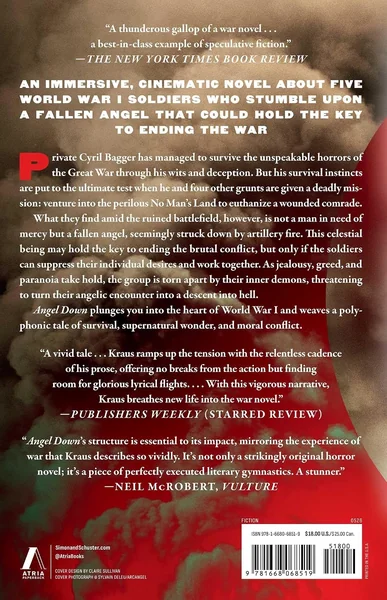
Back cover with synopsis and review quotes about five soldiers encountering a fallen angel.

Where does Angel Down fall short?

A reviewer at Strange Horizons found the novel thin as an experimental work, a World War I story, and a piece of genre fiction. The reviewer argued the style eventually feels like a gimmick meant to impress rather than reveal.
The fallen angel was described as overpowered by the narrative's need to use her as a mouthpiece. The reviewer concluded that the novel fails to make its fundamental message about war feel new.
This critique highlights a divide between readers who prioritize stylistic innovation and those who prioritize character depth. The book does not smooth over this disagreement, leaving readers to decide which element they value more.
Some audiences may find the relentless pacing exhausting rather than exhilarating. The narrative prioritizes atmospheric intensity over traditional character development.
Readers expecting a conventional war story may struggle with the abstracted emotional beats. The experimental form demands patience that not all historical fiction readers possess.
The Strange Horizons reviewer suggested the novel prioritizes form over substance. The fallen angel functions more as a plot device than a fully realized character.
The narrative occasionally sacrifices clarity for stylistic flourish. Readers who prefer grounded historical fiction may find the supernatural elements distracting.
The book does not attempt to reconcile its experimental form with traditional storytelling. This deliberate choice ensures the novel will divide its audience.

Is Angel Down worth reading?

The book was published in July 2025 by Atria Books, an imprint of Simon & Schuster, and won the 2026 Pulitzer Prize for Fiction. A film adaptation was announced to be in development at Imagine Entertainment in January 2026.
The novel appeals to readers who enjoy avant-garde literary fiction and historical speculative fiction. It suits audiences who want a relentless, midsentence narrative that prioritizes atmosphere over traditional resolution.
Readers seeking a conventional war story with a clear ending should approach it with adjusted expectations. The book stands as a complete narrative experience without requiring additional purchases or context.
Weighing these reviews, the draw is its audacious form and momentum, pointing the book toward experimental fiction fans and away from traditionalists. The novel remains a distinct entry in contemporary literary fiction.
Daniel Kraus brings his experience in television and film to the novel's pacing. The adaptation deal at Imagine Entertainment reflects the story's visual potential.
The book was published in July 2025 and quickly gained critical acclaim. It secured a spot on the New York Times Top 10 list of the year.
The novel stands as a complete narrative experience without requiring additional purchases or context. Weighing these reviews, the draw is its audacious form and momentum, pointing the book toward experimental fiction fans and away from traditionalists, though.
The novel remains a distinct entry in contemporary literary fiction. Daniel Kraus returns to the themes of his previous work with a focus on survival and moral ambiguity.
The book delivers a visceral reading experience that demands full attention from its first page. The stylistic gamble defines the novel's legacy as a polarizing but undeniably bold work.

Sources & Further Reading

The key facts and claims in this review are grounded in the retrieved, verified sources listed below.

  1. 1
  2. 2
  3. 3
  4. 4
  5. 5
  6. 6
  7. 7

    Kirkus Reviews

Age & Reading Level

Our age band

Adult

Our age band groups books for browsing; it isn't an age a review gave.

Content to know about

graphic trench warfare
psychological unraveling
military ambition
loss of innocence

Best for: Adults — intense depictions of combat trauma and mature thematic content

Skip if you prefer grounded character development and clear narrative closure, as the experimental form may feel exhausting

Daniel Kraus on Angel Down

Daniel Kraus discusses the premise, characters, and historical research behind his World War I novel Angel Down.

Uploaded by About the Authors TV, 2026 · Watch on YouTube ·

More from this interview on Daniel Kraus' page →

Premise of Angel Down

Kraus explains that in Angel Down, finding a fallen angel trapped in no man's land produces the opposite of an angelic influence, exposing the soldiers' worst instincts as each plots to exploit it.

Crafting the soldiers' ulterior motives

Kraus notes that rather than developing characters organically, he deliberately designed each soldier in the unit to represent a unique angle and motivation for exploiting the angel.

The symbolic weight of Bagger's Bible

Kraus reveals that Bagger lugs around a Bible inherited from his father who died on the Lusitania, carrying it despite his lack of faith as an inescapable reminder of his conscience.

Naming the regiment after the shrike

Kraus gave the commander's fictionalized 43rd Division a nickname inspired by butcher birds that impale prey on thorns, intending the moniker to reflect the commander's sadistic vanity.

From our readers

Reader reviews

Be one of the first readers to answer.

Read it? Was it right for you?

Books like Angel Down

Curated picks for readers who enjoyed Angel Down, with our reasoning for each match.

Discussion

Reader comments