

8 min read
4.6
· 431 Amazon ratingsShare This Review
Sapiens: A Brief History of Humankind by Yuval Noah Harari Review: A Sweeping, Provocative Macro-History
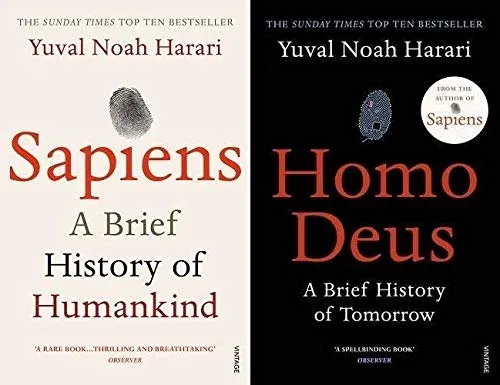
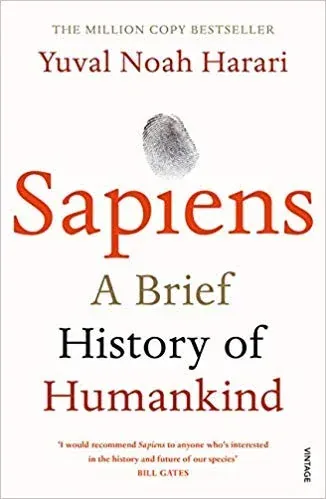
Yuval Noah Harari's Sapiens: A Brief History of Humankind is a macro-history that traces Homo sapiens from the Stone Age to the 21st century across four defining revolutions — Cognitive, Agricultural, the Unification of Humankind, and Scientific — arguing that humanity's singular ability to believe in shared fictions is the engine behind all large-scale cooperation. Originally published in Hebrew in 2011 and in English in 2014, it is a genuinely ambitious work of popular non-fiction that integrates natural and social science, and has drawn both wide acclaim and substantive scholarly criticism for its breadth and interpretive boldness.
 Tap to enlarge
LuvemBooks Verdict
Best for
Intellectually curious general readers who want a single, coherent framework for understanding how Homo sapiens came to dominate the planet — from prehistoric origins through empire, capitalism, and the threshold of a post-human future — and who bring no prior background in history, biology, or economics.
Worth it if
Worth engaging with if you value bold, counterintuitive interpretive claims — such as the argument that the Agricultural Revolution made most individual lives materially worse — and are willing to weigh them critically rather than treat them as settled scholarship.
Skip if
Skip it if you need granular academic depth or exhaustive sourcing on any particular period; specialists have contested specific claims, and the panoramic 400-page scope cannot deliver the rigour of a peer-reviewed monograph on any single era.
What readers & critics say
The Guardian acknowledged that Harari "sets out the deep lines of the story of sapiens with verve" while noting directly that the full sweep of humankind's history cannot really be conveyed in roughly 400 pages. Kirkus Reviews praised the book's "encyclopedic approach from a well-versed scholar who is concise but eloquent, both skeptical and opinionated," calling the airing of history's great debates "satisfying."
“Sets out the deep lines of the story of sapiens with verve — but its full sweep can't really be conveyed in 400 pages.”
— The Guardian“An encyclopedic approach from a well-versed scholar who is concise but eloquent, both skeptical and opinionated.”
— Kirkus ReviewsAge & Reading Level
Recommended age
Adult
Reading level
Adult
who it suits
Skip if you want rigorous, peer-reviewed depth on any single historical period or civilisation.
Sapiens: A Brief History of Humankind by Yuval Noah Harari is Trending
Sapiens Gets a Tenth Anniversary Edition — and a Fresh Round of Buzz
A tenth anniversary edition of Sapiens hit shelves in 2025, and book clubs are picking it back up. The Dothan Houston County Library System just featured it as their September 2026 Chapter Chat pick, putting it in front of a new wave of readers.
Sapiens is making the rounds again, and there are a couple of clear reasons why. First, Harper Perennial released a tenth anniversary edition in 2025 — a natural moment for readers who missed it the first time (or want a fresh copy) to finally dive in. Second, the Dothan Houston County Library System just spotlighted it as their September 2026 Chapter Chat selection, with library director Chris Warren introducing the pick earlier this month. That kind of community book club momentum has a way of spreading.
The timing also feels right culturally. With ongoing public conversations about AI, human identity, and where our species is headed, Harari's central argument — that what makes humans unique is our ability to believe in shared fictions, from money to nations to religions — lands differently now than it might have a decade ago. The book's question of what it even means to be Homo sapiens feels less abstract than ever.
If you've been meaning to read Sapiens for years but never got around to it, the anniversary edition is a solid entry point. Just know going in that it's a big, sweeping book that makes bold claims — scholars have pushed back on some of Harari's interpretations, so it's best read as an ambitious conversation-starter rather than a definitive history textbook.
In This Review
- What Works & What Doesn't
- What the Book Actually Is and Argues
- Scope, Structure, and Interdisciplinary Ambition
- Genuine Strengths: Verve, Counterintuition, and Big Questions
- Critical Pushback: Breadth as a Double-Edged Sword
- Who This Book Is For
What Works & What Doesn't
What Works
- Organises the entirety of human history into a coherent, accessible four-part framework spanning the Cognitive, Agricultural, and Scientific Revolutions
- Central thesis — that large-scale human cooperation is built on shared belief in imagined realities like money, nations, and religion — is original and consistently applied across chapters
- Integrates natural sciences and social sciences into a single analytical framework, connecting prehistoric human behaviour to contemporary institutions
- Harari's counterintuitive reading of the Agricultural Revolution — that population growth came at the cost of individual wellbeing — exemplifies the book's capacity to reframe accepted narratives
- Sustains a genuine moral and philosophical thread about human happiness and progress throughout, giving the historical survey evaluative depth
What Doesn't
- Panoramic scope of roughly 400 pages covering 70,000+ years of history means individual eras and claims receive limited depth — specialists have contested specific interpretations
- A 2022 Current Affairs article by neuroscientist Darshana Narayanan raised specific fact-checking concerns, and the book's breadth has been noted as structurally resistant to expert scrutiny of any single claim
What the Book Actually Is and Argues

Scope, Structure, and Interdisciplinary Ambition
Genuine Strengths: Verve, Counterintuition, and Big Questions
Critical Pushback: Breadth as a Double-Edged Sword
Who This Book Is For
Frequently Asked Questions
Sources & Further Reading
The key facts and claims in this review are grounded in the retrieved, verified sources listed below.
- Cited in this review
- 1
en.wikipedia.org
- 2
- 3
scholarlykitchen.sspnet.org
- Further reading
- 4
Yuval Noah Harari, Wikipedia
- 5
- 6
- 7
ynharari.com
- 8
- 9
bethinking.org
- 10
kara.reviews
- 11
- 12
tylerdevries.com
Related Reviews
Reviews of books we picked for readers who enjoyed Sapiens.



Reader Comments
No comments yet
Be the first to share your thoughts!