8 min read
4.5
· 7,539 Amazon ratingsShare This Review
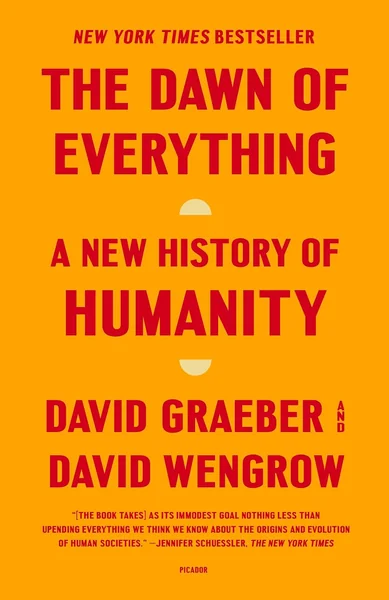
The Dawn of Everything: A New History of Humanity by David Graeber and David Wengrow Review: A Landmark, Myth-Busting Work of Scholarship
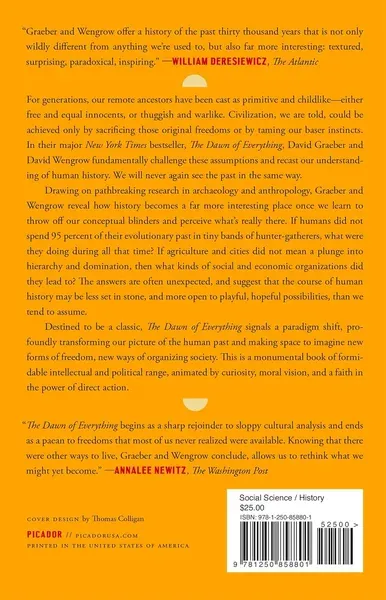
A New York Times bestseller co-authored by anthropologist David Graeber and archaeologist David Wengrow, The Dawn of Everything is a sweeping, award-winning reexamination of human prehistory that dismantles centuries-old assumptions about social evolution, the origins of agriculture, cities, democracy, and inequality — and argues that the human past holds far more possibility than conventional wisdom allows.
 Tap to enlarge
LuvemBooks Verdict
Best for
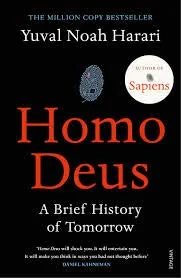
Intellectually engaged general readers, students, and scholars in history, anthropology, archaeology, or political theory who want a rigorous, evidence-based challenge to the deterministic storylines advanced by Harari, Pinker, Diamond, and their peers.
Worth it if
You're frustrated by neat, linear accounts of how civilisation "had to" unfold and are ready to commit to a dense, rewarding 700-page synthesis that replaces those stories with a genuinely more complex picture of human possibility.
Skip if
Casual readers looking for a quick, lightly sourced big-history survey may find the scope, density, and scholarly apparatus more demanding than they bargained for.
What readers & critics say
Bookmarks.reviews describes the book as "erudite, compelling, generative, and frequently remarkably funny," calling it an instant classic for its comprehensive scientific demolition of received myths about early humanity. The Guardian's review situates it squarely in the surge of popular interest in prehistory, noting its particular appeal to those who find established narratives of modernity either constricting or built on false premises.
“Fertile ground for those who find established narratives of modernity either constricting or based on false premises — or both.”
— The GuardianAsk LuvemBooks
Was this helpful?
- Is it worth reading?
- For intellectually engaged readers willing to commit to a long, dense argument, The Dawn of Everything is widely regarded as a landmark work. It won the J.I. Staley Prize from the School for Advanced Research in 2025 and the Wenjin Book Prize from the National Library of China, was a finalist for the Orwell Prize for Political Writing in 2022, and became an instant New York Times bestseller translated into more than thirty languages. The New York Journal of Books praised its 'vivid narrative prose and rich detail,' and writing in Jacobin, anthropologist Giulio Ongaro compared its ambition to what Galileo and Darwin did to astronomy and biology. Those seeking a neat, deterministic account of human history should look elsewhere; those frustrated by the oversimplifications of popular big-history books will find it richly rewarding.
- Similar books
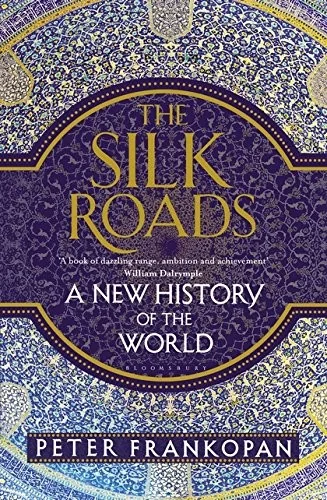
- Readers drawn to The Dawn of Everything will find natural companions in the very books it explicitly challenges. Yuval Noah Harari's Sapiens: A Brief History of Humankind and Jared Diamond's Guns, Germs, and Steel: The Fates of Human Societies are both direct targets of Graeber and Wengrow's critique, making them essential paired reading for understanding the debate. Peter Frankopan's The Silk Roads: A New History of the World shares the ambition of rewriting conventional historical narratives from a non-Eurocentric vantage point, while Howard Zinn's A People's History of the United States offers a similarly politically motivated challenge to mainstream historical storytelling. Joseph Henrich's The WEIRDest People in the World engages some overlapping questions about cultural evolution from a different disciplinary angle.
- Who should read this?
- The Dawn of Everything is written primarily for intellectually engaged general readers alongside students and scholars in history, anthropology, archaeology, political theory, and the social sciences. It is particularly well-suited to readers who have been captivated — or frustrated — by the big-picture popular histories of Yuval Noah Harari, Jared Diamond, Steven Pinker, Francis Fukuyama, or Ian Morris, and who want a serious, evidence-based counter-argument. As Macmillan's publisher description notes, the book is animated by 'curiosity, moral vision, and a faith in the power of direct action,' so readers open to an explicitly political and moral dimension in their intellectual history will find it especially engaging.
- About David Graeber
- Pirate Enlightenment, or the Real Libertalia is a book by David Graeber, published posthumously in 2023.
- What are the main themes?
- The Dawn of Everything's central themes include the origins and contingency of social inequality, the diversity of prehistoric political organisation, and the question of why certain forms of hierarchy and the state became dominant. The book also explores the origins of agriculture, property, cities, democracy, and slavery — arguing in each case that these phenomena are more contested and surprising than conventional accounts suggest. A distinctive thread running through the book is the intellectual agency of Indigenous peoples, whose critiques of European society Graeber and Wengrow argue were instrumental in shaping Enlightenment political thought rather than merely reacting to it.
- What are the scholarly criticisms?
- The Dawn of Everything attracted serious scholarly engagement alongside its widespread acclaim. Historian Walter Scheidel criticised the book for a lack of materialist perspectives, while also calling it 'timely and stimulating.' Other academic reviewers have pushed back specifically on the authors' account of the Indigenous origins of Enlightenment thought, suggesting that at points the argument reaches beyond what the evidence strictly supports. Graeber and Wengrow's willingness to stake bold, sweeping interpretive claims is precisely what makes the book generative — but it is also what keeps certain debates live within the scholarly community.
Summarize this book
Follow up
Synthesized from verified book data & published reviews · How we review
Press Enter to ask. Answers come from our editorial Q&A — start typing to see related questions.
Age & Reading Level
Recommended age
Adult
Reading level
Adult
who it suits
Skip if you prefer concise, thesis-driven popular history over a sprawling, deliberately open-ended scholarly argument.
Our Review
What the Book Actually Argues

Significance and Reception
Strengths: Scope, Ambition, and Narrative Drive
Genuine Limitations and Academic Debate
Who This Book Is For
Sources & Further Reading
The key facts and claims in this review are grounded in the retrieved, verified sources listed below.
- Cited in this review
- 1
en.wikipedia.org
- 2
us.macmillan.com
- Further reading
- 3
- 4
- 5
Books like The Dawn of Everything
Curated picks for readers who enjoyed The Dawn of Everything, with our reasoning for each match.
If you liked The Dawn of Everything