BOOKS
Published

Read Time

4 min read

Curated & edited by

LuvemBooks Editorial

How we create our reviews →
Share This Review

The Bronze Bow by Elizabeth George Speare Review: A Gripping Newbery-Winning Historical Novel

Elizabeth George Speare's The Bronze Bow is a Newbery Medal–winning historical fiction novel set in first-century Galilee, following Daniel bar Jamin's journey from hatred-fueled revenge to something harder-won, with Jesus of Nazareth present as a figure in the background of Daniel's world. The 1997 Clarion Books reissue makes this landmark work of American children's literature available to new generations of middle-grade and young adult readers.

LuvemBooks Verdict

Best for

Middle-grade and adult readers drawn to morally serious historical fiction who want to explore how grief and injustice fuel hatred — and what it costs — through the eyes of a first-century Galilean boy living under Roman occupation.

Worth it if

Worth reading if you're ready to engage with a protagonist whose rage is earned and comprehensible, and whose journey through questions of vengeance, loyalty, and liberation is worked through with genuine historical and spiritual depth.

Skip if

Skip it if you're looking for a straightforward adventure story — the novel's philosophical density and the weight it places on first-century political context will frustrate readers who come without patience for that scaffolding.

What readers & critics say

Kirkus Reviews describes a novel in which Daniel's hatred is "steeled by the constant reminder of his parents' crucifixion" and finds the resolution — in which he discovers love as an antidote — miraculous in effect. Sisandchrys.com called The Bronze Bow "an absolute triumph, a Newbery-medal-winning triumph," and michelleisenhoff.com recommends it broadly to fifth-grade readers and above, world civilizations students, and adults who love well-written historical fiction.

Daniel's hatred is steeled by the constant reminder of his parents' crucifixion — how miraculous when he finds his own heart thawing in a crisis.

Kirkus Reviews
Sources: Kirkus Reviews, sisandchrys.com, michelleisenhoff.com
4.6from 2,629 Amazon ratings— reader ratings, not a LuvemBooks score
In This Review
  • What Works & What Doesn't
  • What the Novel Is and What It Follows
  • Historical Setting and Its Significance
  • Strengths: Thematic Depth and Emotional Stakes
  • Recognition and Place in the Canon
  • Audience Fit and Genuine Limitations

What Works & What Doesn't

What Works
  • Won the Newbery Medal in 1962 for excellence in American children's literature, cementing its canonical status in historical fiction for young readers
  • Builds emotional stakes around a fully realized protagonist — Daniel bar Jamin's hatred of Rome is rooted in concrete, personal loss, not abstraction
  • Engages seriously with the competing pulls of armed resistance and a different vision of liberation, grounded in a historically specific first-century Galilean setting
  • Praised by sisandchrys.com as 'an absolute triumph' for its unflinching treatment of how unrelenting hatred shapes those who carry it
  • Recommended by reviewers for a wide range of audiences beyond middle grade, including history students and adult readers of historical fiction
What Doesn't
  • Younger or less experienced readers may need pre-reading context about first-century Roman-occupied Galilee and Jewish zealot movements to fully follow the political stakes
  • The novel's spiritual and philosophical density — particularly the presence and teachings of Jesus as a counterpoint to Daniel's revolutionary aims — makes it a demanding read for those expecting a straightforward adventure narrative
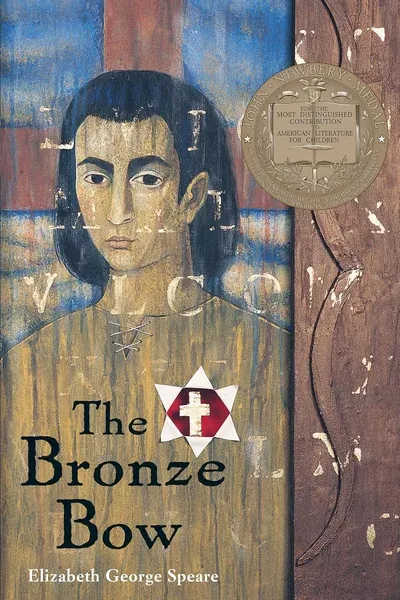
A Newbery Medal–winning work of historical fiction for middle-grade readers, The Bronze Bow remains one of the most recognized novels in its genre, built on a premise of revenge, grief, and the cost of consuming hatred.

What the Novel Is and What It Follows

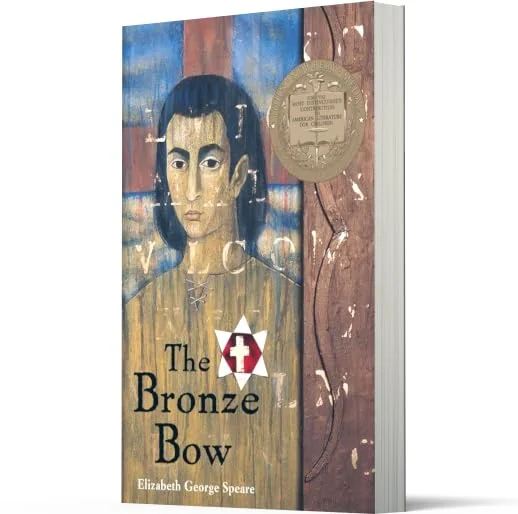
Front cover featuring a portrait of a young person with dark hair and a gold medal seal.
The Bronze Bow centers on Daniel bar Jamin, a young Jewish man living under Roman occupation in first-century Galilee. Daniel's hatred of Rome is not abstract: his father was crucified by the Roman Empire, his mother died of grief in the aftermath, and his younger sister Leah was left deeply traumatized by those losses. Sold into bondage to Amalek the blacksmith as a child, Daniel eventually escapes to the mountains and falls in with Rosh, the leader of an outlaw rebel band bent on one day overthrowing Rome. It is in this mountain camp that Daniel builds a new identity—hardened, furious, and single-minded in his vow of vengeance.
As the story unfolds, Daniel reconnects with figures from his village of Ketzah: Joel bar Hezron and his twin sister Malthace, who ascend the mountain during a holiday. Joel agrees to serve as a spy for Rosh in Capernaum, weaving the trio into a web of loyalty and danger. A captive of extraordinary physical strength, nicknamed Samson by the band, also enters Daniel's orbit and becomes bound to him. When Daniel's grandmother falls ill, he returns to Ketzah and—after her death—is left responsible for Leah. He settles into the blacksmith shop once kept by Simon the Zealot, who has left to follow Jesus of Nazareth, and Daniel's world begins to shift.

Historical Setting and Its Significance

Speare grounds the novel firmly in the political and spiritual landscape of first-century Roman-occupied Israel. The tensions between Jewish subjects and Roman authority, the existence of zealot rebel movements, and the concurrent ministry of Jesus of Nazareth are all woven into the narrative fabric. Jesus appears as a figure in Daniel's world—one whose teachings stand in direct tension with Daniel's hunger for violent liberation. This collision between the impulse toward armed resistance and a radically different vision of freedom is the novel's central moral and spiritual engine.
For readers unfamiliar with the political climate of first-century Judea and Galilee, some context about Roman occupation and the various Jewish responses to it—from zealotry to accommodation—can help illuminate the stakes Speare builds into Daniel's choices. As one reviewer at sisandchrys.com noted, younger readers especially may benefit from having that historical backdrop established before they begin.

Strengths: Thematic Depth and Emotional Stakes

The novel's most frequently praised quality is its unflinching engagement with the effects of unrelenting hatred. Speare does not present Daniel's rage as villainous or simple; it is the entirely comprehensible response of a boy who lost everything to an occupying power. What the novel interrogates is where that hatred leads—what it costs Daniel, Leah, Samson, and those who love him. Sisandchrys.com called The Bronze Bow "an absolute triumph, a Newbery-medal-winning triumph," singling out this thematic seriousness as central to its power.
The cast of supporting characters—Joel, Malthace, Simon, Samson—each carry distinct weight in Daniel's arc, and the novel's emotional stakes are personal as much as political. Daniel's responsibility for Leah, whose trauma has left her unable to leave their home, anchors the abstraction of his revolutionary goals in the immediate, human cost of his choices.

Recognition and Place in the Canon

Speare won the Newbery Medal in 1962 for The Bronze Bow, awarded by the American Library Association for excellence in American children's literature. The medal places the novel in a small company of works judged to represent the highest standard of the form in their year. Notably, Speare had already won the Newbery Medal for The Witch of Blackbird Pond in 1959, making her one of a rare group of two-time Newbery winners. The 1997 Clarion Books reissue is directed at grades 5 through 7, and reviewers—including one at michelleisenhoff.com—have recommended it for world civilizations students, adults who read historical fiction, and those with an interest in the culture of New Testament-era Judaism, broadening its natural audience well beyond the middle-grade classroom.

Audience Fit and Genuine Limitations

The Bronze Bow is best suited to readers ready for morally complex historical fiction—those who can sit with a protagonist whose worldview is shaped by real grief and real injustice, and who can follow a narrative that does not resolve those tensions cheaply. The novel's interweaving of first-century Jewish life, Roman imperial politics, and the figure of Jesus of Nazareth gives it a density that rewards engaged readers but may prove challenging without some prior scaffolding of the historical context. Readers seeking a straightforward adventure story may find the novel's spiritual and philosophical dimensions demanding. Conversely, readers drawn to questions of justice, vengeance, and what it means to be free will find those themes worked through with real seriousness across every chapter.

Sources & Further Reading

The key facts and claims in this review are grounded in the retrieved, verified sources listed below.

  1. Cited in this review
  2. 1
  3. 2
  4. Further reading
  5. 3

    Elizabeth George Speare, Wikipedia

  6. 4
  7. 5
  8. 6
  9. 7
  10. 8