BOOKS
Published

Read Time

8 min read

Reader rating

4.6

· 34,544 Amazon ratings
reader ratings, not a LuvemBooks score
Curated & edited by

LuvemBooks Editorial

How we create our reviews →
Share This Review

The Boy in the Striped Pajamas by John Boyne Review: Innocence at the Auschwitz Fence

John Boyne's novel follows Bruno, the nine-year-old son of Auschwitz's commandant, and his forbidden friendship through the camp fence with Shmuel, a Jewish prisoner his own age. A multi-award-winning classroom staple praised for its child-eye narration, it is also persistently criticized for historical implausibility — a powerful fable best read with that debate in view.

LuvemBooks Verdict

Best for

Best for upper-middle-grade classrooms and families seeking a short, non-graphic first Holocaust-fiction encounter that can be discussed alongside testimony or history.

Worth it if

Worth it if you value a moral fable and child-perspective dread and are prepared to treat its simplifications as a prompt for discussion rather than documentary history.

Skip if

Skip it if historical implausibility—especially Shmuel’s survival and Bruno’s total ignorance—or a devastating non-redemptive ending will outweigh the fable’s emotional force for you.

Kirkus Reviews warned it is “certain to provoke controversy” and hard to see as a children’s book because child readers could miss the painful point, while a reader review on The Guardian Children’s Books Site recommended it to over-elevens for a “stunning plot” that keeps readers hooked. Book bloggers split sharply: Everyday Reading felt “totally manipulated as a reader,” whereas Jodi Milner recommended it as a short, fast, relatively non-graphic way to introduce the subject slowly.

Certain to provoke controversy and difficult to see as a book for children, who could easily miss the painful point.

Kirkus Reviews

recommend this amazing book to anyone over the age of eleven… kept the reader hooked

The Guardian Children’s Books Site
Sources: Kirkus Reviews, The Guardian Children’s Books Site, Everyday Reading, Jodi Milner
4.6from 34,544 Amazon ratings— reader ratings, not a LuvemBooks score

Age & Reading Level

Recommended age

Ages 8–12

Reading level

Middle grade

Content to know about

Holocaust setting at Auschwitz
death of a child
devastating, non-redemptive ending
deliberate historical simplification of the Holocaust

Best for: Ages 9+ — publisher-suggested age, pitched at grades 7–9; the prose is accessible, but the Holocaust subject matter and a genuinely devastating, non-redemptive ending warrant adult guidance for younger readers

Skip if you prioritize documentary accuracy in Holocaust fiction — the fable's premise strains historical credibility and is best paired with testimony or nonfiction

Trending Now
Trending

The Boy in the Striped Pajamas by John Boyne is Trending

Updated Sep 13, 2026
In This Review
  • What Works & What Doesn't
  • What the Book Is
  • Its Reach and Standing
  • What It Does Well
  • The Case Against It
  • Who It Is For

What Works & What Doesn't

What Works
  • A distinctive child-narrator conceit: Bruno's inability to comprehend the camp lets the reader's knowledge supply the horror
  • The cross-fence friendship between Bruno and Shmuel dramatizes innocence and connection against segregation, per the publisher's synopsis
  • Extensively decorated — Irish Book Award Children's Book of the Year, Bisto Book of the Year, and Spain's Que Leer Award among its wins, per the author's site
  • Short, fast-moving, and non-graphic, which readers have recommended as a gradual first introduction to the Holocaust for children
  • A widely used classroom and book-club text, with a tragic ending that refuses an easy redemptive arc
What Doesn't
  • Premise strains historical credibility — critics note a boy Shmuel's age would most likely not have survived at Auschwitz, and Bruno's total ignorance reads as implausible to many
  • Some readers find Bruno unsympathetically obtuse and report feeling emotionally manipulated by the book's coy withholding of its subject
  • As a self-described fable it simplifies the history, so it needs pairing with testimony or nonfiction for readers seeking accuracy
  • The bleak, non-redemptive ending can be devastating for younger or unprepared readers despite the nine-plus age suggestion
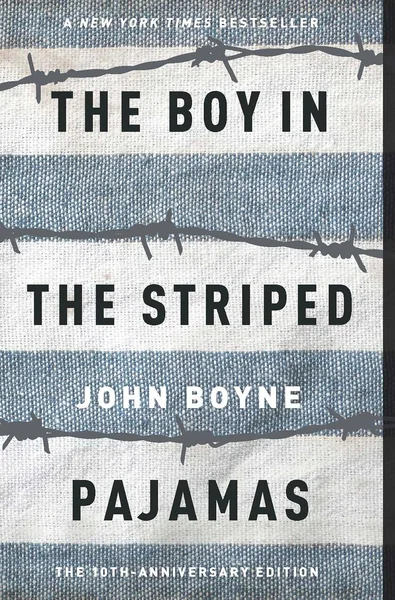
John Boyne's bestselling Holocaust novel about a friendship across the Auschwitz fence is a widely taught, emotionally forceful book whose child-eye narration is also the source of its most persistent criticism.
The Boy in the Striped Pajamas (Young Reader's Choice Award - Intermediate Division) by John Boyne front cover

What the Book Is

The Boy in the Striped Pajamas is a historical novel by Irish author John Boyne, originally published in 2006 and reprinted in this David Fickling Books paperback edition dated October 23, 2007. It follows Bruno, a nine-year-old German boy whose father is appointed Commandant of Auschwitz, forcing the family to leave Berlin and relocate to a house beside the camp. Lonely and with no one to play with, Bruno explores along the fence and meets Shmuel, a Jewish boy his own age imprisoned on the other side. The two talk through the wire almost every day, and a friendship forms between a child who does not understand what the camp is and a child living inside it. Bruno reads Shmuel's striped uniform as pajamas and the camp as a farm, and his incomprehension drives the novel toward its well-known tragic conclusion, in which Bruno crosses to Shmuel's side of the fence. Boyne has described the book as a fable, and it is structured around that conceit: the horror is kept at the edge of a child's field of vision.

Its Reach and Standing

Few Holocaust novels of the past two decades have reached as many readers. According to Boyne's own site, the book won the Irish Book Award for Children's Book of the Year, the People's Choice Book of the Year, the Bisto Book of the Year, and Spain's Que Leer Award for Best International Novel, and was shortlisted for more than a dozen other prizes including the Deutschen Jugendliteraturpreis in Germany. The novel was adapted into a 2008 feature film and has become a fixture of middle-school and early-secondary classrooms; this edition carries a Young Reader's Choice Award (Intermediate Division) designation and is pitched by the publisher at grades seven through nine, with customer-suggested reading ages from nine up. Reader engagement is enormous, and the book functions for many families as a first encounter with Holocaust fiction — a role its defenders and critics both take seriously.

What It Does Well

The novel's central device — filtering industrialized atrocity through a narrator too young to name it — gives the book its force. Bruno's immediate worries (his missing friends, his sister, the view from his window) sit in the foreground while the camp looms uncomprehended behind them, and that gap between what Bruno sees and what the reader knows supplies the dread. One blogger at jodilmilner.com found that choice convincing, writing that Bruno's reactions are realistic for a young child and praising Boyne's writing style as well fitted to the premise, while also noting the book is short, moves quickly, and does not dwell on graphic cruelty — qualities that reader recommended for introducing the subject gradually to an interested child. The friendship itself, conducted in near-daily conversations at the fence, dramatizes connection forming across a division neither boy fully understands, and the ending refuses the survival-and-redemption arc some readers bring to Holocaust stories: as that same reviewer put it, the book delivers not a story of survival against the odds but a tragedy about a boy punished for being a good friend.

The Case Against It

The criticism of this novel is substantial and should not be waved away. Detractors argue that the premise collapses under the mildest historical scrutiny: a nine-year-old at Auschwitz would, as readers have pointed out, most likely have been sent to the gas chambers on arrival, and Bruno's total ignorance of Jews, the camp, and even the word for his own situation strikes many as implausible rather than innocent. In a representative negative review, one blogger described struggling to sympathize with Bruno as "just too dense" and reported feeling manipulated as a reader, faulting the book for coyly withholding its subject and for what she judged to be thin execution. That line of complaint — echoed by educators and Holocaust educators who worry the fable substitutes sentiment for history — means the book works best as a starting point for discussion rather than a final word, and readers seeking documentary accuracy should pair it with testimony or history.

Who It Is For

At roughly 215 pages in this edition, this is a fast, accessible read aimed at upper-middle-grade and young teen readers, and it remains one of the most common gateways into Holocaust literature for that audience. It suits readers and classrooms prepared to talk about what the fable simplifies, and parents should know the ending is genuinely devastating rather than redemptive. Readers who prioritize historical precision in Holocaust fiction will find the implausibilities grating; readers who respond to moral fable and child-perspective narration will understand why it has been so widely awarded and so widely read.

Sources & Further Reading

The key facts and claims in this review are grounded in the retrieved, verified sources listed below.

  1. Cited in this review
  2. 1
  3. 2
  4. Further reading
  5. 3
    John Boyne — author profileHigh-authority source

    John Boyne, Wikipedia

  6. 4
  7. 5
  8. 6
  9. 7
  10. 8