8 min read
4.5
· 17,331 Amazon ratingsShare This Review
Salt to the Sea by Ruta Sepetys Review: A Haunting YA Masterwork of Forgotten History
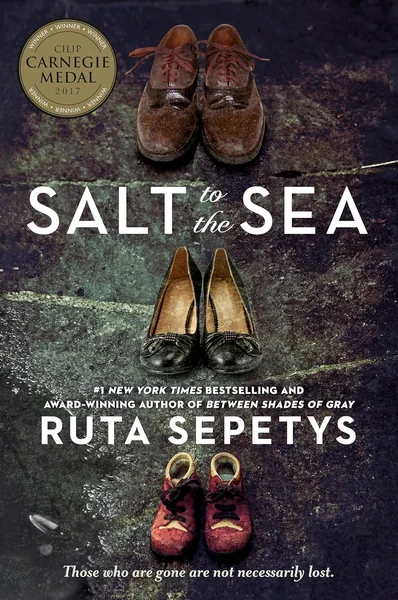
Salt to the Sea is a #1 New York Times bestselling young adult historical fiction novel by Ruta Sepetys, built around the sinking of the MV Wilhelm Gustloff — the deadliest maritime disaster in history — told through four intertwining fictional voices against rigorously researched, real events. Winner of the Carnegie Medal and honored by the Bank Street College of Education, it has drawn praise from major outlets including The Wall Street Journal, Entertainment Weekly, and The Washington Post for its spare, powerful prose and its rare act of literary witness to one of World War II's most overlooked tragedies.
LuvemBooks Verdict
Best for
Readers aged 12 and up who are drawn to character-driven war fiction, particularly those wanting to discover a historically overlooked catastrophe — the sinking of the MV Wilhelm Gustloff — through intimate, multi-perspective storytelling.
Worth it if
Worth reading if you want rigorous historical recovery wrapped in propulsive, emotionally immediate fiction — especially if you already love Sepetys's debut, Between Shades of Grey, or are looking for a Carnegie Medal-winning YA novel that works equally well in a classroom or book club setting.
Skip if
Skip it — or approach with caution — if you prefer single-protagonist, linear narratives or find sustained emotional weight around mass civilian death and wartime loss difficult to endure.
What readers & critics say
The Guardian's review calls the historical accuracy "exemplary," praising Sepetys for successfully delineating four distinct narrative voices that offer "four different ways of seeing the world." Kirkus Reviews describes it as "heartbreaking, historical, and a little bit hopeful," while The Wall Street Journal (as quoted on penguinteen.com) calls it "superlative…masterfully crafted." Common Sense Media characterises it as "an ideal blend of historical facts, riveting drama, compelling characters, and suspense." The novel won the 2017 CILIP Carnegie Medal and was named a Best Children's Book of the Year 2017 with Outstanding Merit by Bank Street College of Education's Children's Book Committee, per Wikipedia.
“The historical accuracy is exemplary — without cramming the novel with too much historical information or dull explanations.”
— The Guardian“Heartbreaking, historical, and a little bit hopeful.”
— Kirkus Reviews“An ideal blend of historical facts, riveting drama, compelling characters, and suspense.”
— Common Sense MediaAsk LuvemBooks
Was this helpful?
- Is it worth reading?
- By virtually every critical and institutional measure, Salt to the Sea stands as an exceptional achievement in young adult historical fiction. It won the Carnegie Medal, earned a #1 New York Times Bestseller ranking, and drew praise from The Wall Street Journal, Entertainment Weekly, The Washington Post, and The Salt Lake Tribune, the last of which called it "one of the best young-adult novels to appear in a very long time." Bestselling author Elizabeth Wein credited Sepetys with breathing "new life into one of the world's most terrible and neglected tragedies" while maintaining "effortless, intimate storytelling." Readers should be aware that the four alternating perspectives require sustained attention, and the emotional weight of mass civilian death and wartime loss is considerable throughout.
- Similar books
- Readers drawn to Salt to the Sea will find natural companions in several works of WWII-era historical fiction. Kelly Rimmer's The Things We Cannot Say similarly centers civilian experience and emotional intimacy against the backdrop of wartime Europe. Heather Morris's The Tattooist of Auschwitz and Kristin Hannah's The Nightingale both excavate overlooked or marginalized WWII stories with character-driven intensity. John Boyne's The Boy in the Striped Pajamas shares the novel's interest in bringing the human scale of wartime tragedy into focus. For readers who want to stay with Sepetys herself, Between Shades of Gray — her debut — covers Soviet deportations of Lithuanians in the same spirit of literary rescue for forgotten histories.
- Who should read this?
- Salt to the Sea is recommended for readers aged 12 and up who are drawn to character-driven war fiction, stories that restore marginalized or forgotten histories, or the work of Ruta Sepetys more broadly. It is particularly well-suited to readers who can sustain engagement across four alternating first-person perspectives — a structure critics praised but which requires more active readerly investment than a single-protagonist narrative. Classroom and book club readers will find the paperback edition especially useful, as it includes discussion questions and exclusive interviews with Wilhelm Gustloff survivors and experts. Those who prefer lighter emotional reads or single-voice storytelling should approach with adjusted expectations.
- What age is it for?
- Best for ages 12 and up. The novel's four alternating first-person perspectives and its unflinching engagement with mass civilian death, wartime displacement, and loss at enormous scale assume a reader with the comprehension and emotional maturity to handle sustained, serious subject matter. It was recognised by the Bank Street College of Education's Children's Book Committee as a Best Children's Book of the Year 2017 with Outstanding Merit, reflecting its appropriateness and value for confident readers in the middle-grade-to-YA range and beyond.
- Tell me about the adaptation
- Universal Pictures optioned Salt to the Sea for a film adaptation, with Scott Neustadter and Michael H. Weber — the screenwriting team behind The Fault in Our Stars — attached to write the screenplay. The review describes this as "a further signal of the story's cultural reach," though no release date or production update is noted in current coverage. Adapting four alternating first-person voices for the screen will be a significant structural challenge, and the screenplay attachment of Neustadter and Weber suggests the production is aiming for the same emotionally grounded approach that distinguished their previous YA adaptation work.
- Is this a good book club pick?
- Salt to the Sea is particularly well-suited to book club and classroom settings. The paperback edition includes dedicated book club questions and exclusive interviews with Wilhelm Gustloff survivors and experts — materials the review highlights as adding "meaningful depth for classroom and group use." The novel's four distinct character perspectives naturally generate discussion about narrative craft, point of view, and the ethics of fictionalising real tragedy, and its historical subject matter — the largely forgotten sinking of the MV Wilhelm Gustloff — gives groups rich factual context to explore alongside the story itself.
- What forgotten history does it uncover?
- The novel centres on the sinking of the MV Wilhelm Gustloff in January 1945 — the deadliest maritime disaster in recorded history — which claimed thousands of lives yet "occupied almost no space in the popular historical imagination" for decades afterward. Sepetys also weaves in the wartime disappearance of the Amber Room, the world-famous ornately decorated chamber looted during the war. Critics described her as a writer who "acts as champion of the interstitial people so often ignored — whole populations lost in the cracks of history," and Salt to the Sea is considered perhaps her most ambitious act of that kind of literary rescue.
Summarize this book
Follow up
Synthesized from verified book data & published reviews · How we review
Press Enter to ask. Answers come from our editorial Q&A — start typing to see related questions.
Age & Reading Level
Recommended age
Ages 12–18
Reading level
Young adult
Content to know about
Best for: Ages 12+ — four alternating perspectives and sustained engagement with mass civilian death, wartime displacement, and loss at enormous scale suit confident readers with the emotional maturity to handle serious subject matter.
Skip if You prefer single-protagonist storytelling or are looking for a lighter-touch historical read.
Our Review
What the Novel Is and What It Does
The Significance of the Subject
Craft and Structure
Reception and Honors
Who This Book Is For and Where It Challenges
Sources & Further Reading
The key facts and claims in this review are grounded in the retrieved, verified sources listed below.
- Cited in this review
- 1
- 2
en.wikipedia.org
- 3
penguinrandomhouse.com
- Further reading
- 4
- 5
rutasepetys.com
- 6
bookbrowse.com
- 7
julias-books.com
- 8
storytellersquad.com
- 9
Books like Salt to the Sea
Curated picks for readers who enjoyed Salt to the Sea, with our reasoning for each match.
If you liked Salt to the Sea