BOOKS
Published

Read Time

4 min read

Reader rating

4.4

· 23,704 Amazon ratings
reader ratings, not a LuvemBooks score
Curated & edited by

LuvemBooks Editorial

How we create our reviews →
Share This Review

The Book Club for Troublesome Women by Marie Bostwick Review: A Spirited Ode to 1960s Sisterhood

Marie Bostwick's novel follows four women — Margaret, Viv, Bitsy, and Charlotte — whose suburban book club becomes an unlikely engine of feminist awakening when they take up Betty Friedan's *The Feminine Mystique*, making it a humorous, thought-provoking, and nostalgic work of historical women's fiction published by Harper Muse on April 22, 2025.

LuvemBooks Verdict

Best for

Readers who love historical women's fiction built around friendship ensembles — particularly fans of mid-century American settings, book-club-within-a-novel structures, and authors like Bonnie Garmus or Kristin Hannah who balance warmth with social critique.

Worth it if

The blend of humor, sisterhood, and period-specific feminist awakening — anchored by The Feminine Mystique as an in-story catalyst — sounds like exactly the kind of affirming, emotionally rich historical fiction you're looking for.

Skip if

Readers who prefer their 1960s history treated with moral ambiguity, darkness, or formal experimentation should look elsewhere — the novel's own publisher describes it as a "nostalgic romp," and that warmth is a feature, not an accident.

Kirkus Reviews characterises the novel as "a lively and unabashedly sentimental" but "sugarcoated take on midcentury suburbia," while the Southern Review of Books positions it more favourably as "a feel-good beach read with substance" that "comes at a time when escape is needed without detaching from reality." Dear Author awarded it a B-minus grade. A Library Journal Starred Review (surfaced via booksbywomen.org) calls it "ideal for fans of historical fiction" and compares it to Lessons in Chemistry and The Women. Lesa's Book Critiques, while praising it as "a very good book," notes that Bostwick's unflinching catalogue of 1963's inequities provoked genuine anger in the reviewer — a testament to the novel's historical texture even within its uplifting frame.

A lively and unabashedly sentimental novel — a sugarcoated take on midcentury suburbia.

Kirkus Reviews
Sources: Kirkus Reviews, Southern Review of Books, Dear Author, Books By Women, Lesa's Book Critiques
4.4from 23,704 Amazon ratings— reader ratings, not a LuvemBooks score
In This Review
  • What Works & What Doesn't
  • What the Novel Is and What Drives It
  • Historical Texture and Social Awareness
  • Tone, Humor, and the Bostwick Voice
  • Reception and Cultural Resonance
  • Who This Novel Serves Best — and Where It Has Limits

What Works & What Doesn't

What Works
  • Weaves humor and social critique together, using comic moments to illuminate the real constraints women faced in early 1960s America
  • Demonstrates genuine historical layering by acknowledging racial inequity within the broader feminist story, not just white suburban experience
  • Backed by strong pre-publication recognition, including USA Today bestseller status and multiple book club selections
  • Bostwick's ensemble of four distinct women — Margaret, Viv, Bitsy, and Charlotte — gives the novel an emotional center built on friendship rather than a single protagonist's arc
  • The novel's use of *The Feminine Mystique* as an in-story catalyst creates a satisfying structural hook that ties literary history to personal transformation
What Doesn't
  • The 'nostalgic romp' framing and intentional warmth signal a reading experience built for uplift — readers who prefer unsettling or morally ambiguous historical fiction may find the tone too affirmative
  • The novel operates firmly within the conventions of uplifting women's historical fiction; those looking for formal or structural experimentation will not find it here
A USA Today bestseller and a novel that plants its flag squarely in the early 1960s American suburbs, The Book Club for Troublesome Women is the kind of historical women's fiction that wears its convictions proudly.

What the Novel Is and What Drives It

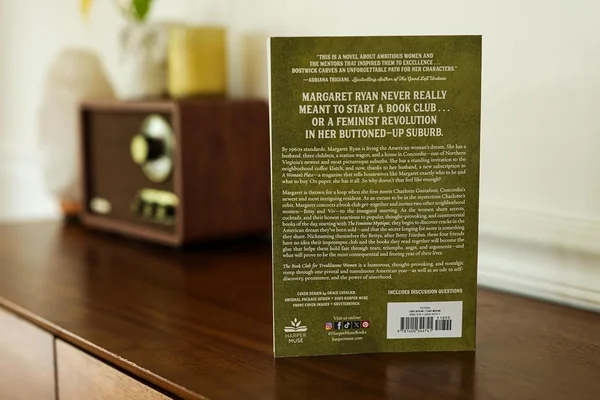
Back cover displaying title, synopsis text, publisher logos, and barcode on olive-green background.
Set during what the publisher describes as "one pivotal and tumultuous American year," the novel centers on Margaret, who never quite intended to start a book club — let alone a feminist revolution. When she and her friends Viv, Bitsy, and Charlotte begin reading Betty Friedan's landmark 1963 work The Feminine Mystique, the text functions as a rallying cry, pushing four ordinary suburban women toward extraordinary self-examination. Bostwick structures the novel around this interplay between literature and life: words on the page become a catalyst for action, and the book club itself transforms from a polite social gathering into a space for genuine reckoning. The publisher describes the novel as "bold and plucky," and the premise delivers on both counts.
that moment when a generation of women started whispering, 'What if…?'

Historical Texture and Social Awareness

One of the novel's defining qualities is its attentiveness to the specific inequities of the era — and it doesn't flatten them into a single, uniform struggle. The Southern Review of Books notes that Bostwick puts period attitudes on display in varied and purposeful ways: Viv confronts her own ignorance about the ways Black women were barred from serving in World War II when she encounters a fellow Army nurse, while Margaret's reflections on equality acknowledge that even the pathways that existed were inequitable. This layering of experience gives the novel a texture that goes beyond a simple celebration of white suburban feminism, acknowledging that sisterhood in the 1960s was complicated by race and class in ways the women themselves had to reckon with.
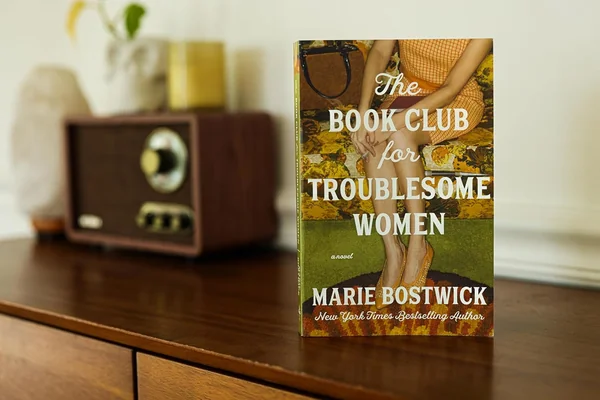
Front cover featuring two women in vintage clothing on a green background with the title and author name.

Tone, Humor, and the Bostwick Voice

Bostwick has built a career — spanning more than twenty works of uplifting contemporary and historical fiction, translated into a dozen languages — on a voice that balances warmth with substance, and The Book Club for Troublesome Women is consistent with that signature. The novel is described by the publisher as a "humorous, thought-provoking, and nostalgic romp," and the Southern Review of Books highlights a scene in which Charlotte likens Bitsy's domestic predicament to the fate of Henry VIII's wives as an example of how Bostwick deploys comedy to illuminate something painful. That tonal balance — finding the absurdity in earnest suffering — is a clear craft choice throughout, and it keeps the novel from tipping into either polemic or sentimentality.

Reception and Cultural Resonance

The novel arrived with notable pre-publication momentum, earning designations as a USA Today bestseller, a Southern Indie Bestseller, a Brenda Novak Book Group Pick, a Gloss Book Club Pick, and a Girlfriend Book Club Pick, as well as a spot on SheReads' Most Anticipated Books of 2025 list. Reader responses gathered by Brave Book Data speak to the novel's atmospheric precision: one reader noted that Bostwick "nailed the atmosphere of early 1960s suburbia — the pressure to be perfect, the hidden anxiety," while another described the book as capturing "that moment when a generation of women started whispering, 'What if…?'" These responses point to a novel that resonates as both period recreation and emotional mirror. Author blurb praise — "No one writes female friendship like the luminous Marie Bostwick" — positions the ensemble dynamic as a central strength, with the four women's relationships framed as the novel's emotional spine.

Who This Novel Serves Best — and Where It Has Limits

The Book Club for Troublesome Women is clearly designed for readers who love historical women's fiction with a strong friendship ensemble at its core — fans of Bostwick's existing work, readers drawn to mid-century American settings, and anyone who finds book-club-within-a-novel structures particularly satisfying. The Southern Review of Books observes that the novel "comes at a time when escape is needed without detaching from reality," which is a fair description of its tonal ambition. That said, readers seeking a darker or more unflinching treatment of 1960s gender politics may find the novel's humor and warmth tip toward reassurance over disruption. The "nostalgic romp" framing in the publisher's own description signals a reading experience that is intentionally accessible and affirming — a genuine strength for its target audience, and an equally genuine signal to readers who prefer their historical fiction without uplift.

Sources & Further Reading

The key facts and claims in this review are grounded in the retrieved, verified sources listed below.

  1. Cited in this review
  2. 1
  3. 2
  4. 3
  5. Further reading
  6. 4
  7. 5
  8. 6
  9. 7
Related Reviews

Reviews of books we picked for readers who enjoyed The Book Club for Troublesome Women.