BOOKS
Published

Read Time

7 min read

Our Rating

3.8

Marie Benedict's Carnegie's Maid is a well-constructed piece of commercial historical fiction, with a compelling protagonist and rich period atmosphere undermined slightly by an over-reliance on romantic plot mechanics in its second half.

A strong book club pick for fans of the genre.

Reviewed by

LuvemBooks

Share This Review

Carnegie's Maid by Marie Benedict Review: Gilded Age Fiction Worth Reading

Our Rating

3.8

Marie Benedict's Carnegie's Maid is a well-constructed piece of commercial historical fiction, with a compelling protagonist and rich period atmosphere undermined slightly by an over-reliance on romantic plot mechanics in its second half. A strong book club pick for fans of the genre.

In This Review
  • What Works & What Doesn't
  • A Novel Built on a Provocative What-If
  • The Protagonist at the Center
  • Prose That Serves the Story
  • The Gilded Age as Backdrop and Argument
  • Where the Novel Stumbles
  • The Case for Your Book Club Shelf
  • Where to Buy

What Works & What Doesn't

What Works
  • Clara Kelley is a well-drawn protagonist whose intelligence is shown through action, not assertion
  • Period atmosphere is specific and immersive without overwhelming the narrative
  • The false-identity premise generates genuine early tension and strong pacing
  • Margaret Carnegie is a memorable supporting character who adds emotional depth
  • Well-suited to book club discussion around class, gender, and the Gilded Age
What Doesn't
  • The romantic plot gradually displaces more interesting social and historical material
  • Labor tensions and immigrant hardship remain background texture rather than substantive themes
  • The central conceit — Clara as secret architect of Carnegie's philanthropy — occasionally strains plausibility
  • Prose prioritizes momentum over literary distinction, which may disappoint more demanding readers

A Novel Built on a Provocative What-If

Carnegie's Maid: A Riveting Historical Fiction Book Club Pick_main_0
Is Carnegie's Maid worth adding to your reading list? A well-crafted historical fiction novel that earns its premise more often than it strains it — though readers wanting genuine Gilded Age critique will need to look elsewhere. The short answer is yes — particularly if you enjoy historical fiction that places women at the center of stories that history traditionally ignored. Marie Benedict's novel asks a bold question: what if a sharp, resourceful Irish immigrant woman quietly shaped the philanthropic vision of one of America's most powerful industrialists, Andrew Carnegie? It's the kind of premise that could easily tip into wish-fulfillment fantasy, and at times it edges close. But Marie Benedict largely earns her conceit through careful period detail and a protagonist whose intelligence feels genuinely earned rather than simply asserted.
Readers drawn to novels that excavate women's hidden influence within the structures of wealth and power will find familiar pleasures here. Benedict works in a well-established tradition of imagining the women who stood just outside the frame of recorded history, and she does it with enough craft to make the exercise feel worthwhile rather than merely formulaic.
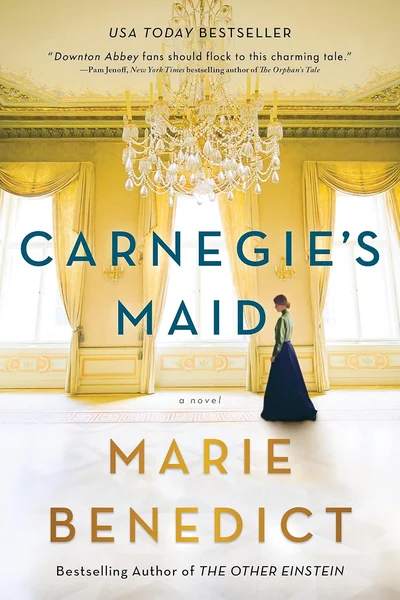
The cover design reflects this sensibility well. Its period aesthetic — muted tones, soft focus, and imagery evoking the late nineteenth century — signals exactly what kind of book this is without overpromising. It positions the novel squarely within the Gilded Age historical fiction market, and that honest packaging is itself a small virtue.

The Protagonist at the Center

The novel's central figure is Clara Kelley, an Irish woman who arrives in America under circumstances that force her to assume a false identity, presenting herself as an experienced lady's maid to secure employment in the Carnegie household. Clara is, by any measure, an impostor — yet Marie Benedict frames this deception not as moral failing but as survival strategy. Clara's quick mind and adaptability allow her to flourish in the role, and her growing closeness to Andrew Carnegie's mother, Margaret, gives the narrative much of its emotional texture.
Clara is a well-constructed protagonist. Her intelligence is demonstrated through action rather than simply proclaimed. She observes, adapts, and thinks carefully about the forces shaping the world around her. The relationship that develops between Clara and Andrew Carnegie is handled with restraint for much of the novel — one of Benedict's better instincts — though the romantic thread eventually becomes more central than the story strictly requires.
The Carnegie family dynamics are rendered with enough specificity to feel grounded in historical reality. Margaret Carnegie, the matriarch, is arguably the most compelling supporting presence in the book. Her influence over her son — both the real historical figure and Benedict's fictional version — carries genuine weight.

Prose That Serves the Story

Marie Benedict writes in clean, accessible prose that prioritizes momentum over literary ornamentation. The sentences move efficiently, the dialogue rarely drags, and the period atmosphere is established through well-chosen detail rather than exhaustive description. This is commercial historical fiction executed with professional competence, not literary ambition, and that distinction matters when calibrating expectations.
The first-person narration through Clara's voice is consistent and controlled. Benedict maintains the character's perspective without significant lapses, and Clara's Irish background — her sense of displacement, her awareness of class — threads through the narrative in ways that feel organic rather than obligatory. The prose won't challenge readers who prefer more experimental or lyrical writing, but it serves the story's purposes cleanly.
Pacing is generally strong through the novel's first half, when the tension of Clara's concealed identity drives events forward. The stakes feel real, and the social world of the Carnegie household is brought to life with confidence.

The Gilded Age as Backdrop and Argument

Carnegie's Maid themes extend beyond the romantic and domestic. The novel engages, at least implicitly, with class mobility, the mythology of the self-made man, and the labor movements reshaping American society in the late nineteenth century. Pittsburgh during the age of steel gives Benedict rich material: the gap between Carnegie's private wealth and the brutal conditions of his workers hovers at the edges of the story, never quite stepping to the center.
This is where the novel is both most interesting and most frustrating. Benedict gestures toward these larger social tensions without fully committing to them. The labor strife, the immigrant experience, and the mechanics of Carnegie's business empire remain backdrop rather than foreground. Readers hoping for a novel that genuinely interrogates the Gilded Age — rather than using it as atmospheric setting for a romance — may find the treatment somewhat thin.
The philanthropic dimension of Carnegie's legacy, and Clara's purported influence upon it, is the novel's central historical argument. Benedict presents this thesis with evident enthusiasm, though the fictional nature of Clara's role means the claim functions more as romantic speculation than historical revisionism.

Where the Novel Stumbles

The main weakness emerges in the second half, when the romantic plot takes increasing precedence over the social and historical material that makes the novel most distinctive. The tension of Clara's false identity — which generates genuine suspense early on — is partially displaced by a more conventional love story arc. This is a familiar problem in commercial historical fiction: the demands of romantic narrative structure can flatten the more complex textures that initially make a book compelling.
Some readers may also find the wish-fulfillment element of the premise — the idea that a brilliant, overlooked woman was secretly responsible for Carnegie's better impulses — a little too convenient. Benedict never quite resolves the tension between historical imagination and historical plausibility. Clara is given such central influence that the conceit occasionally strains credulity, even within the generous terms the novel establishes for itself.
Content warnings worth noting: the novel includes period-appropriate depictions of class discrimination, immigrant hardship, and some emotional intensity around family loss. There is a romantic subplot, though nothing explicit. Appropriate for adult readers and mature older teens.

The Case for Your Book Club Shelf

Despite its limitations, Carnegie's Maid delivers what it promises: an engaging, well-paced historical fiction book club pick centered on a resourceful woman navigating a world designed to exclude her. The book club designation on the cover is well-earned — this is ideal for group discussion, particularly around Clara's hidden labor, the mythology surrounding America's industrial titans, and what immigrant identity costs the people who bear it.
For readers interested in exploring Marie Benedict's broader catalog, she has applied this same formula — a historical woman at the center of a famous man's story — across multiple novels. Those already familiar with her approach will know what to expect here. Those new to her work will find this a solid entry point.
The book is not without its compromises, and literary fiction readers seeking greater ambiguity or stylistic distinction should look elsewhere. But as Gilded Age historical fiction, Marie Benedict's Carnegie's Maid is a well-crafted and genuinely absorbing read that handles Clara's relationship with Carnegie with more intelligence than the genre often manages.

Where to Buy

If you're drawn to historical fiction that centers overlooked women in famous men's stories — and can accept a romance that gradually outpaces its more provocative ideas — Carnegie's Maid earns its place on the shelf; the Amazon link in the sidebar has the current price.

Product Gallery

Carnegie's Maid: A Riveting Historical Fiction Book Club Pick by Marie Benedict front cover
Carnegie's Maid: A Riveting Historical Fiction Book Club Pick by Marie Benedict book cover