
At a glance
About the Author
Susan Storer Clark1 book reviewed
An Uncharted World
A 16th Century Adventure
by Susan Storer Clark
LuvemBooks Verdict
Best for: Historical fiction readers drawn to the age of sail and the transatlantic slave trade who want the story told from the perspective of the enslaved — especially those who value recovered real lives, African spiritual tradition, and vast geographical scope over prose style.
Worth it? Skip it? Read the full verdict →Ask LuvemBooks
Was this helpful?
- Is it worth reading?
- Yes, for the right reader. Reviewer Jaylynn Korrell of Independent Book Review praises an eloquent yet plot-driven story that maintains historical accuracy and deep engagement while never sugarcoating the realities of slavery, and credits the book with saving its real-life heroine from being lost to history. BlueInk Review agrees that historical fiction fans will enjoy its cross-cultural perspectives and depictions of early global exploration. The key caveat: BlueInk finds the prose simple and plainly styled, and the conclusion rather abrupt — so come for scope and recovered history, not stylistic flair.
- Similar books
- Readers drawn to Morayo's story should look to other novels that re-centre figures marginalised by the archive. Lawrence Hill's The Book of Negroes and Esi Edugyan's Washington Black similarly follow enslaved protagonists across continents and oceans. Alice Walker's The Color Purple gives voice to a woman history would silence; Ariel Lawhon's The Pirate Queen recovers a real woman of the age of sail; and James McBride's The Good Lord Bird braids history, voice, and dark humour around the slavery era.
- Who should read this?
- Historical fiction readers who value scope, authenticity of setting, and recovered lives over prose pyrotechnics. It will particularly suit those drawn to the age of sail, to narratives of the slave trade told from the perspective of the enslaved rather than the enslavers, and to fiction that braids African spiritual tradition — including the Yorùbá trickster Èṣù — into a global story. Readers who prefer a single tight point of view, or who want lush prose and a leisurely ending, may find the multi-voice sprawl and abrupt conclusion frustrating.
- Is this a good book club pick?
- Yes — it offers rich discussion material: the ethics of fictionalising a real, erased life; the choice to include a deity, Èṣù, among the narrators; the balance of tragedy against the hope embodied by Pablo; and whether the abrupt ending serves or shortchanges Morayo's homecoming. The divided critical reception — praised for honesty and scope, faulted for plain prose — also gives a group genuine ground for debate.
- Is it all tragedy, or is there hope?
- No — hope is deliberately woven through the darkness. Jaylynn Korrell notes that the tragedy is balanced by glimpses of light along Morayo's journey, chief among them Pablo, a young man who falls in love with her despite believing religious life would be his escape. That counterweight — darkness lit by moments of connection — is what elevates the novel above a catalogue of horrors, even as it refuses to sugarcoat slavery's realities.
- How long is the book?
- The novel runs about 406 pages in its standard edition and was published by HistoryMuse Press in 2026. Most readers should expect roughly ten to twelve hours of reading — a substantial single-volume odyssey rather than a series commitment.
Summarize this book
Follow up
Synthesized from verified book data & published reviews · How we review
Press Enter to ask. Answers come from our editorial Q&A — start typing to see related questions.
Age & Reading Level
Recommended age
Ages 16+
Reading level
Adult
4 content notes · who it suits
Content to know about
Best for: Adults / mature 16+ — sustained depictions of capture, enslavement, and exploitation demand a reader prepared for heavy subject matter
Skip if you're looking for lighter, escapist historical fiction or lush, ornamented prose
Editorial Review
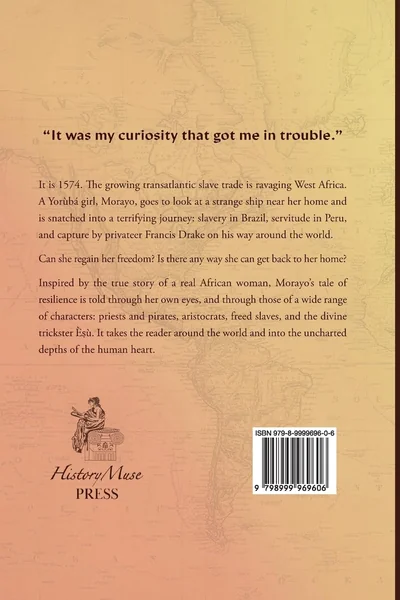
Susan Storer Clark's *An Uncharted World* follows Morayo, a Yorùbá girl captured into slavery in 1574, from Brazil and Peru onto Francis Drake's circumnavigation — a novel inspired by a real African woman. Its global scope and emotional honesty win praise, though its plain prose divides reviewers.
Read the Full ReviewRelated reading
Adjacent titles worth exploring. We haven't reviewed these yet, so they link out to Amazon.