BOOKS
Published

Read Time

3 min read

Curated & edited by

LuvemBooks Editorial

How we create our reviews →
Share This Review

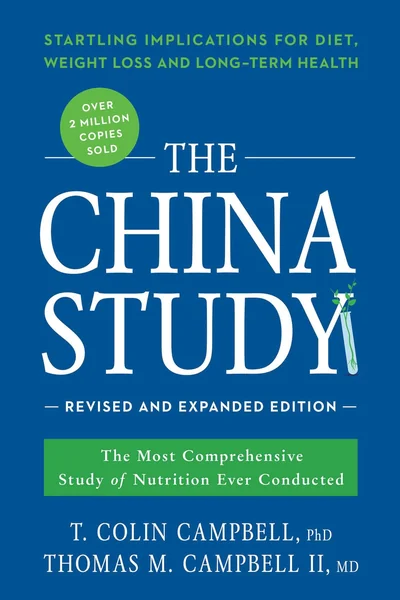
The China Study by T. Colin Campbell & Thomas M. Campbell Review: A Landmark, Contested Nutrition Argument

First published in 2005 and revised in 2016, The China Study by T. Colin Campbell and Thomas M. Campbell makes an ambitious, data-driven case that a whole-food, plant-based diet can prevent and even reverse chronic diseases including coronary heart disease, diabetes, and several cancers — a thesis that has made it one of America's best-selling books about nutrition while also generating sustained scientific debate.

LuvemBooks Verdict

Best for

Readers curious about plant-based eating who want a research-grounded, population-level argument for reducing or eliminating animal products from their diet.

Worth it if

You want a structured scientific rationale — drawn from large-scale epidemiological data — for adopting a whole-food, plant-based diet, and you're comfortable reading one forceful perspective within an active scientific debate rather than a balanced survey of competing frameworks.

Skip if

You want a book that engages seriously with counterarguments, acknowledges the limits of correlational data, or represents the full complexity of current nutritional science — the Campbells' prosecutorial confidence leaves little room for that nuance.

What readers & critics say

According to Wikipedia, the book had sold over one million copies in the United States by October 2013, making it one of America's best-selling books about nutrition; that same source notes it is described as "loosely based" on the China–Cornell–Oxford Project, a characterisation that reflects longstanding methodological debate around the causal claims the authors build on its correlational data.

Sources: Wikipedia
4.7from 5,214 Amazon ratings— reader ratings, not a LuvemBooks score
In This Review
  • What Works & What Doesn't
  • What the Book Actually Argues
  • The Research Underpinning the Claims
  • Cultural Reach and Commercial Significance
  • Where the Book Draws Criticism
  • Who This Book Is For

What Works & What Doesn't

What Works
  • One of America's best-selling nutrition books, with over one million copies sold by 2013, reflecting broad and sustained reader engagement
  • Examines a wide range of chronic diseases — including coronary heart disease, diabetes, breast cancer, prostate cancer, and bowel cancer — through a unified dietary lens rather than in isolation
  • Draws on the large-scale China–Cornell–Oxford Project, a 20-year epidemiological study across 65 counties, giving the argument an unusually broad population data foundation
  • Challenges reductionist nutrition science and argues for studying whole dietary patterns and nutrient interactions, offering a distinct methodological perspective
  • The 2016 revised and expanded edition from BenBella Books updates the original 2005 text, making it the most current version of the Campbells' argument
What Doesn't
  • The book is described as 'loosely based' on the China–Cornell–Oxford Project, and critics have questioned whether its correlational epidemiological data can support the broad causal dietary claims the authors construct upon it
  • The Campbells' absolute positions — including the claim that any dietary cholesterol above 0 mg is unhealthy and their wholesale dismissal of low-carbohydrate diets — put the book at odds with portions of the wider nutrition research literature
  • The prosecutorial tone and single-framework confidence leave little room for the genuine complexity and ongoing debate within nutritional science, which may frustrate readers seeking a balanced survey of the evidence
The revised and expanded edition of The China Study is one of the most commercially successful and hotly debated nutrition books of the twenty-first century, a work that frames its dietary argument not as lifestyle advice but as a scientific imperative.

What the Book Actually Argues

At its core, The China Study is a population-level argument against animal-product consumption. T. Colin Campbell and Thomas M. Campbell examine the relationship between the consumption of animal products — including beef, pork, poultry, fish, eggs, cheese, and milk — and the incidence of chronic illnesses such as coronary heart disease, type 2 diabetes, breast cancer, prostate cancer, and bowel cancer. Their central conclusion is that people who eat a predominantly whole-food, vegan diet, while also reducing processed foods and refined carbohydrates, can escape, reduce, or reverse the development of these diseases. The book goes so far as to state that "eating foods that contain any cholesterol above 0 mg is unhealthy." It also recommends sunshine exposure or vitamin D supplementation, and vitamin B12 supplements for those who eliminate animal products entirely — practical caveats embedded within a sweeping dietary thesis.

The Research Underpinning the Claims

The book draws its title and much of its authority from the China–Cornell–Oxford Project, a 20-year epidemiological study that examined mortality rates from cancer and other chronic diseases recorded between 1973 and 1975 across 65 counties in China, cross-referenced with 1983–84 dietary surveys and blood work from 100 people in each county. According to Wikipedia, the book is described as "loosely based" on that project — a characterization worth noting, since the Campbells extend its findings into a broader, sweeping indictment of the standard Western diet. The authors also push back explicitly against reductionist nutrition science — the practice of isolating single nutrients as villains or heroes — arguing instead that whole dietary patterns and the interactions between nutrients are what determine health outcomes. This holistic methodological stance is one of the book's more philosophically distinct contributions to the nutrition conversation.

Cultural Reach and Commercial Significance

Few nutrition books have matched The China Study's footprint. Originally published in January 2005, it had sold over one million copies in the United States by October 2013, according to Wikipedia, establishing it as one of America's best-selling books about nutrition. The revised and expanded edition was published by BenBella Books in December 2016, updating the original text for a new generation of readers and a changed dietary landscape. The book has been translated into more than a dozen languages, including German, Polish, Japanese, Korean, Chinese, and Urdu, reflecting a global reach that goes well beyond the plant-based diet community. That scale of readership is a measure of how effectively the Campbells communicated a complex epidemiological argument to a general audience.

Where the Book Draws Criticism

The China Study has been a consistent target of methodological critique since its original publication. Critics — including nutrition researchers and science writers — have challenged whether the correlational data from the China–Cornell–Oxford Project can sustain the causal claims the authors build upon it, and whether a study focused on rural Chinese counties in the 1970s can be extrapolated into universal dietary recommendations. The book's dismissal of low-carbohydrate diets such as the Atkins diet, and its absolute position on dietary cholesterol, have also been challenged by researchers who point to more recent clinical evidence that complicates a blanket condemnation of all animal-derived foods. Readers approaching the book as settled consensus science rather than as one forceful perspective within an active scientific debate will find that the broader nutrition literature does not uniformly support every conclusion the Campbells draw.

Who This Book Is For

The China Study is designed for general readers interested in the relationship between diet and long-term health, particularly those curious about plant-based eating or seeking a research-grounded rationale for reducing or eliminating animal products. The revised edition makes it the current definitive version for new readers. Those who have already adopted a whole-food, plant-based diet will find the Campbells' framework offers a structured scientific argument for their choices. Readers who prefer to weigh multiple competing nutritional frameworks, or who want a book that engages with counterarguments in depth, may find the Campbells' confident, prosecutorial tone less satisfying. As a cultural document, however — a book that moved plant-based nutrition from the margins to the mainstream conversation — its place is secure.

Sources & Further Reading

The key facts and claims in this review are grounded in the retrieved, verified sources listed below.

  1. Cited in this review
  2. 1
  3. Further reading
  4. 2
  5. 3