BOOKS
Published

Read Time

4 min read

Curated & edited by

LuvemBooks Editorial

How we create our reviews →
Share This Review

Forks Over Knives by Gene Stone Review: A Plant-Based Manifesto for Better Health

Edited by Gene Stone, with forewords by T. Colin Campbell and Caldwell B. Esselstyn, Forks Over Knives is the companion book to the 2011 documentary of the same name, building a science- and ethics-grounded case for a whole-food, plant-based diet as a means of preventing and treating chronic disease. A New York Times bestseller, it is essential reading for anyone drawn to the film's central argument, though readers seeking exhaustive scientific depth may find the companion format somewhat limiting.

LuvemBooks Verdict

Best for

Readers who have watched the Forks Over Knives documentary and want a text that reinforces its message, addresses common misconceptions about plant-based eating, and offers 96 practical recipes to help them make the shift to a whole-food, plant-based lifestyle.

Worth it if

You are a newcomer to the whole-food, plant-based movement looking for a credible, accessible entry point that combines dietary science context — anchored by the China–Cornell–Oxford Project — with hands-on recipe guidance.

Skip if

Readers who already have a strong grounding in nutritional science or have worked through Campbell's The China Study and Esselstyn's own books are likely to find the material familiar and the scientific treatment too surface-level for their needs.

What readers & critics say

According to the Audible listing, some readers who expected deep scientific rigour found the book disappointing, noting a bias toward anecdote and insufficient counterbalance to the plant-based argument. The Responsible Eating and Living interview with editor Gene Stone reflects the book's enthusiastic reception within the plant-based community, where it was embraced as a shareable companion to the documentary.

Sources: Audible, Responsible Eating and Living
4.5from 3,300 Amazon ratings— reader ratings, not a LuvemBooks score
In This Review
  • What Works & What Doesn't
  • What the Book Is and What It Argues
  • Its Place in the Whole-Food, Plant-Based Conversation
  • Genuine Strengths
  • A Genuine Limitation: Depth vs. Accessibility
  • Who This Book Is For

What Works & What Doesn't

What Works
  • Forewords by T. Colin Campbell and Caldwell B. Esselstyn lend genuine scientific and clinical authority
  • Grounded in the landmark 20-year China–Cornell–Oxford Project, one of the most expansive nutritional studies ever conducted
  • Includes 96 plant-based recipes from 25 contributors, adding practical, everyday utility alongside the science
  • Structured to address and dismantle common misconceptions about plant-based eating, making it accessible to newcomers
  • A New York Times bestseller with broad cultural reach as a cornerstone text of the whole-food, plant-based movement
What Doesn't
  • As a documentary companion, the scientific content is written for a general audience rather than offering the depth that readers seeking rigorous engagement with the research may want
  • Readers already familiar with Campbell's *The China Study* or Esselstyn's work may find significant overlap with material they have encountered elsewhere
A New York Times bestseller, Forks Over Knives edited by Gene Stone translates the landmark 2011 documentary's central argument into book form, presenting a whole-food, plant-based diet as a serious intervention for chronic illness.

What the Book Is and What It Argues

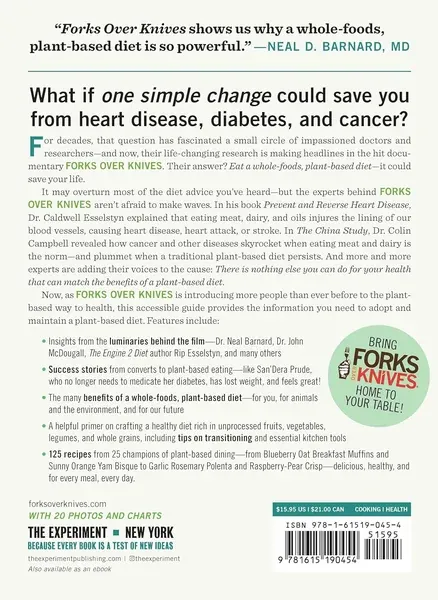
Back cover with synopsis, testimonial quotes, recipe count, and barcode.
Forks Over Knives is a companion book to the 2011 American documentary film of the same name, edited by Gene Stone and featuring forewords by two of the movement's most prominent scientific figures: physician Caldwell B. Esselstyn and professor of nutritional biochemistry T. Colin Campbell. The book's core argument mirrors the film's: that many chronic diseases — including obesity, cardiovascular disease, and cancer — can be prevented and treated by adopting a whole-food, plant-based diet built around whole grains, legumes, tubers, vegetables, and fruits, while avoiding animal products and ultra-processed foods. Campbell's foreword connects the book to his foundational 20-year China–Cornell–Oxford Project, the research that underpinned his conclusions in The China Study, linking the so-called Western diet of processed and animal-based foods to coronary artery disease, diabetes, obesity, and cancer. Esselstyn's foreword brings the clinical lens of an American physician who has long championed dietary intervention. Together, the framing is authoritative and deliberate.

Its Place in the Whole-Food, Plant-Based Conversation

The Forks Over Knives brand launched at a specific cultural moment: the documentary premiered on May 2, 2011, attended by figures including actor Angela Bassett, and quickly became a touchstone of the plant-based health movement. The book arrived alongside it, not as an independent research text but as a vehicle for extending the film's reach into homes and onto bookshelves. Gene Stone serves as editor rather than sole author, bringing in the voices of Campbell and Esselstyn as foreword contributors, as well as — per the audio edition's supplementary materials — recipes from 25 champions of plant-based dining. This positions Forks Over Knives as a gateway and practical guide rather than a dense academic treatise, designed to translate the documentary's persuasive power into actionable information for a general audience.
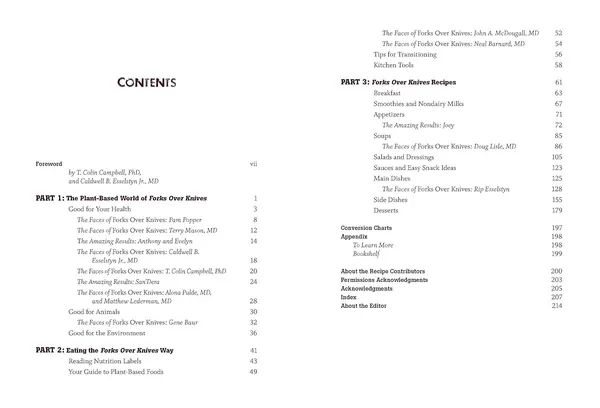
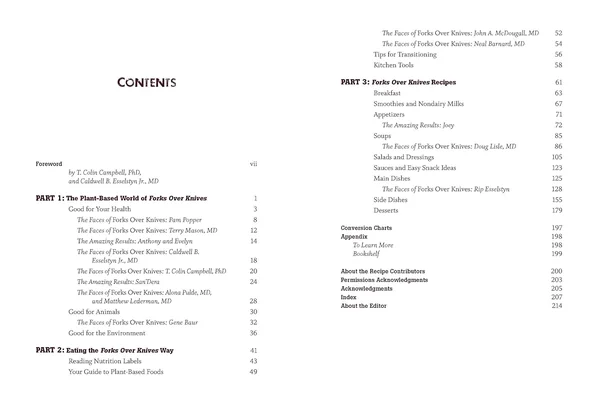
Table of contents showing two parts: plant-based world overview and practical eating guidance with recipes.

Genuine Strengths

The book's most durable asset is the calibre of its scientific anchors. Campbell's China–Cornell–Oxford Project remains one of the most expansive nutritional studies ever conducted, and having both Campbell and Esselstyn lend their authority via forewords gives the book a credibility that many popular diet titles lack. The text is structured to address misconceptions surrounding plant-based eating, offering readers a framework for understanding the lifestyle rather than simply a set of rules to follow. The recipe component — 96 plant-based recipes spanning breakfast through dessert, from Blueberry Oat Breakfast Muffins to Raspberry-Pear Crisp — rounds out the book's practical dimension, written with the aim of making whole-food cooking accessible. Roger Ebert, reviewing the documentary in the Chicago Sun-Times, gave it three out of four stars and wrote that it was "a film that could save your life," a verdict that speaks to the emotional and informational impact of the Forks Over Knives project as a whole.

A Genuine Limitation: Depth vs. Accessibility

The book's companion-to-film structure is simultaneously its greatest asset and its most consistent point of frustration for certain readers. Some readers, as noted on Audible, have found that the scientific core — the deep research behind the "eat plants, not meat" argument — is not explored with the rigour they expected, and that the book does not substantially exceed what the documentary itself covers. For readers who arrive already persuaded by the film and want a comprehensive engagement with the underlying science, the book's accessible, popular-press approach may feel like a surface treatment of a genuinely complex body of evidence. It is designed as an entry point, and reads accordingly.

Who This Book Is For

Forks Over Knives is best suited to readers who encountered the documentary and want a text to reinforce, expand, and practically apply its message in daily life. The combination of dietary science context, myth-busting content around plant-based eating, and a substantial recipe section makes it a coherent starter package for anyone considering a shift toward whole-food, plant-based eating. Readers who already have a strong background in nutritional science or who have worked through Campbell's The China Study may find the material familiar. For the genuinely curious newcomer to the plant-based movement, however, this New York Times bestseller remains one of the movement's most recognisable and widely circulated entry points.

Sources & Further Reading

The key facts and claims in this review are grounded in the retrieved, verified sources listed below.

  1. Cited in this review
  2. 1
  3. 2
  4. Further reading
  5. 3
    Gene Stone — author profileHigh-authority source

    Gene Stone, Wikipedia

  6. 4
  7. 5
  8. 6

    responsibleeatingandliving.com

  9. 7
  10. 8
  11. 9
  12. 10