Protocols by Andrew D. Huberman Review: A Body Operating Manual
by Andrew D. Huberman, Unknown Author
Andrew Huberman’s Protocols operates as a clinical reference for physiological optimization across seven categories. The Stanford neuroscientist translates decades of podcast research into actionable daily habits. Readers seeking consolidated science-backed advice will find value, though the exhaustive scope risks triggering optimization anxiety.
Readers seeking consolidated science-backed advice will find value in this clinical reference that translates decades of podcast research into actionable routines.
Worth it if
Worth reading if you want to translate dense neurobiology into actionable routines without needing a biology degree.
Skip if
Skip it if you are prone to health anxiety or prefer simple, low-effort wellness advice over exhaustive self-tracking.
Where reviewers agree and split
Readers rate it 4.6 on Amazon. The reviews we read that discuss it in depth split on some points:
Negative
Slate · Press review: provokes unhealthy fixation and panic rather than helping
Mixed
JOuHealth · Book blog: objectively breaks down scientific backing with clear caveats
Positive
Performance Protocol · Book blog: largely succeeds with useful, caveated guidance for dedicated readers
Positive
Book of the Day · Book blog: praises its practical, honest manual-style approach to health optimization
Overall verdicts are our summary of each review we read, from its headline, rating and conclusion.
What readers & critics say
Some critics warn the 540-page manual can provoke a 'frenzied feeling of insufficiency' and unhealthy fixation for health-anxious readers, while others praise its mechanism-first approach as a sturdy, practical companion for those seeking to consolidate Huberman Lab advice.
Andrew Huberman’s Protocols covers physiological optimization across seven categories, translating decades of podcast research into practical routines. Readers will find value in its systematic approach, though the exhaustive scope risks triggering optimization anxiety. It is best suited for dedicated readers willing to treat each protocol as a personal experiment rather than a quick fix.
Is it worth reading?
It is worth reading if you want to translate complex science into practical routines. The book excels at translating complex concepts into practical steps for sleep, stress, and physical performance, though it demands active participation. Readers should be prepared to abandon linear consumption in favor of selective reading to avoid cognitive overload.
The book is written for adults wanting reliable health information and curious readers wanting a dip-in reference. It is particularly valuable for podcast listeners who want a centralized archive of scattered episodes organized for quick retrieval. Dedicated readers willing to test protocols will find immense value, while those prone to health worries may find it overwhelming.
Does it require prior scientific knowledge?
No. Huberman deliberately uses clear language to make complex science understandable for readers. The text outlines each recommendation before detailing practical routines, ensuring readers understand the foundational concepts without formal training.
Is it better for podcast listeners or new readers?
It offers value for listeners, functioning as a comprehensive archive for decades of episodes. Readers who already follow the podcast will recognize familiar concepts like physiological sighs and morning light. For new readers, the manual format provides an accessible entry point into Huberman's broader health initiatives.
Does the book address mental health alongside physical health?
Yes, the text explicitly covers stress control, focus, and motivation alongside physical categories like sleep and exercise. Huberman frames psychological optimization as inseparable from physiological habits, explaining how nervous system regulation impacts both mood and performance.
Summarize this book
Is it worth reading?
Who should read this?
Does it require prior scientific knowledge?
Is it better for podcast listeners or new readers?
Does the book address mental health alongside physical health?
Summarize this book
Andrew Huberman’s Protocols functions as a comprehensive reference guide, structured into seven distinct categories like sleep, exercise, and stress control. The Stanford neuroscientist explains the biological mechanisms behind each recommendation before outlining actionable steps, allowing readers to skip chapters for immediate problems. The volume consolidates years of podcast discussions and scientific research into a manual-style format that prioritizes foundational routines and specific performance techniques.
Follow up
How long does it take to read?
Does it require a biology background?
Synthesized from verified book data & published reviews · How we review
Ask LuvemBooks
What would you like to know about Protocols by Andrew D. Huberman?
Answers come from our editorial notes on this book. If we haven't covered something, we'll say so.
Readers often ask
Editorial Review
We review the evidence: reader verdicts, gathered and weighed with AI assistance and edited by LuvemBooks, rather than one reader's first-hand take.
Andrew Huberman’s Protocols functions as a comprehensive reference guide for physiological optimization, though its exhaustive scope may overwhelm readers seeking quick fixes.
What the Book Actually Is
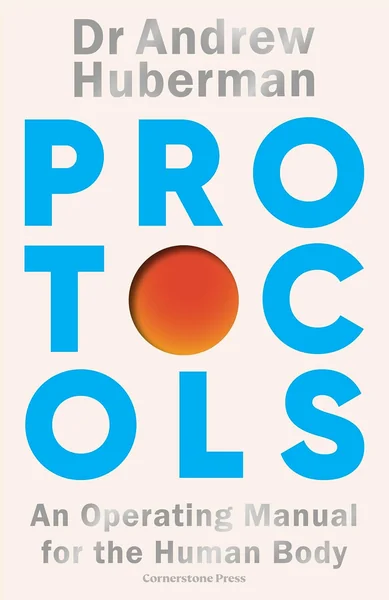
Andrew Huberman released Protocols: An Operating Manual for the Human Body in September 2026 through Simon & Schuster. The Stanford neuroscientist and Huberman Lab podcast host structures the text as a clinical reference rather than a narrative.
Readers will find the content divided into seven distinct categories: sleep, exercise, stress control, nutrition, light, focus, motivation, and learning, and personal growth. The book explains the biological mechanisms behind each recommendation before outlining actionable steps.
This format allows audiences to skip chapters and consult specific sections for immediate problems like poor sleep or stress management. The volume runs to 540 pages in standard editions, or 688 in others, serving as a consolidation of years of podcast discussions and scientific research.
Book of the Day notes that the conversational tone mimics a lecturer speaking after the lecture hall has emptied. The author sorts advice into foundational daily habits and a toolbox of specific techniques for performance enhancement.
How It Handles the Evidence Base
The text approaches health advice through a lens of peer-reviewed science and primary source documentation. JOuHealth notes that foundational habits like morning daylight exposure, post-meal walking, and paced breathing are supported by controlled studies and meta-analyses.
Other recommendations, such as precise cold exposure timing or specific supplement protocols, rely on smaller studies or narrow demographic groups. Book of the Day highlights that Huberman draws heavily on his own research and expert interviews, documenting his sources rather than asserting facts.
This methodical transparency distinguishes the work from typical wellness literature that prioritizes anecdotal success stories. Readers are encouraged to treat each protocol as a personal experiment rather than a guaranteed prescription.
The book explicitly advises consulting a physician before altering sleep, cold exposure, or supplement routines. JOuHealth specifies that tracking should focus on sleep duration, resting heart rate, and glucose levels rather than obsessing over every variable.
Performance Protocol notes that the text repeatedly covers fasting, metabolic stress, and cellular repair mechanisms.
The Tension Between Empowerment and Obsession
Critical reception reveals a sharp divide regarding the book's psychological impact on its audience. A Slate reviewer warns that the sheer volume of recommendations can provoke a "frenzied feeling of insufficiency" for individuals already struggling with health issues.
The reviewer argues that the clinical framing may trigger unhealthy fixation on optimization, leading readers to panic rather than improve their well-being. Book of the Day observes that much of the surrounding enthusiasm stems from personal testimony rather than clinical proof.
While the conversational tone makes complex biology accessible, the constant emphasis on physiological tracking risks alienating readers who prefer simplicity. The book demands active participation, which can feel exhausting rather than empowering for some demographics.
Performance Protocol frames the text as a high bar cleared by the podcast's quality, but notes the need for external implementation systems. Slate describes Huberman's core proposition as using applied science to optimize the human body for the highest possible performance.
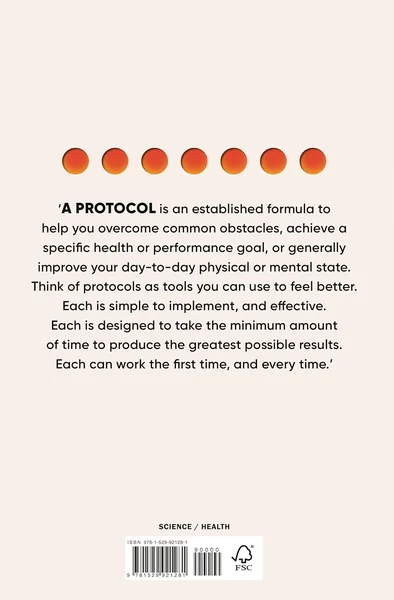
Back cover with a row of orange circles, a definition of protocols, and a barcode at the bottom.
Structural Design and Accessibility
The manual format requires readers to abandon linear consumption in favor of targeted consultation. Each protocol occupies its own section, allowing immediate access to specific physiological concerns.
Book of the Day emphasizes that the author explains the mechanism first and then provides the actionable step. This pedagogical approach ensures that readers understand the biological "why" before executing the "how".
The text avoids heavy academic jargon, making complex neurobiology digestible for a general audience. Readers do not require a biology degree to comprehend the foundational concepts.
The structure deliberately discourages attempting every protocol simultaneously to prevent cognitive overload. JOuHealth points out that the studies behind certain practices are small or conducted on narrow groups like winter swimmers.
Implementation and Commercial Context
Huberman leverages his massive Huberman Lab podcast audience to promote the book, which serves as a direct extension of his free educational content. The text functions as a centralized archive for decades of scattered episodes, organized for quick retrieval.
Readers who already follow the podcast will recognize familiar concepts like physiological sighs, morning light, and cortisol rhythms. The value for this existing audience lies in consolidation rather than novel discovery.
Performance Protocol suggests pairing the book with independent tracking tools to translate understanding into executable systems. The author's commercial ecosystem relies on the podcast's massive reach to drive book sales and direct listeners to his broader health initiatives.
Book of the Day advises readers to pick one area, run it for weeks, and keep detailed notes before moving forward. Performance Protocol maps specific chapters to training, sleep, and longevity frameworks for those seeking structured progression.
Is Protocols Worth Reading?
The critical reception reveals that the book offers immense value for podcast listeners seeking consolidated advice and curious readers wanting a dip-in reference. It excels at translating dense neurobiology into practical daily habits for sleep, stress, and physical performance.
The text pairs effectively with Matthew Walker’s Why We Sleep for deeper scientific context and James Clear’s Atomic Habits for behavioral implementation. Those prone to optimization anxiety or seeking a quick health transformation may find the manual overwhelming and counterproductive.
The book ultimately rewards patience and selective application over exhaustive adherence.
Sources & Further Reading
The key facts and claims in this review are grounded in the retrieved, verified sources listed below.
Huberman says his debut book took eight years and four complete rewrites to ensure the information was thoroughly verified and as up-to-date as possible. He wanted to focus strictly on actionable practices that are scientifically proven to improve mental and physical health.
From our readers
Reader reviews
No LuvemBooks readers have answered yet.
Read it? Was it right for you?
Books like Protocols by Andrew D. Huberman
Curated picks for readers who enjoyed Protocols by Andrew D. Huberman, with our reasoning for each match.