BOOKS
Published

Read Time

10 min read

Reader rating

4.6

· 5,715 Amazon ratings
reader ratings, not a LuvemBooks score
Curated & edited by

LuvemBooks Editorial

How we create our reviews →
Share This Review

Metabolical by Robert H. Lustig Review: A Sweeping Indictment of Processed Food and Modern Medicine

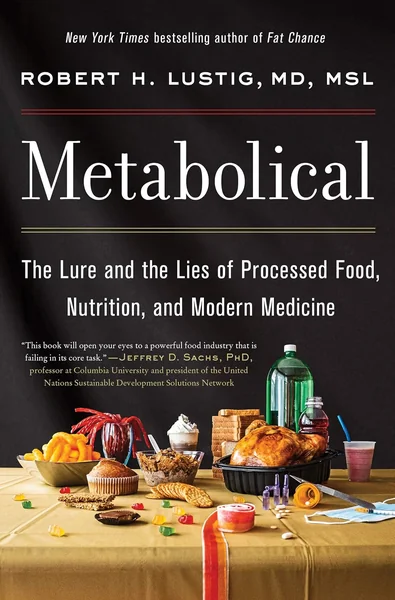
Robert H. Lustig's Metabolical is a New York Times bestselling work of narrative health science that argues processed food has driven eight core pathologies underlying virtually all chronic disease — and that the healthcare, food, and pharmaceutical industries have systematically obscured this reality. This review is based on published source material and reception accounts; it does not reflect hands-on use or application of the book's recommendations.
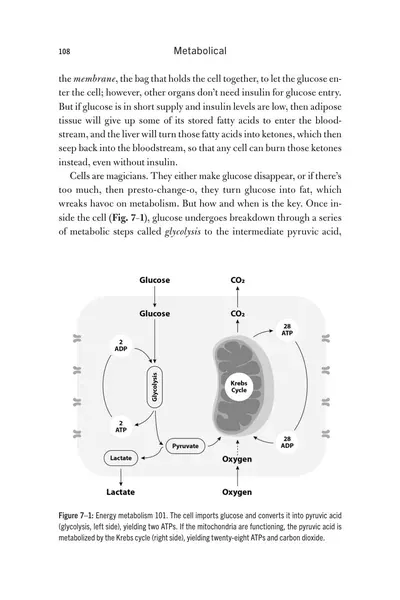
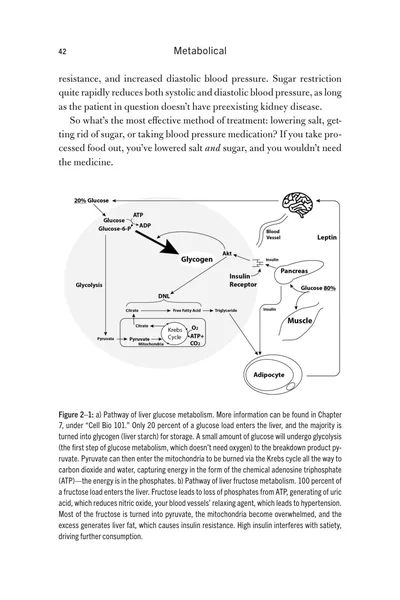
Interior page showing a metabolic pathway diagram illustrating glucose processing and energy production in the body.Interior page showing a metabolic pathway diagram illustrating how processed food components affect blood glucose and related health conditions.Diagram showing cellular glucose metabolism pathways, illustrating energy production through glycolysis and the Krebs cycle.Tap to enlarge

LuvemBooks Verdict

Best for

Readers who want to understand the structural and biological mechanisms driving the chronic disease epidemic — not just what to eat, but how the food environment was shaped, who benefits, and what the science shows beneath layers of industry-influenced messaging.

Worth it if

Worth engaging with if you're ready to approach it as a work of narrative science and institutional critique — one that reframes how metabolic health is understood at a systemic level, backed by over a thousand cited references available online.

Skip if

Skip it if you're looking for a focused, step-by-step dietary protocol or if confrontational indictments of established medical and food-industry institutions are likely to read as overreach rather than corrective science.

Red Pen Reviews found the diet advice in Metabolical "fairly healthy" but assessed its scientific arguments as weak, and noted the whole-food approach would be very hard to follow in practice. Dr. Perlmutter's site offers a more enthusiastic take, describing the book as providing "a comprehensive analysis of how the modern food environment, particularly the prevalence of processed foods, contributes to widespread health issues."

Sources: Red Pen Reviews, Dr. Perlmutter
4.6from 5,715 Amazon ratings— reader ratings, not a LuvemBooks score

Age & Reading Level

Recommended age

Adult

Reading level

Adult

Content to know about

institutional critique of food, pharmaceutical, and medical industries

Skip if you want a practical, step-by-step dietary guide rather than a wide-ranging work of narrative science and systemic critique.

In This Review
  • What Works & What Doesn't
  • What the Book Actually Argues
  • Scope, Scale, and Scientific Ambition
  • Lustig's Voice and Credibility
  • Genuine Limitations and Who May Struggle
  • Who This Book Is For

What Works & What Doesn't

What Works
  • Written by a credentialed pediatric neuroendocrinologist with a long publication and research record, lending clinical authority to its arguments
  • Unusually broad in scope, connecting metabolic science, food-systems economics, pharmaceutical policy, and environmental impact into a unified thesis
  • Backed by 1,054 cited references, made available online, allowing motivated readers to verify claims against primary scientific literature
  • A New York Times bestseller, reflecting wide readership reach for a scientifically grounded health science title
  • Designed to make complex metabolic and nutrition science accessible to general readers without sacrificing evidential rigor
What Doesn't
  • The book's extraordinarily wide scope — spanning biochemistry, policy, environment, and medicine — makes it a demanding read rather than a focused dietary guide or practical protocol
  • Its confrontational institutional critique of Big Food, Big Pharma, and Big Medicine will not land equally with all readers, and those who prefer incrementalist argument may find the tone polarizing
  • Verifying the book's claims requires consulting a separate online reference list rather than in-text footnotes, adding a step that many readers will not take
  • The book's primary value is reframing systemic understanding of chronic disease, not providing actionable step-by-step health recommendations
Metabolical is a New York Times bestseller that mounts a sweeping, science-anchored case against processed food, modern medicine's incentive structures, and the industries Lustig collectively names "Big Medicine, Big Food, Big Pharma, and Big Government" — a book whose ambition matches the scale of the crisis it describes.

What the Book Actually Argues

At its core, Metabolical is organized around a single, sprawling claim: that eight distinct pathologies underlie all chronic disease, and that the rise of processed food over the past fifty years has driven each of them — with consequences for individual metabolic health, the broader economy, and the environment. Robert H. Lustig, an Emeritus Professor of Pediatrics in the Division of Endocrinology and a pediatric neuroendocrinologist, frames the book as both a diagnostic document and "an urgent manifesto and strategy to cure both us and the planet." Rather than focusing narrowly on diet, Lustig weaves together nutrition science, medicine, environmental impact, and social policy, positioning the processed-food crisis as a systemic failure rather than a matter of individual choice or willpower.
heresies — concepts which buck the established dogma — except they are true
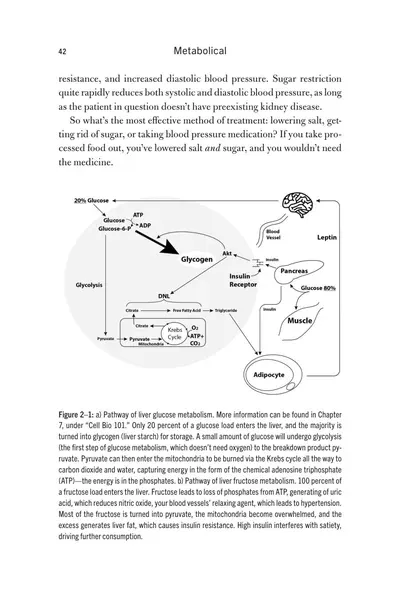
Interior page showing a metabolic pathway diagram illustrating glucose processing and energy production in the body.
The book divides its argument between what Lustig calls "the real story of food" and "the story of real food" — unpacking how the food supply transformed and what whole, unprocessed food actually does in the body. This dual framing gives the book both a prosecutorial and a prescriptive dimension: it is as much a call to action as it is an explanation.

Scope, Scale, and Scientific Ambition

One of the book's most distinctive structural features is the decision to move its 1,054 references entirely online rather than print them in the volume itself. As Lustig explains directly, including them would have added roughly seventy pages and meaningfully raised the book's cost. For readers who engage with primary literature, the online reference list provides immediate access to the underlying sources; for general readers, it keeps the text from becoming impenetrable. This choice reflects the book's unusual positioning: it is written for a general audience but insists, emphatically, on scientific verifiability. Lustig describes the book as filled with what he calls "heresies — concepts which buck the established dogma — except they are true," a framing that signals both the book's confrontational posture and its author's confidence in the evidentiary record behind it.
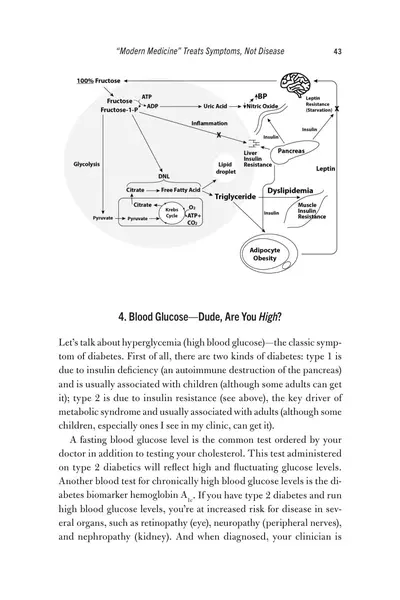
Interior page showing a metabolic pathway diagram illustrating how processed food components affect blood glucose and related health conditions.
The publisher, Harper, describes Lustig's particular strength as an ability to "connect the dots" for the general reader — synthesizing complex metabolic science, epidemiological data, and institutional critique into a coherent through-line accessible to non-specialists.

Lustig's Voice and Credibility

Lustig arrives at Metabolical with a substantial platform. He is the author of Fat Chance, The Hacking of the American Mind, Sugar Has 56 Names, and The Fat Chance Cookbook, and is the editor of the academic volume Obesity Before Birth. His background as a pediatric neuroendocrinologist lends the book a clinical grounding that distinguishes it from popular wellness titles written without medical or research credentials. The argument in Metabolical extends and sharpens positions Lustig has developed across his career — particularly his long-standing critique of sugar and processed carbohydrates — and situates them within a broader indictment of the healthcare paradigm he argues has "gone off the rails."
Diagram showing cellular glucose metabolism pathways, illustrating energy production through glycolysis and the Krebs cycle.
That institutional credibility is central to how the book positions itself: not as contrarian provocation, but as corrective science. Whether readers find that posture persuasive or overstated will depend significantly on their prior engagement with nutrition research and their disposition toward systemic critique of established medical and food-industry orthodoxy.

Genuine Limitations and Who May Struggle

Metabolical's very ambition creates real friction for some readers. The book's scope — spanning metabolic biochemistry, food-systems policy, pharmaceutical economics, and environmental consequence — is extraordinarily wide, and Lustig prosecutes each front with the same intensity. Readers seeking a focused dietary guide or a single-topic health book may find the breadth demanding; the book is not structured as a step-by-step plan. The confrontational framing — routinely positioning established institutions as complicit in a decades-long public health failure — will resonate strongly with readers already skeptical of food-industry and pharmaceutical influence, but may read as overstated to those who prefer more measured, incremental argumentation. Additionally, the book's recommendation that readers consult an online reference list, rather than footnotes in the text, requires active engagement outside the book itself to verify claims — a workflow not every reader will follow through on.
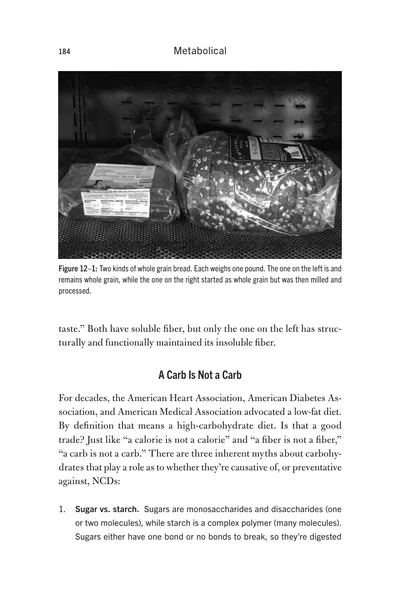
Interior page comparing two types of whole grain bread, illustrating carbohydrate processing differences discussed in nutritional science.

Who This Book Is For

Metabolical is designed for readers who want to understand the structural and biological mechanisms behind the chronic disease epidemic — not just what to eat, but why the food environment looks the way it does, who benefits, and what the science actually shows beneath layers of industry-shaped messaging. Readers who engaged with Lustig's earlier Fat Chance will find Metabolical a significantly more ambitious successor. Those who come to nutrition science through popular titles like Michael Pollan's work will encounter a more technically dense, more polemical argument here. The book is best approached as a work of narrative science and institutional critique rather than as a practical protocol — its power lies in reframing how readers understand metabolic health at a systemic level, not in delivering week-by-week instructions.

Sources & Further Reading

The key facts and claims in this review are grounded in the retrieved, verified sources listed below.

  1. 1

    Robert H. Lustig, Wikipedia