BOOKS
Published

Read Time

3 min read

Curated & edited by

LuvemBooks Editorial

How we create our reviews →
Share This Review

The Song of the Blue Bottle Tree by India Hayford Review: A Haunting, Unflinching Southern Debut

India Hayford's debut novel places an extraordinary protagonist — Genevieve Charbonneau, snake-handler and speaker to the dead — at the center of a folk-magic-laced story set in 1967 rural Arkansas, where found family, survival, and the long reach of trauma collide in a novel Publishers Marketplace named a Buzz Books selection and blurbists from Kim Michele Richardson to Donna Everhart have called riveting and unforgettable.

LuvemBooks Verdict

Best for

Readers drawn to grounded Southern fiction — fans of Delia Owens, Barbara Kingsolver, or Kelly Mustian — who want folk magic and women's interiority rooted in specific landscape and family history rather than vague Gothic atmosphere.

Worth it if

You want a debut Southern novel with a genuinely original protagonist, moral and structural weight, and mysticism earned through two centuries of real family roots in the Arkansas land it depicts.

Skip if

You prefer Southern Gothic atmosphere without sustained engagement with domestic abuse, sexual assault, PTSD, and religious trauma, or if sharp tonal shifts between dark humor and genuine brutality feel jarring rather than purposeful to you.

What readers & critics say

Dear Author awarded the novel an A-minus, calling it "a haunting story about letting go and the things we leave behind, the power of names, and the ties that bind," grounding its praise in Hayford's naturalist biography and deep family connection to the land. Story Street Writers describes it as "magnificent and grotesque," noting that some characters and scenes will leave readers "horrified, sickened, and angry" — a signal of the novel's unflinching tonal range — while endorser Donna Everhart, quoted on Penguin Random House's page, praises it as "a rousing story of good over evil, brought to life with skill and heart."

A haunting story about letting go, the power of names, and the ties that bind.

Dear Author

Magnificent and grotesque — some characters and scenes will leave the reader horrified, sickened, and angry.

Story Street Writers

A rousing story of good over evil, brought to life with skill and heart.

Donna Everhart via Penguin Random House

A riveting exploration of tangled familial bonds, loss, love and the redemption of fierce womanhood.

Kim Michele Richardson via Wind City Books
Sources: Dear Author, Story Street Writers, Penguin Random House
4.6from 5,339 Amazon ratings— reader ratings, not a LuvemBooks score

Look inside the book

Preview the actual pages, via Google Books
In This Review
  • What Works & What Doesn't
  • What the Novel Is and What It Contains
  • The Novel's Significance and Place in the Genre
  • Storytelling Strengths: Character, Plot, and Voice
  • Genuine Limitations and Who May Struggle With It
  • Who This Novel Is For and Why It Matters Now

What Works & What Doesn't

What Works
  • Genevieve Charbonneau is a richly original protagonist — snake-handler, ghost-speaker, and perpetual outsider — whose central tension between connection and flight drives the novel's emotional stakes
  • Praised by Kim Michele Richardson as 'riveting' and 'utterly unforgettable,' the novel draws strong early endorsements from established voices in Southern fiction
  • Set on land where Hayford's own family roots go back two centuries, the 1967 Arkansas setting carries the specificity of deep personal knowledge rather than researched approximation
  • Named a Publishers Marketplace Buzz Books selection, the debut arrived with significant pre-publication industry recognition
  • The novel's interlocking plot resolutions — abused women finding agency, a ghost finding release, a predator becoming prey — give the story moral and structural weight beyond a single character arc
What Doesn't
  • Domestic abuse, sexual assault, PTSD, and religious trauma are integral — not peripheral — to the story, making this a challenging read for those sensitive to sustained dark material
  • The novel's blend of dark humor and genuine brutality demands tolerance for sharp tonal shifts, which is central to Hayford's design but may not suit all readers
A debut novel of rare tonal range, The Song of the Blue Bottle Tree announces India Hayford as a Southern literary voice worth serious attention.

What the Novel Is and What It Contains

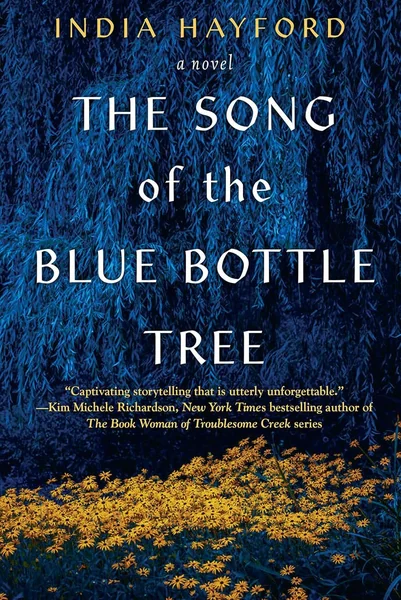
The Song of the Blue Bottle Tree by India Hayford front cover
Genevieve Charbonneau is not a conventional heroine. She talks to ghosts, keeps a particular understanding with rattlesnakes, and has spent years drifting through the South under a name she lifted from a tombstone — a disguise that signals both her outsider status and the novel's preoccupation with the power of names. Her wandering has taken her through an Alabama mental hospital, a Louisiana circus, and a Texas hoochy-kootch before she allows herself, for the first time in a decade, to return to her grandmother's farmhouse in Arkansas. What begins as a brief visit to pay respects to the dead becomes something far larger when a chance encounter in a graveyard with a haunted young Vietnam veteran reconnects Genevieve with the surviving remnants of a family she believed lost to her. Set firmly in 1967, the novel weaves folk magic, magical realism, and dark humor through a story that Penguin Random House describes as being about "found family, folk magic, the long shadow of trauma, the salvation of human connection, and the transcendent beauty of nature."

The Novel's Significance and Place in the Genre

Hayford brings a naturalist's eye to a tradition already rich with writers who treat Southern landscape as a moral and psychological force. The publisher's positioning alongside Delia Owens, Barbara Kingsolver, Kelly Mustian, and Quinn Connor situates the novel within a strand of contemporary Southern fiction that takes women's interiority and rural ecology seriously as co-equal subjects. What distinguishes Hayford's entry into that company is her biography: the novel is set on land where her own family roots stretch back two centuries, lending the Arkansas setting a specificity that goes beyond atmosphere. Publishers Marketplace recognized the manuscript as a Buzz Books selection, marking it as one of the debut titles the industry identified as having significant momentum ahead of publication.

Storytelling Strengths: Character, Plot, and Voice

The narrative engine is driven by consequence. Genevieve's return sets off a chain of interlocking transformations: an abused woman and her daughters find the courage to fight back, a ghost discovers its path away from life, and — in a moral inversion the publisher describes with wry precision — a sanctimonious predator becomes the prey. At the center of it all, Genevieve must weigh her hunger for meaningful connection against her equally powerful compulsion to flee. Kim Michele Richardson, New York Times bestselling author of The Book Woman of Troublesome Creek series, calls the novel "a riveting exploration of tangled familial bonds, loss, love and the redemption of fierce womanhood" and names the storytelling "utterly unforgettable." Donna Everhart, author of The Saints of Swallow Hill, praises the book's "offbeat, colorful personalities, beguiling pastimes and unsung heroes," describing it as "a rousing story of good over evil, brought to life with skill and heart." The combination of dark humor and harrowing subject matter — what the publisher calls "otherworldly and beautiful as it is unflinching and wry" — is one the early reception consistently highlights as a distinguishing quality.

Genuine Limitations and Who May Struggle With It

The novel does not soften its material. Domestic abuse, sexual assault, PTSD, and religious trauma are all integral to the story, and sources note these themes are handled with care but are not incidental — they are structural. Readers who prefer Southern Gothic atmosphere without sustained engagement with violence and its aftermath may find the novel demanding. Genevieve herself is a deliberately unconventional figure: a woman operating entirely outside social norms, moving through the world by instinct and folk knowledge. Readers who want a traditionally grounded or easily legible protagonist may find her unsettling in ways that go beyond pleasant strangeness. The novel's tonal blend — dark humor alongside genuine brutality — requires some tolerance for emotional whiplash, which is part of Hayford's design but is not universally comfortable.

Who This Novel Is For and Why It Matters Now

The Song of the Blue Bottle Tree is designed for readers who want Southern fiction that earns its mysticism through specific, rooted storytelling rather than vague atmospheric gestures. The novel's themes — the long shadow of family trauma, the redemptive potential of chosen kinship, the cost and value of remaining in one place — resonate well beyond 1967 Arkansas. Readers drawn to the work of Delia Owens or Barbara Kingsolver, or who have responded to the grounded folk magic of Kelly Mustian's fiction, have the most direct on-ramp. As a debut, it signals not only a confident individual novel but the arrival of a writer with deep material to draw from: two centuries of family history on a specific piece of land is an unusual inheritance for a fiction writer, and this novel makes use of it fully.

Sources & Further Reading

The key facts and claims in this review are grounded in the retrieved, verified sources listed below.

  1. 1
  2. 2
  3. 3
  4. 4
  5. 5
  6. 6
  7. 7
  8. 8