8 min read
4.6
· 60,859 Amazon ratingsShare This Review

Our review
Fahrenheit 451 by Ray Bradbury Review: A Timeless Dystopian Warning Against Censorship
Ray Bradbury's dystopian novel Fahrenheit 451 remains one of the most culturally enduring works of American speculative fiction, following fireman Guy Montag through a future society where books are outlawed and burned — a premise that has only grown more resonant across the decades since its first publication.
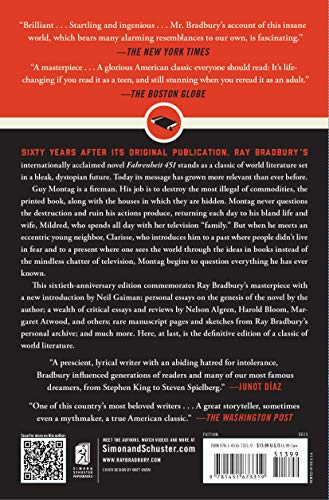 Tap to enlarge
LuvemBooks Verdict
Best for
Readers aged fifteen and up who want an authoritative, compact entry point into dystopian fiction — especially those drawn to the politics of censorship, intellectual freedom, and state control — and who are ready to engage with a novel that is as much a lyrical polemic as it is a narrative.
Worth it if
You want a short, thematically dense work whose warnings about censorship, mass entertainment, and the suppression of dissent feel as urgent today as they did in 1953, and whose Bradbury-introduced Simon & Schuster reissue provides direct authorial context for its creation.
Skip if
You prefer expansive world-building, a large ensemble cast, or a documentary-realist prose style — Bradbury's parable-like structure and lyrical, impressionistic writing are genuine stylistic commitments that will feel like a mismatch to readers expecting sociological procedural detail.
What readers & critics say
Wikipedia notes that Fahrenheit 451 is considered one of Bradbury's best works and has generated adaptations across film, graphic literature, documentary, and music, underscoring its uncontested standing in American literary culture. Kirkus Reviews describes it as "one of the most important literary contributions to the genre," combining a vital metaphor for free expression with a "vivid, crisp prose and thunderbolt of a message."
“Bradbury's vivid, crisp prose and thunderbolt of a message electrified every synapse in my brain.”
— Kirkus ReviewsAsk LuvemBooks
Was this helpful?
- Is it worth reading?
- LuvemBooks considers Fahrenheit 451 a foundational dystopian novel that earns its place on any essential reading list through the sheer staying power of its central premise and the urgency Bradbury brought to its construction. Its cultural reach — encompassing François Truffaut's film adaptation, Tim Hamilton's authorised graphic novel, Michael Moore's documentary Fahrenheit 9/11, and a 2025 concept album — attests to a work that has consistently provoked artists and thinkers far beyond the boundaries of science fiction. The key caveat is one of style and scope: readers who want expansive world-building or realist prose may find the lyrical, parable-like approach a mismatch, but for the majority of its readership across more than seven decades, the approach clearly works.
- Similar books
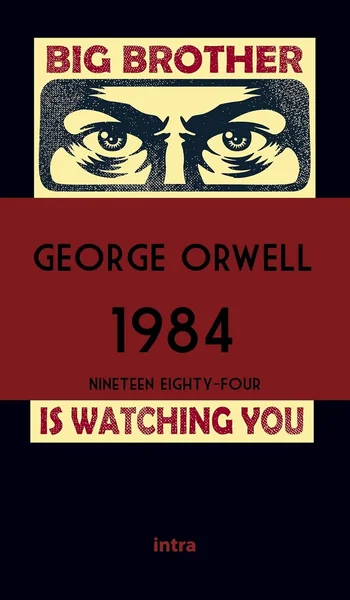
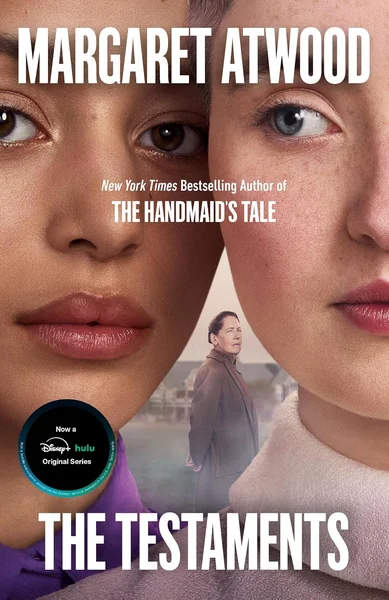
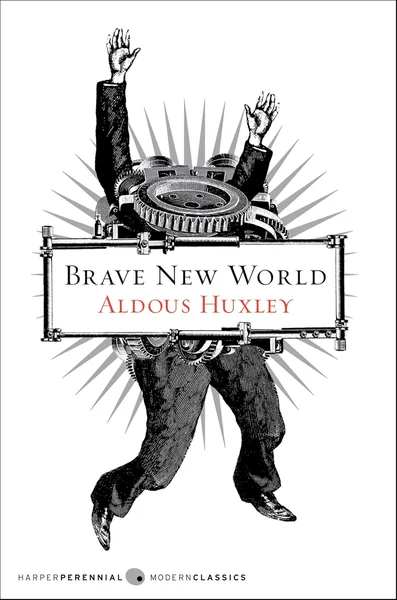
- Readers drawn to Fahrenheit 451's dystopian premise and political urgency will find natural companions in George Orwell's Nineteen Eighty-Four, which shares the novel's focus on state censorship and the suppression of individual thought, and Aldous Huxley's Brave New World, which similarly examines social control through mass entertainment rather than overt force. For readers interested in the genre's broader tradition, Yevgeny Zamyatin's We is widely considered a foundational precursor, and Margaret Atwood's The Handmaid's Tale extends the dystopian form into questions of gender and bodily autonomy. All four titles are frequently paired with Bradbury's novel in discussions of essential twentieth-century speculative fiction.
- Who should read this?
- Fahrenheit 451 is recommended for readers aged fifteen and older and works particularly well for those encountering dystopian literature for the first time, given its compact length and clear, driving narrative momentum. It also rewards readers already familiar with Orwell or Huxley who want to explore the American dystopian tradition. Readers who prefer expansive world-building or a large cast of characters may find Bradbury's tight, almost parable-like focus constraining, and those who favour documentary-style realist prose over lyrical, impressionistic writing should be aware that the style is genuinely distinctive.
- What age is it for?
- Best for readers aged 15 and up. The novel's themes of state censorship, intellectual suppression, and political dissent are substantive and require a degree of critical engagement that suits mid-teenage readers and older. Bradbury's lyrical, abstract prose also benefits from a reader with some experience of literary fiction.
- Tell me about the adaptations
- Fahrenheit 451 has generated adaptations across multiple media. François Truffaut directed the best-known film version, and in June 2009 an authorised graphic novel adaptation illustrated by Tim Hamilton was published. Michael Moore's 2004 documentary Fahrenheit 9/11 explicitly invoked Bradbury's title and themes in its examination of post–September 11 American politics. Most recently, in 2025, a composition on the instrumental concept album The Ray Bradbury Chronicles was structured around the novel's key narrative stages. LuvemBooks notes that this breadth of cultural response — across film, graphic literature, documentary, and music — signals a work that has consistently provoked artists and thinkers far beyond the boundaries of the science fiction genre.
- Why did Bradbury write it?
- Bradbury was candid about the fears that drove the book's creation: he wrote it during a period when he was worried about the direction of the country, noting that books were being removed from shelves and that many people were afraid. This autobiographical urgency gives the novel a polemical core — it is a sustained argument against censorship, the suppression of dissent, and the erosion of intellectual life through mass entertainment and state control. Bradbury continued to engage with the text publicly for decades after publication, adding a "Coda" in 1979 and producing numerous commentaries on the novel between 1953 and his later years, underscoring that he regarded it as a living warning rather than a fixed historical document.
- What's the famous opening line?
- The novel opens with what LuvemBooks describes as one of the most recognised lines in American fiction: "It was a special pleasure to see things eaten, to see things blackened and changed." The line establishes Guy Montag's initial, uncritical embrace of destruction — his pleasure in burning — before his gradual transformation into a dissident begins. It is a deliberate and effective piece of scene-setting: the reader enters the story through Montag's corrupted perspective, which makes his eventual awakening all the more resonant.
Summarize this book
Follow up
Synthesized from verified book data & published reviews · How we review
Press Enter to ask. Answers come from our editorial Q&A — start typing to see related questions.
Our Review
What the Novel Is and What It Contains
Significance and Place in the Canon
Bradbury's Intent and the Novel's Argument
Genuine Strengths as a Work of Speculative Fiction
Who the Novel Is For and Where It Asks the Most of Its Readers
Sources & Further Reading
The key facts and claims in this review are grounded in the retrieved, verified sources listed below.
- 1
en.wikipedia.org
- 2
web.english.upenn.edu
- 3
lexiconic.net
- 4
- 5
- 6
- 7
becoming-carmen.com
- 8
greenishbookshelf.com
- 9
cannonballread.com
- 10
womenlawyersinbergen.org
- 11
- 12
Age & Reading Level
Recommended age
Ages 12–18
Reading level
Young adult
2 content notes · who it suits
Content to know about
Best for: Ages 15+ — the novel's themes of political censorship, state control, and intellectual suppression, combined with Bradbury's lyrical and abstract prose style, suit mid-teenage readers and older.
Skip if you want expansive world-building, a large cast, or documentary-style realist prose in your speculative fiction.
Be one of the first readers to answer.
Read it? Was it right for you?
Reader reviews
No reader reviews yet
Read it? Be the first to say what you thought.
Books like Fahrenheit 451
Curated picks for readers who enjoyed Fahrenheit 451, with our reasoning for each match.
More by Ray Bradbury

If you liked Fahrenheit 451