BOOKS
Published

Read Time

4 min read

Reader rating

4.7

· 3,751 Amazon ratings
reader ratings, not a LuvemBooks score
Curated & edited by

LuvemBooks Editorial

How we create our reviews →
Share This Review

The Tucci Cookbook by Stanley Tucci Review: A Generous Italian Family Table

The Tucci Cookbook is a hardcover Italian cookbook published by Gallery Books in 2012, co-written by Stanley Tucci with his parents Joan and Stan Tucci, alongside chef Gianni Scappin and Mimi Stanley Taft, with a foreword by Mario Batali and photography by Francesco Tonelli. Built around nearly 200 recipes rooted in Italian home cooking, the book weaves family memory, wine pairings by Tyler Coleman, and the culinary legacy that runs from the Tucci household table to Big Night and beyond. This review assesses the book's content, structure, and reception from published sources — not a kitchen test.

LuvemBooks Verdict

Best for

Readers drawn to Italian-American home cooking with a strong narrative dimension — especially those who love Stanley Tucci's film Big Night and want recipes rooted in genuine family memory rather than celebrity polish.

Worth it if

The personal storytelling, collaborative family authorship, and accessible wine pairings appeal — this is a cookbook as much about inherited culinary identity as it is about technique.

Skip if

Those seeking encyclopedic Italian regional coverage or a rigorous, technique-forward reference will find the scope deliberately personal and the authorial voice diffuse across five named contributors.

Publishers Weekly calls it "a truly delightful cookbook," grounding its praise in the book's connection to Big Night and its comforting, elegant simplicity — while also noting, in its review of the follow-up, that The Tucci Cookbook set a high bar of domestic authenticity its sequel struggled to match (publishersweekly.com). The foodiebibliophile.com reviewer observes that the recipes are simple and easily attainable for a home cook, though not particularly new or innovative, while affirming that Tucci's culinary credibility is genuine.

Stanley Tucci, before The Lovely Bones and Julie & Julia, first wrote, directed, and starred in Big Night — a small but brilliant film.

Publishers Weekly

Fans of The Tucci Cookbook hoping for another helping of Tucci's rich trove of family recipes may not find [the sequel] very satisfying.

Publishers Weekly
Sources: Publishers Weekly, Foodie Bibliophile
4.7from 3,751 Amazon ratings— reader ratings, not a LuvemBooks score

Look inside the book

Preview the actual pages, via Google Books
In This Review
  • What Works & What Doesn't
  • What the Book Is and Where It Comes From
  • The Recipes: Scope and Character
  • Significance: A Lineage, Not Just a Name
  • Strengths: Voice, Narrative, and Wine Integration
  • Limitations and Who May Want More

What Works & What Doesn't

What Works
  • Nearly 200 recipes grounded in an authentic Italian-American family culinary tradition, co-written with Tucci's own parents and longtime family collaborator Gianni Scappin
  • Personal storytelling woven into each recipe — including memories tied to the making of Big Night — gives the collection narrative depth beyond a standard recipe reference
  • Accessible wine pairings by Tyler Coleman accompany every recipe, calibrated for home cooks rather than specialists
  • Philanthropic dimension: Tucci donated a portion of profits to the Food Bank of New York City, noted by Jonathan Waxman as central to the book's generous spirit
  • Publishers Weekly calls it 'a truly delightful cookbook,' and Lidia Bastianich recommends it with 'much admiration' as an intimate record of Italian heritage
What Doesn't
  • The book's scope is deliberately personal — readers seeking broad Italian regional coverage or a rigorous technique-forward reference will find it centered on the Tucci family's own traditions
  • The collaborative authorship (five named contributors plus a foreword) means the book does not sustain a single, consistent authorial voice throughout
A cookbook rooted in Italian-American family memory as much as in the kitchen, The Tucci Cookbook earns its place on the shelf through generosity of spirit and the depth of the culinary lineage it represents.

What the Book Is and Where It Comes From

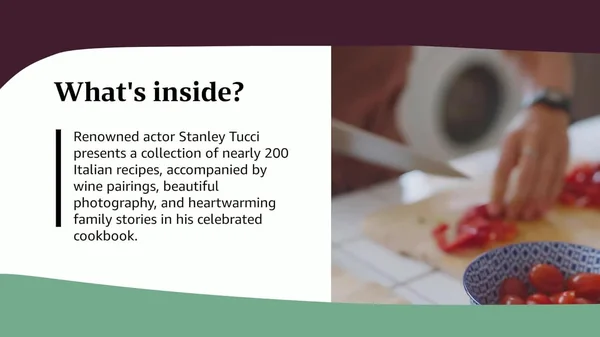
Interior page showing hands preparing Italian food with tomatoes and cooking implements, reflecting the cookbook's focus on family recipes.
The Tucci Cookbook is not a celebrity vanity project assembled at arm's length. Stanley Tucci co-wrote it with his own parents, Joan and Stan Tucci, along with Gianni Scappin — the chef who had previously co-authored Cucina & Famiglia with Joan Tucci — and Mimi Stanley Taft. The foreword is contributed by Mario Batali, and wine pairings throughout are provided by Tyler Coleman. That collaborative authorship matters: the book's nearly 200 recipes draw on a lineage of Italian home cooking that predates Tucci's film career, anchored in the flavors and traditions of an actual family kitchen rather than constructed for a television moment.
That philanthropic commitment gives the book a dimension beyond recipe collection. Publishers Weekly describes the finished product as
The through-line connecting the book's personal and culinary identity is Big Night, Tucci's film about two Italian brothers running a restaurant on the New Jersey shore in the 1950s. As Publishers Weekly notes, a risotto with butternut squash, lobster, and sage appears here because Tucci remembers Scappin preparing it for him during the film's research. The cookbook culminates with a recipe for the timpano — the elaborate drum of pasta that is Big Night's centerpiece — along with a vegetarian version, giving the book a satisfying narrative closure that links screen to table.

The Recipes: Scope and Character

The collection spans antipasti through dessert, grounded in what Publishers Weekly calls "the comforting, elegant simplicity of Italian home cooking." Recipes include pork tenderloin with fennel and rosemary, seared tuna with tomato and bread salad, and a risotto combining butternut squash, lobster, and sage. Seasonal produce and regional Italian staples recur throughout: a riff on prosciutto with melon replaces the melon with quartered figs from Stan Tucci's backyard fig trees; a dessert pairs northern Italian polenta with plums, with figs offered again as a substitute. Each recipe is accompanied by an accessible wine pairing from Tyler Coleman — Publishers Weekly singles out "bubbly and light white" for the fig-and-prosciutto dish as an example of how those pairings are calibrated for a home audience rather than an expert one.

Significance: A Lineage, Not Just a Name

The book's cultural weight comes from its position within an ongoing Tucci culinary story. Cucina & Famiglia, the earlier volume by Joan Tucci and Scappin, established the family's food traditions in print; The Tucci Cookbook extends and personalises that record under Stanley's name, with his parents as co-authors. Lidia Bastianich, writing as a blurb contributor, describes it as "an intimate glimpse into the Italian heritage that Stanley holds dear — sharing the memories and flavors of his family table," and recommends it with "much admiration." Chef Jonathan Waxman calls the book's defining quality generous: "from portion sizes to the constant theme of hospitality to Tucci's decision to donate a portion of the profits to the Food Bank of New York City." That philanthropic commitment gives the book a dimension beyond recipe collection.

Strengths: Voice, Narrative, and Wine Integration

Publishers Weekly describes the finished product as "a truly delightful cookbook," and the sources point to several concrete reasons for that assessment. The personal storytelling woven around individual recipes — the fig tree, the Big Night research sessions, the family memories — gives the book texture that straightforward technique manuals lack. The wine pairings by Tyler Coleman are consistently framed for accessibility rather than connoisseurship, which aligns with the home-cook audience the book courts. The food photography is the work of Francesco Tonelli, and the publisher's description characterises it as "mouthwatering." The recipes are written to evoke the Italian tradition of la cucina di casa — unfussy, ingredient-forward, rooted in season and place — which Publishers Weekly acknowledges finds expression even in dishes with a touch of elegance, like the lobster risotto.

Limitations and Who May Want More

The strongest honest caveat on record comes not from the book itself but from the reaction it generated in its sequel's wake. When The Tucci Table appeared, Publishers Weekly observed that fans of The Tucci Cookbook "hoping for another helping of Tucci's rich trove of family recipes may not find this book very satisfying" — a backhanded compliment to the original that also signals the first book set a high bar of domestic authenticity the follow-up struggled to match. Taken on its own terms, The Tucci Cookbook is most rewarding for readers drawn to Italian-American home cooking with a narrative dimension; those seeking a rigorous technique-forward reference, or coverage of Italian regional cooking beyond the Tucci family's particular traditions, will find the scope deliberately personal rather than encyclopedic. The collaborative authorship, while a genuine strength for authenticity, also means the book does not read as a single authorial voice — something readers who come to it primarily for Tucci's wit as a writer should keep in mind.

Sources & Further Reading

The key facts and claims in this review are grounded in the retrieved, verified sources listed below.

  1. 1

    Stanley Tucci, Wikipedia

  2. 2
  3. 3
  4. 4
  5. 5
  6. 6
  7. 7
  8. 8
Related Reviews

Reviews of books we picked for readers who enjoyed The Tucci Cookbook.