BOOKS
Published
Read Time
9 min read
Share This Review
A Wrinkle in Time by Madeleine L'Engle Review: A Newbery-Winning Classic of Enduring Power
First published in 1962 and winner of the Newbery Medal, the Sequoyah Book Award, and the Lewis Carroll Shelf Award, A Wrinkle in Time by Madeleine L'Engle is a landmark science fantasy novel that follows awkward, brilliant Meg Murry and her companions on a journey across the universe to rescue her father from a cosmic evil — a book that has challenged, delighted, and divided readers across generations.
Tap to enlargeIn This Review
- What Works & What Doesn't
- What the Book Is and What It Sets in Motion
- Significance and Place in the Canon
- Strengths: Ambition, Originality, and a Female Protagonist at the Center
- Controversy and the Book's Contested Legacy
- The Square Fish Edition and Who the Book Is For
What Works & What Doesn't
What Works
- Winner of the Newbery Medal (1963), the Sequoyah Book Award, and the Lewis Carroll Shelf Award — among the most decorated children's novels of its era
- Pioneering in placing a self-doubting, intellectually driven girl (Meg Murry) at the center of a science-fantasy adventure at a time when that was genuinely unconventional
- Blends theoretical physics concepts, cosmic stakes, and Christian-inflected themes into a form aimed at middle-grade readers — an unusually ambitious tonal and conceptual mix
- The Square Fish 2007 edition adds a previously unpublished interview with L'Engle and her Newbery Medal acceptance speech, enriching the historical record for readers and educators
- Opens a five-book series (the Time Quintet), giving invested readers an extended world to explore
What Doesn't
- Librarian Carolyn Horovitz, writing in the Newbery retrospective, raised questions about the depth of its literary quality even while praising its entertainment value — a debate that has persisted in scholarly circles
- Its interweaving of liberal Christian theology has drawn sustained criticism from conservative religious groups and led to repeated challenges and bannings, making it a complex recommendation in some contexts
This review covers the content and published reception of A Wrinkle in Time based on the available record; it does not reflect hands-on reading or testing.

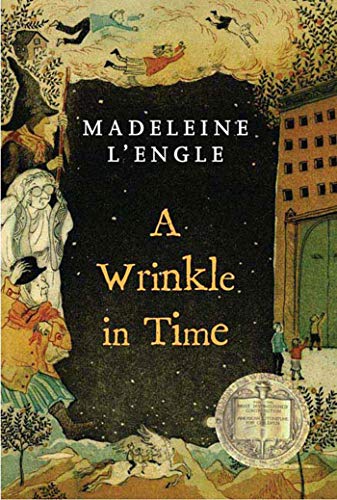
A Wrinkle in Time: (Newbery Medal Winner) by Madeleine L'Engle front cover
What the Book Is and What It Sets in Motion
A Wrinkle in Time is a science fantasy novel — the first entry in Madeleine L'Engle's five-book Time Quintet — originally published in 1962. Its central figure is Meg Murry, a self-doubting but fiercely intelligent teenager who, along with her preternaturally gifted younger brother Charles Wallace and her classmate Calvin O'Keefe, is guided by three supernatural beings — Mrs. Whatsit, Mrs. Who, and Mrs. Which — through a phenomenon called a tesseract, a wrinkle in the fabric of space-time. Their destination is the planet Camazotz, where Meg's father, a physicist named Mr. Murray, is being held captive by a malevolent force known as IT — a pulsing, disembodied brain that imposes absolute conformity. The stakes extend beyond the Murray family: a dark evil called the Black Thing is described as threatening the entire universe. The novel is structured as a rescue mission, but its true engine is Meg's interior struggle with fear, self-worth, and love.
“good entertainment and that the writer carries the story along with a great deal of verve.”
Significance and Place in the Canon
Few debut children's novels have had as turbulent or ultimately triumphant a reception as this one. L'Engle's manuscript was famously rejected by some 26 publishers before John Farrar of Farrar, Straus and Giroux agreed to publish it under the Ariel imprint. The gamble paid off decisively: in 1963 the Association for Library Service to Children awarded it the Newbery Medal, given annually to the author of the most distinguished contribution to American children's literature. It also won the Sequoyah Book Award and the Lewis Carroll Shelf Award, and was a runner-up for the Hans Christian Andersen Award. More than six decades later, it remains the opening volume of a beloved five-book series, and its cultural reach has extended to film, television, and — as a prominent pop-culture reference — the Netflix series Stranger Things.

Back cover with synopsis, other titles in series, and publisher information.
Strengths: Ambition, Originality, and a Female Protagonist at the Center
L'Engle's decision to place an awkward, self-critical girl at the heart of a science-fantasy adventure was itself a departure from convention. As Wikipedia's reception summary notes, some early critics flagged the choice as a flaw — an indication of how unusual it was at the time. The novel blends concepts from theoretical physics (the tesseract, the fifth dimension) with Christian theological themes and the emotional texture of a middle-grade coming-of-age story, a combination that had no obvious precedent. Librarian Carolyn Horovitz, writing in the retrospective Newbery and Caldecott Medal Books: 1956–1965, acknowledged that the book is "good entertainment and that the writer carries the story along with a great deal of verve." Its willingness to ask large questions — about conformity, free will, the nature of evil, and what it means to love imperfect people — within the frame of a children's adventure gave it a gravity uncommon in the genre.
Controversy and the Book's Contested Legacy
L'Engle's liberal Christian worldview, woven throughout the novel, has made A Wrinkle in Time a perennial target of criticism from opposite ends of the ideological spectrum. Conservative Christian groups have objected to certain elements as incompatible with orthodox belief, while others have challenged the book on entirely different grounds. It has appeared on challenged and banned book lists, a distinction that underscores how much interpretive weight the novel has always carried. Horovitz also raised a more literary reservation, noting there is "some question about the depth of its quality" alongside its undeniable entertainment value — a critique that has followed the book into the scholarly conversation ever since. These tensions are part of the novel's record, not incidental to it.
The Square Fish Edition and Who the Book Is For
The edition under review is the Square Fish reprint, published in May 2007 alongside the rest of the Time Quintet. It includes two items not present in the original publication: a previously unpublished interview with L'Engle and a transcription of her Newbery Medal acceptance speech — materials that add historical and biographical context for readers who want to understand the novel's origins and its author's intentions. The novel is designed for readers aged nine and up, and the Time Quintet framing means that those who connect with Meg's story have four subsequent volumes to continue into. Readers drawn to science fantasy with emotional depth, questions of good versus evil on a cosmic scale, and a protagonist whose defining weapon is love rather than physical power are the book's core audience — though its theological undercurrents and conceptual density mean it rewards different things at different ages.

Frequently Asked Questions
Is A Wrinkle in Time worth reading?
The review describes it as a novel of uncommon gravity for its genre, one that asks large questions about conformity, free will, the nature of evil, and what it means to love imperfect people within the frame of a children's adventure. Librarian Carolyn Horovitz acknowledged it as good entertainment carried along with a great deal of verve. LuvemBooks notes it rewards different things at different ages, making it a book with lasting re-read value.
Who is the target audience for this book?
The novel is designed for readers aged nine and up. The review identifies its core audience as readers drawn to science fantasy with emotional depth, questions of good versus evil on a cosmic scale, and a protagonist whose defining weapon is love rather than physical power. Its theological undercurrents and conceptual density mean it also rewards older readers returning to it.
What are the main themes of this book?
The review highlights conformity, free will, the nature of evil, and what it means to love imperfect people as the novel's central thematic concerns. These large questions are framed within a children's adventure, giving the book a gravity uncommon in the genre. Christian theological themes are also woven throughout, alongside concepts drawn from theoretical physics.
What is the plot of this book?
The novel follows Meg Murry, her younger brother Charles Wallace, and classmate Calvin O'Keefe as they are guided by three supernatural beings through a tesseract — a wrinkle in the fabric of space-time — to the planet Camazotz. There, Meg's father, a physicist named Mr. Murray, is held captive by a malevolent force called IT, a pulsing disembodied brain that imposes absolute conformity. The review notes that while the novel is structured as a rescue mission, its true engine is Meg's interior struggle with fear, self-worth, and love.
Who are the main characters in this book?
The central figure is Meg Murry, described in the review as a self-doubting but fiercely intelligent teenager. She is joined by her preternaturally gifted younger brother Charles Wallace and her classmate Calvin O'Keefe. Three supernatural guides — Mrs. Whatsit, Mrs. Who, and Mrs. Which — lead the children on their journey, while the antagonist IT and the cosmic threat known as the Black Thing serve as the forces of evil.
What kind of book is this book — science fiction or fantasy?
The review classifies it as a science fantasy novel, a blend that had no obvious precedent at the time of publication. It combines concepts from theoretical physics, such as the tesseract and the fifth dimension, with Christian theological themes and the emotional texture of a middle-grade coming-of-age story. This unusual combination is cited as one of the book's defining strengths.
What is a tesseract in this book?
The review describes the tesseract as a wrinkle in the fabric of space-time, the phenomenon through which Meg and her companions travel to the planet Camazotz. It is one of the theoretical physics concepts L'Engle weaves into the novel alongside references to the fifth dimension. The tesseract functions as both a plot device and a symbol of the book's ambition to blend science and fantasy.
What awards has this book won?
The review notes that the novel won the Newbery Medal in 1963, awarded by the Association for Library Service to Children to the author of the most distinguished contribution to American children's literature. It also won the Sequoyah Book Award and the Lewis Carroll Shelf Award, and was a runner-up for the Hans Christian Andersen Award. These honors followed a famously difficult path to publication, with the manuscript rejected by some 26 publishers before Farrar, Straus and Giroux agreed to publish it.
How many times was this book rejected before publication?
The review recounts that L'Engle's manuscript was rejected by some 26 publishers before John Farrar of Farrar, Straus and Giroux agreed to publish it under the Ariel imprint. The gamble paid off decisively, as the book went on to win the Newbery Medal the following year. The review describes this as one of the most turbulent yet ultimately triumphant receptions of any debut children's novel.
Has this book been banned or challenged?
Yes, the review notes that the novel has appeared on challenged and banned book lists, a distinction it attributes to the interpretive weight the book has always carried. Conservative Christian groups have objected to certain elements as incompatible with orthodox belief, while others have challenged it on entirely different grounds. The review frames these controversies as part of the novel's record, not incidental to it.
Sources & Further Reading
The key facts and claims in this review are grounded in the retrieved, verified sources listed below.
- 1
en.wikipedia.org
- 2
booksamillion.com
- 3
bookanalysis.com
- 4
houseofcadmus.com
- 5
literaryladiesguide.com
- 6
- 7
greenishbookshelf.com
- 8
- 9
- 10
- 11
ala.org
- 12
Reader Comments
No comments yet
Be the first to share your thoughts!