At a glance
About the Author
Madeleine L'Engle2 books reviewed
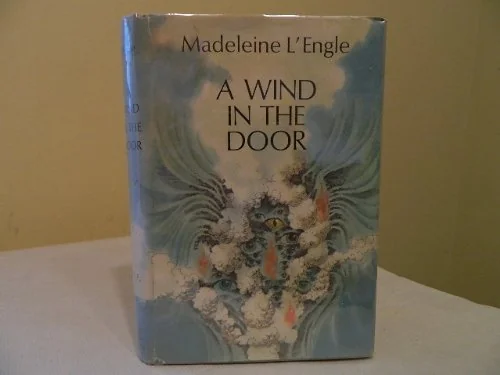
A Wind in the Door
by Madeleine L'Engle
LuvemBooks Verdict
Best for: Readers aged 9 and up — and curious adults — who are drawn to ideas as much as adventure and want a young adult fantasy that treats cellular biology, classical theology, and cosmic ethics as equally serious narrative languages.
Worth it? Skip it? Read the full verdict →Ask LuvemBooks
Was this helpful?
- Is it worth reading?
- For readers receptive to L'Engle's mytho-scientific vision, A Wind in the Door is genuinely rewarding. The conceptual ambition — treating cellular biology and ancient cosmology as compatible narrative languages — is, as LuvemBooks notes, unlike anything else in young adult fantasy, and critics including Michele Murray in The New York Times praised it as a 'completely convincing tale.' Mari Ness at Tor.com called it 'L'Engle at the height of her poetic powers,' lamenting that its failure to match A Wrinkle in Time's fame is 'a genuine shame.' The caveat is real: Kirkus Reviews found that Meg's transformation arrives with unconvincing ease, and the novel's social critique can feel strained — readers who prefer tightly integrated allegory may notice the seams.
- Similar books
- Readers who respond to A Wind in the Door's blend of cosmic stakes and moral interiority will find kindred territory in several directions. A Swiftly Tilting Planet and A Ring of Endless Light — both by Madeleine L'Engle — continue the Time Quintet's expansion of mytho-scientific ideas. Norton Juster's The Phantom Tollbooth shares the spirit of a young protagonist navigating an absurdist yet philosophically serious otherworld. Susan Cooper's The Dark Is Rising brings comparable mythic weight and child-hero urgency to British fantasy, while Rebecca Stead's When You Reach Me borrows directly from A Wrinkle in Time's time-travel logic for a contemporary middle-grade mystery. Lois Lowry's The Giver occupies similar thematic territory around individual choice, cosmic order, and the cost of moral courage.
- Who should read this?
- A Wind in the Door is best suited to young readers — and adults — who are drawn to ideas as much as to adventure: theology, biology, and the ethics of love are as central to the plot as any action set-piece. As Michele Murray observed in The New York Times, it works for both readers familiar with the Murry family and those meeting them for the first time, though prior knowledge of A Wrinkle in Time deepens the emotional resonance. Readers who prefer tightly plotted allegory with clean symbolic integration may feel the strain the review and Kirkus identify; those comfortable with ambitious, occasionally uneven storytelling will find it one of the more philosophically serious works in the young adult science fantasy tradition.
- What age is it for?
- Best for ages 12 and up. A Wind in the Door is a young adult novel whose abstract theological and scientific concepts — cellular biology as cosmic metaphor, the ethics of loving an enemy, existential annihilation — suit confident readers comfortable with layered, idea-driven storytelling rather than younger children seeking straightforward adventure.
- How does it compare to A Wrinkle in Time?
- A Wind in the Door is a more philosophically ambitious and inward-looking book than A Wrinkle in Time: where the first novel sends Meg across the universe on a rescue mission, the sequel turns the quest inside a single mitochondrion, and the central challenge is a moral act — identifying genuine goodness in an antagonist — rather than a physical confrontation. Critics including Mari Ness at Tor.com argue the novel represents 'L'Engle at the height of her poetic powers,' though Kirkus Reviews found its emotional arc less convincingly resolved than the original's. Readers coming from A Wrinkle in Time will find the Murry family and Calvin O'Keefe fully established, but the emotional payoff of Proginoskes' sacrifice is richer for knowing these characters.
- How was it received by critics?
- Critical reception has been mixed but substantive. Kirkus Reviews, in its original 1973 notice, acknowledged 'the audacity of Ms. L'Engle's mytho-scientific imagination and her undoubted storytelling abilities,' while also finding that Meg's transformation arrives with 'unconvincing ease' and that the novel strains to connect America's social ills to the metaphysics of mitochondria and farandolae. Michele Murray, writing in The New York Times, called it a 'completely convincing tale' that blends classical theology, contemporary family life, and science fiction. More recently, Mari Ness at Tor.com (2012) called it 'L'Engle at the height of her poetic powers' and described the novel's relative obscurity compared to A Wrinkle in Time as 'a genuine shame.'
Summarize this book
Follow up
Synthesized from verified book data & published reviews · How we review
Press Enter to ask. Answers come from our editorial Q&A — start typing to see related questions.
Age & Reading Level
Recommended age
Ages 12–18
Reading level
Young adult
3 content notes · who it suits
Content to know about
Best for: Ages 12+ — abstract theological and scientific concepts (cellular biology as cosmic metaphor, the ethics of loving an enemy) suit confident YA readers rather than younger children
Skip if you want tightly integrated allegory where every symbolic thread resolves cleanly
Editorial Review
A Wind in the Door is a young adult science fantasy novel by Madeleine L'Engle, the second entry in the Time Quintet, in which fourteen-year-old Meg Murry races to save her gravely ill brother Charles Wallace by journeying inside his very cells. Its audacious blend of cosmic mythology, cellular biology, and moral urgency makes it one of the most inventive entries in the genre.
Read the Full Review
![Shadow and Bone [SHADOW & BONE] [Paperback] by LeighBardugo](https://cdn.luvembooks.com/birthdais/media/original_images/Shadow_and_Bone_SHADOW__BONE_Paperback_main_0.webp)