BOOKS
Published

Read Time

9 min read

Reader rating

4.4

· 10,006 Amazon ratings
reader ratings, not a LuvemBooks score
Curated & edited by

LuvemBooks Editorial

How we create our reviews →
Share This Review
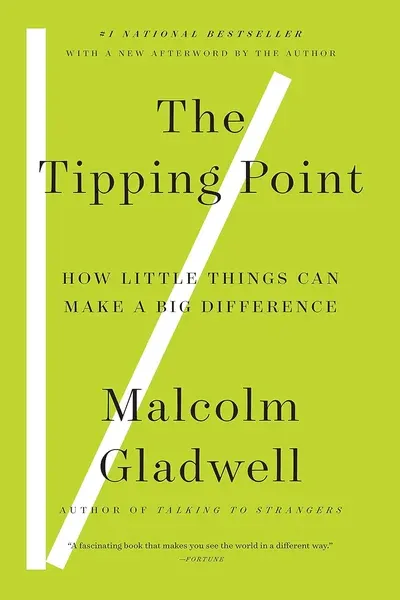
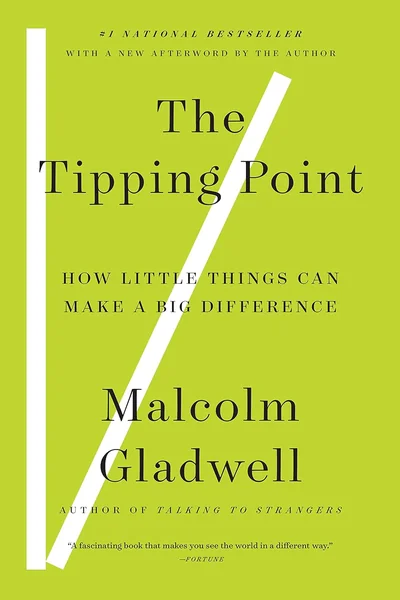
The Tipping Point: How Little Things Can Make a Big Difference by Malcolm Gladwell front cover

Our review

The Tipping Point by Malcolm Gladwell Review: A Landmark Study of Social Contagion

The Tipping Point is Malcolm Gladwell's debut non-fiction book, first published by Little, Brown in 2000, arguing that social epidemics — the sudden spread of ideas, products, and behaviors — obey identifiable rules that anyone can learn to harness. It became a New York Times bestseller and sold 1.7 million copies by 2006, cementing Gladwell as one of the most widely read popular science writers of his generation.

LuvemBooks Verdict

Best for

Curious general readers — marketers, educators, public-health communicators, and community organizers — who want an engaging, story-driven introduction to how ideas, trends, and behaviors achieve viral spread.

Worth it if

Worth reading if you want a memorable conceptual vocabulary (Connectors, Mavens, Salesmen, Stickiness, Context) for thinking about social change and are happy to treat it as an idea-rich starting point rather than a methodologically rigorous academic text.

Skip if

Skip it if you have a formal social-science or epidemiology background and need empirically tight, peer-reviewed frameworks — scholarly critics have questioned some of the underlying research Gladwell relies on, and Fast Company reported as early as 2008 that the model's predictive reliability had come under challenge.

BookPage praised the book's "intriguing illustrations," noting that Gladwell "manages both to maintain the specificity of each example and apply it usefully to his Tipping Point theories." Wikipedia's reception summary records that The Guardian ranked The Tipping Point at number 94 on its list of 100 Best Books of the 21st Century, and the book spent extensive time on the New York Times bestseller list, selling over 1.7 million copies by 2006.

“Part of the effectiveness of The Tipping Point lies in the intriguing illustrations Gladwell uses to explain his ideas.”

— BookPage
Sources: BookPage, Wikipedia
4.4from 10,006 Amazon ratings— reader ratings, not a LuvemBooks score
Buy on Amazon

Age & Reading Level

Recommended age

Adult

Reading level

Adult

Skip if you're looking for a methodologically rigorous, empirically formal treatment of diffusion or social-epidemic theory.

In This Review
  • What Works & What Doesn't
  • What the Book Actually Argues
  • The Framework: Three Rules of Epidemics
  • Reception and Cultural Impact
  • Real Strengths and Genuine Limitations
  • Who This Book Is For

What Works & What Doesn't

What Works
  • Introduces a clear, memorable three-part framework (Law of the Few, Stickiness Factor, Power of Context) that organizes complex social dynamics into accessible concepts
  • Draws on a wide and specific range of case studies — from the Hush Puppies revival to New York City crime reduction — keeping abstract ideas grounded in concrete events
  • BookPage praised Gladwell's ability to maintain the specificity of each example while connecting it usefully to his broader theory
  • Sold 1.7 million copies by 2006 and named a New York Times bestseller, reflecting sustained, broad reader engagement
  • Its vocabulary of Connectors, Mavens, and Salesmen has entered mainstream business and cultural discourse, demonstrating lasting conceptual utility
What Doesn't
  • Some of the underlying research — including Milgram's small-world experiment — has faced academic scrutiny, and Fast Company reported as early as 2008 that the model's predictive power had been questioned
  • Readers with formal social-science or epidemiology backgrounds may find the framework more narrative than rigorously empirical, better suited as an introduction than a scholarly reference
This review covers the book's content, framework, and published reception; it does not reflect hands-on application of its ideas.
The Tipping Point: How Little Things Can Make a Big Difference by Malcolm Gladwell front cover

What the Book Actually Argues

At its core, The Tipping Point poses a deceptively simple question: why do some ideas, trends, and products suddenly explode into mass popularity while others quietly disappear? Gladwell, a staff writer for The New Yorker and former business and science reporter, frames his answer in epidemiological terms. As he writes in the book, "Ideas and products and messages and behaviors spread like viruses do." The tipping point itself, he defines, is "the moment of critical mass, the threshold, the boiling point" — the instant at which a slow-burning trend ignites into a full social epidemic. Gladwell builds this thesis around three rules he calls the agents of change: the Law of the Few, the Stickiness Factor, and the Power of Context.
“part of the effectiveness of The Tipping Point lies in the intriguing illustrations Gladwell uses to explain his ideas”— BookPage

The Framework: Three Rules of Epidemics

The Law of the Few holds that epidemics are disproportionately driven by a small number of people with unusual social gifts — what Gladwell sorts into three types: Connectors (people who maintain vast, cross-cultural social networks), Mavens (information brokers who accumulate and share knowledge), and Salesmen (persuaders who close the loop between information and action). He illustrates Connectors through figures such as Dallas businessman Roger Horchow and Chicagoan Lois Weisberg, and through Stanley Milgram's small-world experiments and the midnight ride of Paul Revere. The Stickiness Factor examines why certain messages lodge in memory — using Sesame Street and children's program Blue's Clues as case studies in engineered memorability. The Power of Context argues that human behavior is far more sensitive to environment than to individual character, a point Gladwell anchors in the broken-windows theory and New York City's crime decline after targeted cleanup of the subway system.

Reception and Cultural Impact

BookPage noted that "part of the effectiveness of The Tipping Point lies in the intriguing illustrations Gladwell uses to explain his ideas," singling out his ability to "maintain the specificity of each example and apply it usefully to his Tipping Point theories." The book sold 1.7 million copies by 2006, and sales surged again following the release of Gladwell's next book, Blink — a testimony to the kind of self-reinforcing popularity the book itself describes. Wikipedia's reception summary records that The Guardian ranked The Tipping Point at number 94 on its list of 100 Best Books of the 21st Century. In the wake of publication, Gladwell commanded speaking fees of as much as $40,000 per lecture. The book is also a New York Times bestseller, a status it shares with Gladwell's subsequent titles including Outliers and David and Goliath.

Real Strengths and Genuine Limitations

The book's chief strength is its narrative engine. Rather than presenting social science in the abstract, Gladwell moves through a gallery of sharply specific cases: the inexplicable 1990s revival of Hush Puppies shoes, the Columbia House music advertising campaign, Rebecca Wells' novel Divine Secrets of the Ya-Ya Sisterhood, teen suicide contagion in Micronesia, and the Bernie Goetz subway shooting — each recruited to demonstrate a different facet of the framework. As BookPage observed, Gladwell "manages both to maintain the specificity of each example and apply it usefully to his Tipping Point theories," a balance that is harder to strike than it sounds in popular non-fiction. That said, scholarly critics have questioned whether some of the research Gladwell leans on — including Milgram's small-world experiment, which underpins parts of the Law of the Few — holds up under scrutiny, and Fast Company noted as early as 2008 that the tipping-point model's predictive reliability had come under challenge. Readers who bring academic social-science backgrounds may find the framework more evocative than empirically rigorous.

Who This Book Is For

The Tipping Point is addressed to anyone curious about how change actually propagates — marketers, public-health communicators, educators, community organizers, and general readers drawn to big-ideas non-fiction. BookPage captures both sides of the reading experience well: the book "alternates between daunting and heartening in what it asks its readers to do and understand," yet ultimately delivers, in Gladwell's own words, a "bedrock belief that change is possible." More than two decades after its first publication, it remains one of the most widely cited entry points into the literature on social dynamics and viral spread — its vocabulary of Connectors, Mavens, and Salesmen now standard shorthand in business and popular culture alike. Those seeking a methodologically formal treatment of diffusion theory will want to supplement it with primary academic literature; those seeking an engaging, idea-rich starting point will find the book well-suited to the task.

Sources & Further Reading

The key facts and claims in this review are grounded in the retrieved, verified sources listed below.

  1. Cited in this review
  2. 1
  3. 2
  4. 3
  5. Further reading
  6. 4

    Malcolm Gladwell, Wikipedia

  7. 5
  8. 6
  9. 7
  10. 8
  11. 9
  12. 10
  13. 11
  14. 12
  15. 13