At a glance

LuvemBooks Verdict
Best for: Curious general readers — marketers, educators, public-health communicators, and community organizers — who want an engaging, story-driven introduction to how ideas, trends, and behaviors achieve viral spread.
Worth it? Skip it? Read the full verdict →Ask LuvemBooks
Was this helpful?
- Is it worth reading?
- For general readers, marketers, educators, public-health communicators, and community organizers curious about how change actually propagates, The Tipping Point remains one of the most engaging entry points into the literature on social dynamics — its narrative engine and sharply specific case studies keep abstract ideas grounded in concrete events. BookPage noted that the book "alternates between daunting and heartening" but ultimately delivers on Gladwell's promise of a "bedrock belief that change is possible." The key caveat: readers with formal social-science or epidemiology backgrounds may find the framework more evocative than empirically rigorous, and some of the underlying research — including Milgram's small-world experiment — has faced academic scrutiny since publication.
- Similar books
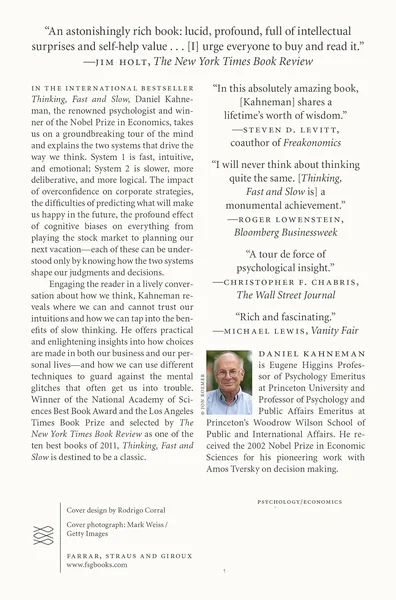
- Readers who enjoy The Tipping Point's blend of behavioral science and narrative case studies will find strong companions in several other big-ideas non-fiction titles. Freakonomics by Steven D. Levitt and Stephen J. Dubner applies economic thinking to surprising social phenomena in a similarly story-driven way. Thinking, Fast and Slow by Daniel Kahneman offers a more rigorous but still accessible exploration of the cognitive systems that shape human decision-making. The Black Swan by Nassim Nicholas Taleb examines the outsized impact of rare, unpredictable events — a natural counterpoint to Gladwell's framework for predictable social epidemics. Gladwell's own Outliers and Blink are direct follow-ons for readers who want to continue in the same vein, as is Made to Stick by Chip Heath and Dan Heath, which builds directly on the Stickiness Factor concept.
- Who should read this?
- The Tipping Point is addressed to anyone curious about how change actually propagates — marketers, public-health communicators, educators, and community organizers will find the framework practically useful, while general readers drawn to big-ideas non-fiction will appreciate the accessible, story-driven presentation. It is particularly well-suited as an introductory text on social dynamics and viral spread, and its vocabulary has become standard shorthand in business and popular culture. Readers with formal social-science or epidemiology backgrounds should approach it as an engaging starting point rather than a scholarly reference, and may want to supplement it with primary academic literature.
- About Malcolm Gladwell
- Malcolm Timothy Gladwell is a British-Canadian journalist, author, and public speaker.
- What are the key concepts?
- The book's central framework rests on three rules: the Law of the Few, the Stickiness Factor, and the Power of Context. The Law of the Few holds that social epidemics are driven disproportionately by three types of unusually gifted people — Connectors (who maintain vast cross-cultural social networks, exemplified by figures like Roger Horchow and Lois Weisberg), Mavens (information brokers), and Salesmen (persuaders). The Stickiness Factor explains why certain messages lodge in memory, using Sesame Street and Blue's Clues as case studies in engineered memorability. The Power of Context argues — drawing on broken-windows theory and New York City's crime decline — that environment shapes behavior far more than individual character.
- What are the book's limitations?
- The book's primary limitation, noted by scholarly critics, is that some of the research it relies on has faced subsequent academic scrutiny — most notably Milgram's small-world experiment, which underpins parts of the Law of the Few. Fast Company reported as early as 2008 that the tipping-point model's predictive reliability had come under challenge. Readers with formal social-science or epidemiology backgrounds may find the framework more narrative than rigorously empirical, and LuvemBooks recommends treating it as a compelling introduction to social dynamics rather than a methodologically definitive reference.
Summarize this book
Follow up
Synthesized from verified book data & published reviews · How we review
Press Enter to ask. Answers come from our editorial Q&A — start typing to see related questions.
Editorial Review
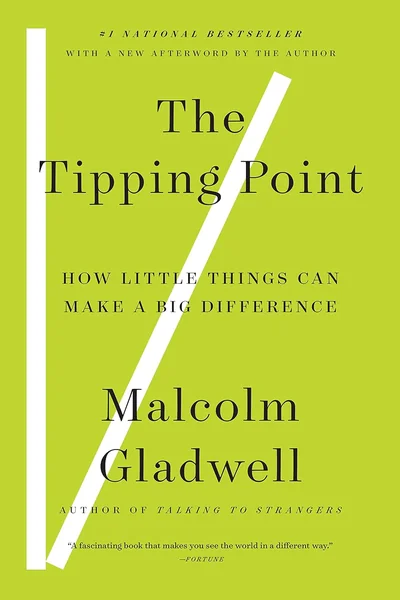
The Tipping Point is Malcolm Gladwell's debut non-fiction book, first published by Little, Brown in 2000, arguing that social epidemics — the sudden spread of ideas, products, and behaviors — obey identifiable rules that anyone can learn to harness. It became a New York Times bestseller and sold 1.…
Read the Full ReviewBooks like The Tipping Point
Curated picks for readers who enjoyed The Tipping Point, with our reasoning for each match.
If you liked The Tipping Point