
BOOKS
Published

Read Time

8 min read

Reader rating

4.4

· 4,600 Amazon ratings
reader ratings, not a LuvemBooks score
Curated & edited by

LuvemBooks Editorial

How we create our reviews →
Share This Review

SuperFreakonomics by Steven D. Levitt & Stephen J. Dubner Review: Provocative Economics, Controversy Included

SuperFreakonomics is the follow-up non-fiction book from University of Chicago economist Steven D. Levitt and New York Times journalist Stephen J. Dubner, applying unconventional economic reasoning to subjects ranging from street prostitution to suicide bombing to climate change — and generating serious pushback from scientists on the latter. This review is based on published sources and reception, not hands-on use of the audiobook.

LuvemBooks Verdict

Best for

Fans of popular social science and behavioural economics who enjoyed Freakonomics and want more data-driven, contrarian takes on everyday human behaviour — delivered in a brisk, accessible audiobook narrated by co-author Dubner himself.

Worth it if

You enjoy having received wisdom challenged by economic analysis and are happy to treat the climate chapter as one provocative perspective to be weighed against expert scientific sources, rather than a definitive account.

Skip if

Readers seeking a scientifically reliable treatment of climate change should look elsewhere — the book's most prominent chapter was publicly disputed by the very scientists it cites, and the broader contrarianism can feel like provocation for its own sake rather than genuine analytical rigour.

Kirkus Reviews called it "jaunty, entertaining and smart," praising Levitt and Dubner for making economics "accessible, even compelling," while The Guardian found the authors "straining for effect rather than coming up with any particularly original insights," hobbled by its attempts to be edgy. The Week highlighted "shoddy statistical work" in places and noted that a climate scientist interviewed for the book's most contentious chapter "has made clear he disagrees" with its conclusions. The CFA Institute's Financial Analysts Journal described it as "a worthy successor" that nonetheless "faces the challenges of most sequels" in meeting high expectations, and the LSE Review of Books praised the illustrated edition as "punchy and vibrant to the final page."

Jaunty, entertaining and smart. Levitt and Dubner do a good service by making economics accessible, even compelling.

Kirkus Reviews

The impression is of authors straining for effect rather than coming up with any particularly original insights.

The Guardian
Sources: Kirkus Reviews, The Guardian, The Week, CFA Institute Financial Analysts Journal, LSE Review of Books
4.4from 4,600 Amazon ratings— reader ratings, not a LuvemBooks score
In This Review
  • What Works & What Doesn't
  • What the Book Is and What It Covers
  • The Authors' Signature Approach
  • The Climate Chapter: Where the Controversy Lives
  • Strengths as a Popular Non-Fiction Work
  • Who This Book Is For

What Works & What Doesn't

What Works
  • Narrated by co-author Stephen J. Dubner, whose journalistic fluency with the material makes it well-suited to the audiobook format
  • Covers a genuinely eclectic range of topics — street economics, terrorism, and geoengineering — in an accessible, fast-moving style
  • At 7 hours and 28 minutes, the unabridged runtime is brisk enough to sustain attention across varied subject matter
  • Extends the contrarian, data-driven framework of the original Freakonomics without requiring readers to have read the first book
What Doesn't
  • The climate change chapter drew pointed, substantive criticism from named scientists — including Elizabeth Kolbert of critical coverage and Ken Caldeira, whose own research the book cites — raising serious questions about its factual accuracy in that section
  • The book's deliberately provocative framing can read as contrarianism for its own sake, which frustrates readers looking for analytical rigour alongside the iconoclasm
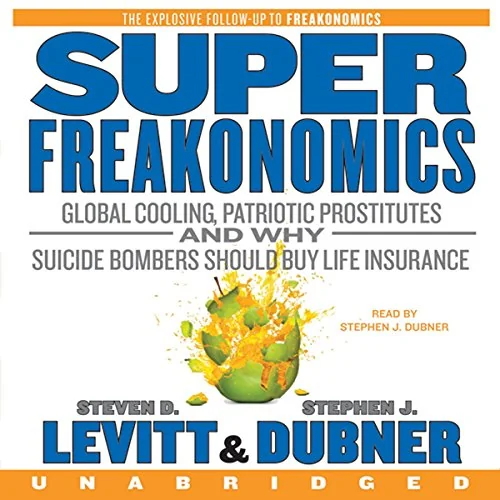
SuperFreakonomics is the kind of book that provokes strong reactions — and in its climate chapter, it generated some of the most substantive scientific criticism levelled at a popular economics title in recent memory.
SuperFreakonomics: Global Cooling, Patriotic Prostitutes, and Why Suicide Bombers Should Buy Life Insurance by Steven D. Levitt, Stephen J. Dubner front cover

What the Book Is and What It Covers

Released on October 20, 2009 in the United States, SuperFreakonomics is the second non-fiction book from the partnership of University of Chicago economist Steven D. Levitt and New York Times journalist Stephen J. Dubner — the team behind the original Freakonomics (2006). Structured around a set of loosely connected case studies, the book applies economic and data-driven thinking to topics that mainstream discourse tends to avoid or romanticise: the economics of street prostitution, the actuarial logic (or lack thereof) that should govern a suicide bomber's financial planning, and the authors' own heterodox take on how humanity might address global cooling and climate change. The audiobook edition, narrated by Dubner himself and running 7 hours and 28 minutes, is unabridged and released through William Morrow.
just about everything they have to say on the topic is, factually speaking, wrong.

The Authors' Signature Approach

Levitt and Dubner built their audience on the premise that economic analysis, applied without ideological or social deference, reveals surprising truths hiding in plain sight. SuperFreakonomics extends that franchise deliberately. As the London School of Economics Blog noted in its coverage of the illustrated edition, the authors "aren't seeking to be vanilla; they're striving to provide unique insights into topics which have highly interesting economic stories attached to them, but which many don't or won't talk about." The result is a book designed to unsettle comfortable assumptions — a posture that wins devoted readers among those who enjoy having received wisdom challenged, and frustrates others who find the contrarianism performative.

The Climate Chapter: Where the Controversy Lives

The book's most contentious section concerns climate change and geoengineering, and the criticism it attracted from scientists was direct and detailed. Elizabeth Kolbert, science writer for critical coverage* and a widely recognised authority on global warming, stated that "just about everything they have to say on the topic is, factually speaking, wrong." Climate scientist Ken Caldeira, whose research the book cites in support of the claim that CO₂ is "not the right villain," disputed that characterisation of his own work — a significant problem for a chapter that leans heavily on his authority. Raymond Pierrehumbert published an open letter to Levitt at RealClimate.org examining the authors' arithmetic on solar photovoltaic options. Whatever one thinks of the book's broader project, these are substantive, named critiques from credentialed scientists — not political grievances — and they bear directly on the accuracy of a central section of the book.
Outside the climate chapter, SuperFreakonomics delivers the accessible, data-curious storytelling that made its predecessor a crossover success. Dubner's narration in the audiobook format is a genuine asset: as a journalist and co-author, he brings both fluency with the material and a conversational ease that suits the book's informal analytical style. The 7-hour-28-minute runtime keeps the pace brisk without feeling truncated. For readers drawn to popular social science — books that use data and economic logic as lenses on human behaviour — the title sits squarely in a well-established and popular genre, and it does not pretend to be a conventional economics textbook.

Who This Book Is For

Readers who came to SuperFreakonomics from Freakonomics will find the sequel consistent in tone, structure, and ambition. Those new to the series can begin here without prior context — each chapter functions independently. The audiobook format, with the author-narrator's direct delivery, suits commuters and listeners who consume non-fiction on the go. However, readers who want a rigorous, scientifically reliable treatment of climate change will find the book's most prominent chapter actively contested by domain experts, and should supplement it accordingly. The book is best understood as a work of popular economic storytelling designed to provoke fresh questions — not as a settled reference on any single topic it covers.

Sources & Further Reading

The key facts and claims in this review are grounded in the retrieved, verified sources listed below.

  1. Cited in this review
  2. 1
  3. 2
  4. 3
  5. Further reading
  6. 4
  7. 5
  8. 6
  9. 7
  10. 8
  11. 9
  12. 10