At a glance

LuvemBooks Verdict
Best for: Readers with a serious appetite for political history, urban studies, or biography who want to understand how institutional power is actually built and abused — and who are prepared to commit to a 1,280-page deep dive into twentieth-century American governance.
Worth it? Skip it? Read the full verdict →Ask LuvemBooks
Was this helpful?
- Is it worth reading?
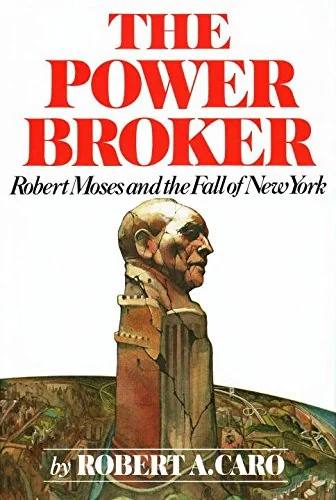
- For readers drawn to political history, urban studies, biography, or the mechanics of institutional power, the case for The Power Broker is exceptionally strong. David Halberstam called it 'surely the greatest book ever written about a city,' and despite its length, critical coverage notes readers find it difficult to put down and describes its themes as 'too timeless to seem dated.' The book won the Pulitzer Prize in 1975, was named one of the Modern Library's hundred greatest nonfiction books of the twentieth century, and has remained a touchstone for city planners and politicians across five decades. The only honest caveat is the approximately 1,280-page length — a genuine barrier for readers seeking a concise introduction.
- Similar books
- Readers who admire The Power Broker tend to gravitate toward other landmark political biographies with the same combination of exhaustive research and narrative momentum. Caro's own Master of the Senate: The Years of Lyndon Johnson applies the same methodology — and the same unsparing analysis of how power is accumulated — to Lyndon Johnson's Senate career. Ron Chernow's Alexander Hamilton offers a similarly sweeping portrait of a foundational American political figure, while David McCullough's John Adams provides a more concise but equally acclaimed study of power and character. Walter Isaacson's Steve Jobs translates the 'visionary who reshapes the world at human cost' template into the twentieth-century technology landscape. The Autobiography of Malcolm X rounds out the group as a canonical American biography dealing with power, identity, and institution-building from a very different vantage point.
- Who should read this?
- The Power Broker is essential reading for anyone seriously interested in political history, urban planning, city government, or the mechanics of institutional power in American democracy. Critical coverage notes that one need not have a particular interest in New York to be gripped by it — the book's central subject, how unelected power is built and wielded, resonates far beyond the city. It will also reward readers drawn to long-form biography and narrative nonfiction written at a novelistic level of detail. The one honest filter is length: at approximately 1,280 pages, it is not a casual pick, and readers looking for a concise introduction to Moses or to Caro should calibrate expectations accordingly.
- About Robert A. Caro
- Robert Allan Caro is an American journalist and author known for his biographies of United States political figures Robert Moses and Lyndon Johnson.
- What are the main themes?
- The Power Broker's dominant theme is the mechanics of institutional power — specifically, how an unelected official can accumulate authority that exceeds that of elected leaders by designing structures (public authorities, construction contracts, patronage networks) that place resources beyond democratic oversight. Equally central is the personal cost of that accumulation: Moses's arc from idealistic progressive reformer to autocrat is Caro's exhibit for how the pursuit of power can corrupt even a figure who began with genuine reformist intent. A third major theme is the human cost of unchecked urban development — the displacement of communities, the systematic subordination of mass transit to automobile infrastructure, and the way the poorest and least politically connected bore the greatest burden of Moses's vision. Critical coverage describes these themes as 'too timeless to seem dated,' and the book's influence on city planners and politicians across five decades bears that out.
- Where should I start with Robert A. Caro?
- For most readers, The Power Broker is the natural starting point — it is Caro's most famous work, stands completely on its own, and serves as the fullest demonstration of his method. Readers who finish it wanting more of the same approach can move to the multi-volume Years of Lyndon Johnson series, of which Master of the Senate is one installment; LuvemBooks has reviewed that volume for readers ready to make the transition. The London Sunday Times has called Caro 'the greatest political biographer of our times,' a verdict that applies equally to both subjects.
Summarize this book
Follow up
Synthesized from verified book data & published reviews · How we review
Press Enter to ask. Answers come from our editorial Q&A — start typing to see related questions.
Age & Reading Level
Recommended age
Adult
Reading level
Adult
2 content notes · who it suits
Content to know about
Skip if you want a concise, fast-paced read — at approximately 1,280 pages, the book demands exceptional time and commitment.
Editorial Review
Robert A. Caro's biography of Robert Moses is a Pulitzer Prize-winning, Modern Library–ranked landmark that traces how one unelected bureaucrat accumulated more power than the Mayor or Governor of New York — and used it to reshape an entire city, often at enormous human cost.…
Read the Full ReviewBooks like The Power Broker
Curated picks for readers who enjoyed The Power Broker, with our reasoning for each match.
More by Robert A Caro
If you liked The Power Broker