A Visual Approach to Self-Improvement
Is Personal Development: 50 Bestsellers in Infographics worth reading for busy professionals seeking rapid insights? Ivi Green's ambitious compilation attempts to distill half a century of self-help wisdom into digestible visual formats. The concept addresses a genuine market need—time-strapped readers who want core concepts without wading through hundreds of pages of traditional prose.
This personal development infographics book review reveals both the strengths and limitations of condensing complex psychological and business concepts into charts, diagrams, and visual summaries. Unlike comprehensive works such as Atomic Habits or The 7 Habits of Highly Effective People, Green's approach prioritizes accessibility over depth, making it a fundamentally different reading experience.
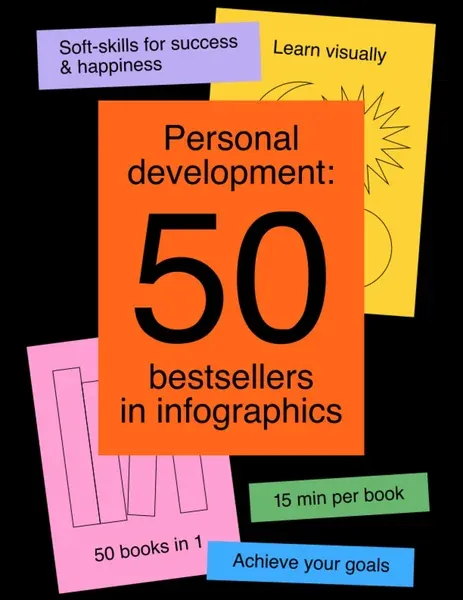
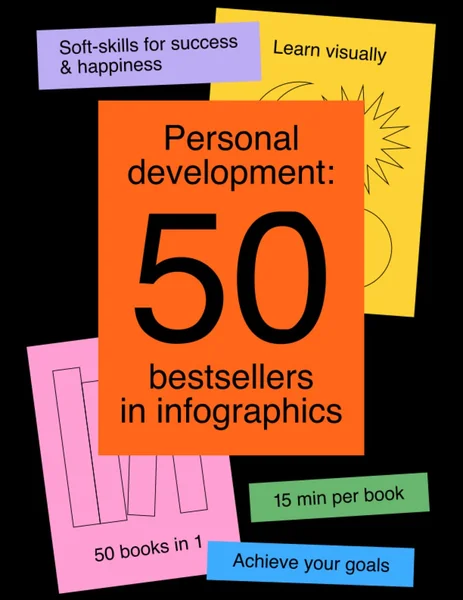
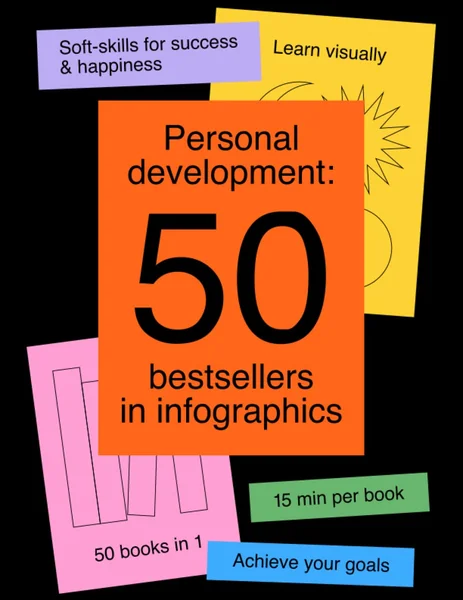
The book's colorful geometric cover design immediately signals its visual-first philosophy, promising readers a departure from text-heavy self-improvement manuals. However, the question remains whether infographics can effectively convey the nuanced insights that made these fifty books bestsellers in the first place.
Green's Visual Communication Strategy
The author employs a systematic approach to visual information design, transforming abstract concepts into concrete visual elements. Each book summary receives dedicated infographic treatment, utilizing consistent design principles that enhance comprehension and retention. The visual hierarchy guides readers through key concepts using color coding, flowcharts, and statistical representations.
Green demonstrates understanding of cognitive load theory, breaking complex ideas into manageable visual chunks. The infographic format forces concision, eliminating verbose explanations that often obscure core principles in traditional self-help literature. For visual learners, this approach can accelerate understanding and improve recall compared to linear text processing.
However, the visual translation process inevitably involves editorial choices about which concepts deserve emphasis. Green's interpretations may not align with every reader's understanding of the source material, creating potential gaps between the original authors' intentions and the simplified presentations.
Content Coverage and Selection Criteria
The fifty-book selection spans decades of self-improvement literature, from classic works to contemporary bestsellers. Green includes foundational texts alongside modern behavioral science approaches, creating a comprehensive survey of the personal development landscape. The main strength lies in exposing readers to diverse philosophical and practical approaches they might otherwise overlook.
Each summary attempts to capture essential frameworks, actionable strategies, and core insights. The infographic treatment works particularly well for books with inherent visual elements—productivity systems, habit formation models, and decision-making frameworks translate naturally to graphic representation. Books heavy on narrative or philosophical exploration prove more challenging to condense effectively.
The compilation format allows readers to compare approaches across different authors and methodologies. Unlike most personal development books, this creates opportunities for synthesis and cross-pollination of ideas that might not emerge from reading individual titles in isolation.
The infographic approach succeeds brilliantly with certain types of content. Process-oriented concepts, statistical insights, and systematic frameworks benefit from visual presentation. Readers can quickly grasp cause-and-effect relationships, comparative analyses, and step-by-step procedures that might require multiple readings in traditional text format.
The main weakness emerges with content requiring emotional resonance or complex contextual understanding. Personal anecdotes, case studies, and nuanced arguments lose impact when reduced to bullet points and diagrams. The visual format struggles to convey the persuasive storytelling that makes many bestsellers compelling and memorable.
Additionally, the condensation process necessarily eliminates supporting evidence, detailed explanations, and qualifying statements that provide crucial context. Readers gain broad exposure but may develop incomplete or oversimplified understanding of sophisticated concepts that require deeper engagement.
Practical Value for Different Learning Styles
Perfect for visual learners who struggle with traditional text-heavy self-improvement books, this compilation offers genuine accessibility benefits. The format accommodates busy schedules, allowing readers to absorb key insights during brief reading sessions. The visual memory aids can enhance retention compared to linear note-taking from conventional books.
For experienced readers familiar with personal development literature, the book serves as an effective review and synthesis tool. It can refresh memory of previously read works and highlight connections between different authors' approaches. However, newcomers to self-improvement may find the condensed format insufficient for developing genuine understanding or motivation for implementation.
The book functions best as a reconnaissance tool—helping readers identify which full-length works deserve their complete attention. The bottom line: it complements rather than replaces comprehensive reading, serving as both introduction and review resource depending on the reader's experience level.