BOOKS
Published
Read Time
5 min read
Our Rating
4
An excellently illustrated guide that makes complex mechanical concepts accessible through visual learning, though some examples feel dated despite the revised edition.
Reviewed by
LuvemBooks
Share This Review
The Way Things Work by David Macaulay: Visual Learning Guide - Review
Our Rating
4
An excellently illustrated guide that makes complex mechanical concepts accessible through visual learning, though some examples feel dated despite the revised edition.
In This Review
- What Works & What Doesn't
- Illustrations That Actually Teach
- Making the Complex Simple
- Educational Value Across Ages
- Where It Shows Its Age
- A Visual Learning Investment
What Works & What Doesn't
What Works
- Outstanding illustrations that truly teach rather than just decorate
- Accessible to multiple age groups with different learning needs
- Transforms complex engineering concepts into understandable explanations
- Encourages curiosity about everyday objects and how they function
- Visual approach works well for readers who struggle with text-heavy explanations
What Doesn't
- Some examples feel dated despite being a "newly revised" edition
- Limited coverage of modern digital and electronic technologies
- Text explanations sometimes feel minimal compared to illustrations
- Focus on mechanical systems may not satisfy readers interested in current technology
Illustrations That Actually Teach
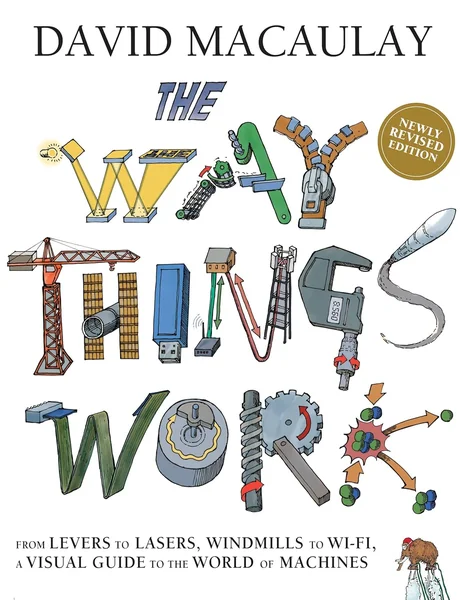
The rare illustrated reference that earns its place on the shelf through specifics, not status — David Macaulay's cross-sections and sequential diagrams do genuine explanatory work that prose alone cannot. Each mechanism gets dissected through carefully crafted illustrations that reveal internal workings usually hidden from view. Cross-sections show how a refrigerator maintains cold temperatures, while sequential diagrams demonstrate how a car engine converts fuel into motion.
The illustrations aren't merely decorative—they serve as the primary teaching tool. Complex concepts like hydraulics, pneumatics, and electrical circuits become comprehensible through detailed visual breakdowns. The artistic style balances technical accuracy with accessibility, avoiding both oversimplification and intimidating complexity.
Making the Complex Simple
The book excels at breaking down intimidating subjects into digestible explanations. Topics that might overwhelm readers in traditional engineering texts become approachable through the visual format. The progression from simple machines (levers, pulleys, wedges) to complex systems (computers, jet engines, nuclear reactors) follows a logical learning curve.
Each explanation builds on previously established concepts, creating a foundation that supports more advanced understanding. The book doesn't assume prior technical knowledge, making it accessible to curious beginners while remaining informative for readers with some mechanical background.
Educational Value Across Ages
This book works for multiple age groups, though in different ways. Younger readers (ages 8-12) can focus on the illustrations and basic concepts, while teenagers and adults can engage with the more detailed explanations and technical terminology. The visual approach means readers can extract value appropriate to their comprehension level.
Parents and educators appreciate how it sparks curiosity about everyday objects. Children who typically ignore how their bicycle works might become fascinated after seeing the detailed gear and brake illustrations. The book transforms mundane items into interesting puzzles worth understanding.
Where It Shows Its Age
Despite being a revised edition, some sections feel dated. The focus on mechanical systems, while foundational, doesn't adequately address modern technology like smartphones, solar panels, or electric vehicles. Young readers might wonder why their tablet doesn't get the same detailed treatment as a typewriter.
The main weakness lies in its limited coverage of contemporary innovations. The mechanical principles remain relevant, but specific examples sometimes feel like museum pieces. A truly modern revision would balance timeless principles with current applications.
The text can also feel secondary to the illustrations, sometimes providing minimal explanation for complex concepts. Readers seeking deeper theoretical understanding might find themselves wanting more detailed explanations alongside the visual elements.
A Visual Learning Investment
For families with curious kids or adults who learn better through pictures than text, this book delivers exceptional value. It makes abstract engineering concrete — a refrigerator's cooling cycle, a jet engine's thrust sequence — in ways that stick precisely because you can see the mechanism moving on the page.
If you want a single volume that answers "how does that work?" for nearly anything in your house or garage, this earns its shelf space — the Amazon link in the sidebar has the current price.
Related Reviews
Reviews of books we picked for readers who enjoyed The Way Things Work.