
BOOKS
Published
Read Time
6 min read
Our Rating
3.5
A warmly observed but unevenly paced travel memoir that distinguishes itself through its trio structure and honest portrayal of female friendship under pressure.
Most rewarding for readers navigating their own quarter-life transitions, though the book's broad scope occasionally dilutes its emotional depth.
Reviewed by
LuvemBooks
Share This Review
The Lost Girls by Jennifer Baggett Review: Quarter-Life Crisis
Our Rating
3.5
A warmly observed but unevenly paced travel memoir that distinguishes itself through its trio structure and honest portrayal of female friendship under pressure. Most rewarding for readers navigating their own quarter-life transitions, though the book's broad scope occasionally dilutes its emotional depth.
In This Review
- What Works & What Doesn't
- Three Voices, One Journey
- The Quarter-Life Crisis as Narrative Engine
- Prose, Pacing, and the Problem of Scale
- Friendship as the Real Subject
- Who This Book Is For
- Where to Buy
What Works & What Doesn't
What Works
- Distinctive trio-narrator structure offers a more honest, multivocal account than typical solo memoirs
- Genuine emotional ambiguity — the book resists tidy resolution in ways that feel true
- Friendship dynamics portrayed with unusual candor, including conflict and self-doubt
- Strong thematic focus on quarter-life paralysis that resonates well beyond its travel context
What Doesn't
- Uneven pacing across four continents; some sections feel like travelogue rather than memoir
- The prose rarely rises to the lyrical standard the best travel writing demands
- Three competing voices occasionally crowd out the quieter, more affecting moments
Three Voices, One Journey
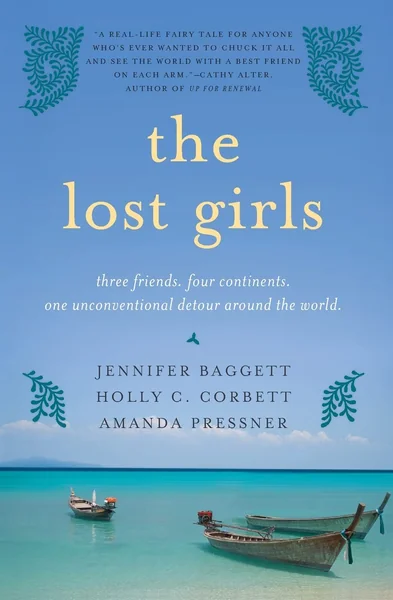
An honest, polyphonic travel memoir that earns its warmth through friction rather than resolution. Jennifer Baggett's The Lost Girls is a travel memoir co-written with Holly C. Corbett and Amanda Pressner, each contributing her own perspective to the unfolding narrative. The result is a memoir that reads more like a polyphonic conversation than a solo confession. Readers who come expecting the introspective depth of a single-narrator travel memoir may find this approach initially disorienting. Those who appreciate the texture of real friendship — the negotiation, the friction, the loyalty — will find it more honest.
Baggett, Corbett, and Pressner's voices are distinct enough to track across continents. One carries more professional anxiety, another grapples more openly with romantic uncertainty, and the third tends to anchor the group's momentum. The book doesn't over-explain these differences, which is to its credit. The characterization emerges through accumulated decision-making rather than expository summary.
The Quarter-Life Crisis as Narrative Engine
Jennifer Baggett and her co-authors frame their departure not as recklessness but as a deliberate attempt to interrogate assumptions before they calcify into permanent life architecture. The memoir is fundamentally an examination of a specific kind of early-adulthood paralysis: the sense that a conventional path — career ladder, relationship milestones, apartment lease — has been accepted rather than chosen.
This is the book's most resonant theme, and it lands with particular force for readers in their late twenties or early thirties who recognize the creeping unease the authors describe. The travel itself — spanning four continents — functions less as the point and more as the pressure-testing environment. What changes isn't the destination but the travelers' relationship to their own expectations.
Where the memoir earns genuine respect is in its refusal to package this transformation too neatly. The self-discovery isn't complete by the final chapter. The women return to lives that must now be rebuilt rather than simply resumed, and that ambiguity feels truer to the experience than a triumphant resolution would.
Prose, Pacing, and the Problem of Scale
The writing across Jennifer Baggett's book is readable and occasionally vivid, though it rarely achieves the lyrical intensity that the best travel writing demands. The prose is clean, the scene-setting functional, and the pacing generally reliable. Where the book struggles is in sustaining momentum across four continents and an extended period of travel. Some sections breathe with genuine emotional specificity. Others feel compressed into travelogue mode, cataloguing experiences rather than excavating them.
The format also creates an uneven distribution of depth. Certain stretches carry enough weight to justify their length. Others feel like connective tissue, present because the chronology demands it rather than because the insight does. A tighter editorial hand could have sharpened the book considerably without sacrificing its essential character.
This is the main weakness: the sheer scope of the journey sometimes works against the intimacy that makes personal memoirs memorable. When three voices are competing for space across four continents, some of the quieter emotional moments get crowded out.
Friendship as the Real Subject
Strip away the itinerary, and The Lost Girls — Jennifer Baggett's memoir — is ultimately a book about what friendship looks like under sustained pressure. The three women argue, support each other, withdraw, reconnect, and occasionally question whether the whole enterprise was wise. These interpersonal dynamics are handled with more honesty than the genre typically allows.
The book doesn't romanticize female friendship. It acknowledges that proximity and shared crisis can fracture relationships as readily as it can deepen them. This is the narrative thread that holds the book together across its more episodic sections, and it's what distinguishes it from a straightforward gap-year account.
Readers who have navigated long-term friendships through significant life transitions will likely find this dimension of the book the most affecting. It's also the dimension that ages best — the specific cultural encounters date the book in ways that the emotional dynamics do not.
Who This Book Is For
The Lost Girls works best for readers who are either at a crossroads themselves or who have recently emerged from one. It speaks most directly to women in their late twenties and early thirties wrestling with the gap between expected and chosen lives. That audience will find Baggett, Corbett, and Pressner's account validating, occasionally inspiring, and — crucially — honest enough to earn that validation.
Readers seeking purely lyrical travel writing may find it insufficient. Readers expecting the raw psychological excavation of a single-narrator memoir may find the trio format diffuses the intensity they're after. But as a record of what it looks like when three real people bet on their own growth and navigate the messy outcomes together, Jennifer Baggett's The Lost Girls holds up.
The book's jacket presents it as a detour. In practice, it functions more as a reckoning — imperfectly written, genuinely felt, and more self-aware than its genre usually requires.
Where to Buy
If you're in your late twenties or early thirties and suspect you've accepted a life rather than chosen one, this is the memoir to pick up — the Amazon link in the sidebar has the current price.