BOOKS
Published

Read Time

3 min read

Curated & edited by

LuvemBooks Editorial

How we create our reviews →
Share This Review

Smarter Homes by Alexandra Deschamps-Sonsino Review: A Thoughtful Industry Guide for IoT Designers

Smarter Homes: How Technology Will Change Your Home Life is a 2018 non-fiction industry guide by interaction designer and IoT thought leader Alexandra Deschamps-Sonsino, published by Apress, that traces the history of smart home technology and critically examines how consumer products for the connected home are designed, marketed, and shaped by dominant players such as Amazon, Google, and Apple — aimed squarely at product designers, R&D professionals, and trends researchers.

LuvemBooks Verdict

Best for

Product designers, R&D professionals, trends researchers, and IoT entrepreneurs who want a historically and culturally grounded framework for developing connected-home products — rather than another technical implementation guide.

Worth it if

You work in smart home product development or IoT trends research and want to understand the cultural, social, and design-ethics context that dominant platforms like Amazon, Google, and Apple have largely bypassed.

Skip if

You're a general consumer looking for practical advice on choosing, installing, or setting up smart home devices — this book offers strategic and contextual analysis, not product recommendations or setup guidance.

A reviewer at codecentric.de praised the book for helping "smart home enthusiasts make up their own minds by providing the socio-economic, historical, architectural and aesthetic context, thus filling significant knowledge gaps," while iyarweb.wordpress.com, reporting from an IoT Hessen meetup where Deschamps-Sonsino presented the book, offered a contemporaneous account of its reception among IoT practitioners.

Sources: codecentric.de, iyarweb.wordpress.com
In This Review
  • What Works & What Doesn't
  • What the Book Actually Is and Argues
  • Scope and Structure
  • Strengths: Credentials, Context, and Critical Perspective
  • Limitations and Audience Fit
  • Relevance and Who Will Benefit Most

What Works & What Doesn't

What Works
  • Written by a verified IoT industry leader — ranked first among 100 IoT Influencers by Postscapes in 2016 — giving the analysis real practitioner authority
  • Room-by-room structure (living room, kitchen, bathroom, garage, garden, and more) makes it easy to navigate toward the most relevant spaces and use cases
  • Goes beyond technical specs to address cultural, social, and design-ethics dimensions of smart home development, including sections on assistive technologies and digital responsibility
  • Explicitly critiques the industry's copy-paste dependency on Amazon, Google, and Apple, offering a more historically and culturally grounded framework for product development
What Doesn't
  • Designed for product designers, R&D professionals, and trends researchers — general consumers seeking practical smart home setup advice will find limited utility here
  • Published in 2018, so specific product references and the competitive landscape it describes reflect that era's market; readers should weigh time-sensitive details accordingly
A focused, critically minded industry guide, Smarter Homes makes the case that understanding history and cultural context is the essential first step for anyone building products for the connected home.

What the Book Actually Is and Argues

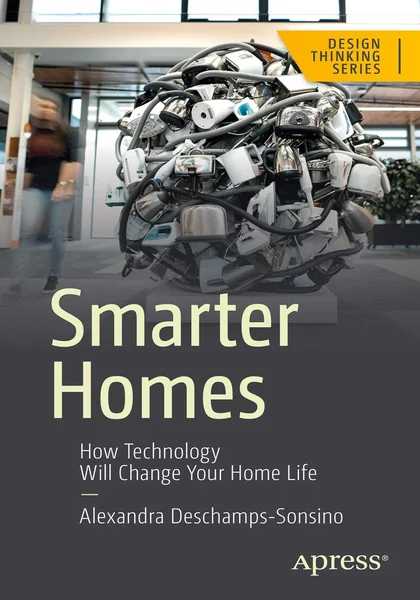
Smarter Homes: How Technology Will Change Your Home Life (Design Thinking) by Alexandra Deschamps-Sonsino front cover
Smarter Homes: How Technology Will Change Your Home Life is a non-fiction industry guide, not a consumer how-to manual. Published by Apress in 2018, it is written by Alexandra Deschamps-Sonsino — an interaction designer, product designer, consultant, and entrepreneur whose work has been exhibited at the Museum of Modern Art in New York, the Victoria & Albert Museum, and the London Design Museum. The book's central argument, as stated in its own publisher description, is that product developers working in the smart home space have largely operated with a copy-paste mindset, following the lead of larger businesses such as Amazon, Google, and Apple rather than drawing on deeper historical and cultural wellsprings. Deschamps-Sonsino sets out to correct that by presenting the history of smart homes alongside the many players — from science fiction writing and the entertainment industry to modern interior design and architecture movements — that have shaped collective aspirations around the connected home.

Scope and Structure

The book is organized room by room and theme by theme, giving it a practical architecture that mirrors how people actually inhabit their homes. Chapters move through the living room (covering picture frames, radios, sound systems, televisions, and thermostats), the children's bedroom, the master bedroom, the kitchen, the bathroom, the entrance, doors, cameras, the garage, and the garden. Beyond the domestic tour, the book broadens into emerging themes: sections titled "Living As a Service," "The New Bohemians," "The Nagging Home," and "Assistive Technologies" signal that Deschamps-Sonsino is interested in social and cultural dimensions of smart home technology, not merely its technical specifications. A concluding chapter on "Digital Responsibility" and "Creative Criticism" reinforces the book's design-ethics orientation. This structure makes it straightforward for readers to navigate toward the spaces and questions most relevant to their own work.

Strengths: Credentials, Context, and Critical Perspective

Deschamps-Sonsino brings verifiable authority to this subject. She was named first in Postscapes' 2016 list of 100 Internet of Things Influencers, and her company Tinker was the first distributor of the Arduino platform in the United Kingdom — credentials that ground her analysis in hands-on industry experience rather than academic speculation. The book's stated learning outcomes reflect genuine breadth: readers are directed to understand the historical context for current smart home products, review the social dimensions of home product development, discover new technologies being developed or already available, and track industry behaviors that may affect longer-term market trends for consumer products. That the book explicitly asks product developers to look beyond dominant platforms and toward cultural, artistic, and design history is a distinguishing feature in a field where most writing focuses narrowly on technical implementation.

Limitations and Audience Fit

The book is explicitly addressed to a professional and semi-professional audience: product designers, R&D teams, trends researchers, and business owners exploring IoT opportunities. General consumers curious about setting up a smart home will find little practical installation or purchasing guidance here. The book's value is strategic and contextual rather than instructional. Additionally, the smart home space moves quickly, and a guide published in 2018 — however carefully researched — reflects the product landscape and dominant platforms of that moment; readers should approach specific product references with that temporal context in mind. Some readers may also note that the book's critical stance toward the copy-paste culture of the industry, while intellectually valuable, is more diagnostic than prescriptive: it is stronger on identifying the problem than on charting a precise path forward for individual product teams.

Relevance and Who Will Benefit Most

Despite its 2018 publication date, the foundational questions Smarter Homes raises — about how cultural history, social behavior, and design ethics should inform connected-product development — remain as relevant as the ongoing expansion of the IoT sector itself. The publisher positions the book as a resource for anyone working in product design and development who wants to understand what has been done before and identify avenues for future development. For that audience, Deschamps-Sonsino's room-by-room framework combined with her thematic chapters on emerging trends offers a rare synthesis of historical grounding and forward-looking industry analysis. Readers in trends research, in particular, will find the sections on "Living As a Service" and "Assistive Technologies" a useful conceptual scaffold for thinking about where the smart home market is heading beyond the current generation of voice-assistant-anchored devices.

Sources & Further Reading

The key facts and claims in this review are grounded in the retrieved, verified sources listed below.

  1. Cited in this review
  2. 1
  3. Further reading
  4. 2
  5. 3
  6. 4
  7. 5
  8. 6