BOOKS
Published

Read Time

9 min read

Reader rating

4.6

· 104,920 Amazon ratings
reader ratings, not a LuvemBooks score
Curated & edited by

LuvemBooks Editorial

How we create our reviews →
Share This Review

James by Percival Everett Review: A Pulitzer-Winning Reimagining of an American Classic

Percival Everett's James is a #1 New York Times bestselling novel that retells Adventures of Huckleberry Finn from the perspective of the enslaved Jim — renamed and reclaimed as James — sweeping the 2024–2025 awards circuit with the Pulitzer Prize for Fiction, the National Book Award, and the Kirkus Prize, among other major honors. This review is based on published reception and source materials, not hands-on reading.

LuvemBooks Verdict

Best for

Readers of literary fiction and Black American literature — particularly those familiar with Adventures of Huckleberry Finn — who want to engage with one of the most awarded and critically discussed American novels of the mid-2020s.

Worth it if

You're drawn to formally ambitious, intertextually rich fiction that uses dark humor and narrative inversion to reframe how American literature has historically distributed consciousness, sympathy, and voice.

Skip if

You're unfamiliar with Adventures of Huckleberry Finn and unwilling to engage with its source material, or you're looking for a light, straightforward adventure narrative rather than a layered, demanding literary reckoning with American slavery.

Kirkus Reviews awarded the novel a starred review, describing Everett as "audacious and prolific" in shifting the central viewpoint to the "more enigmatic and heroic Jim." The Los Angeles Review of Books highlights the novel's core formal invention — that James performs ignorance for white society while the reader is admitted to his full intelligence — as its defining structural achievement. The book's awards record, noted across sources including pulitzer.org and penguinrandomhouse.com, is extraordinary: winner of the 2025 Pulitzer Prize for Fiction, the 2024 National Book Award, and the Kirkus Prize, as well as a #1 New York Times bestseller.

Audacious and prolific, Everett dives into the very heart of Twain's epochal odyssey, shifting the viewpoint to the more enigmatic and heroic Jim.

Kirkus Reviews
Sources: Kirkus Reviews, Los Angeles Review of Books, Pulitzer Prize, Penguin Random House
4.6from 104,920 Amazon ratings— reader ratings, not a LuvemBooks score

Look inside the book

Preview the actual pages, via Google Books
In This Review
  • What Works & What Doesn't
  • What the Novel Actually Is and Does
  • The Central Argument and Its Stakes
  • Critical Reception and Awards Significance
  • Strengths: Voice, Intertextuality, and Satirical Force
  • Who This Novel Is For — and Where It Challenges

What Works & What Doesn't

What Works
  • Winner of the Pulitzer Prize for Fiction, the National Book Award, and the Kirkus Prize — one of the most decorated American novels in recent years
  • Restores full interiority and agency to Jim — renamed James — a character long marginalized in one of American literature's most debated classics
  • Jonathan Lethem praised it as an 'irrevocable intervention into the canon,' engaging not only Twain but Melville, Ellison, and Kafka
  • Critics called it 'Genius,' and it was named a best book of the year by critical coverage, The New Yorker, The Atlantic, TIME, and more
  • Blends dark humor with harrowing subject matter in a way the publisher describes as both 'action-packed' and satirically incisive
What Doesn't
  • Readers unfamiliar with Adventures of Huckleberry Finn will miss the full force of Everett's inversions and intertextual play
  • The novel's formal ambition and layered engagement with American literary history demand active, attentive reading — it is not a light or casual narrative experience
James is a bold, celebrated literary novel — not a how-to or reference work — and this review draws on published critical sources and the public record rather than a personal read.
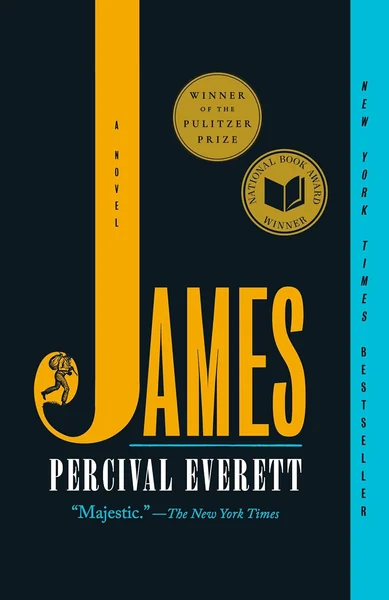
James (Pulitzer Prize Winner): A Novel by Percival Everett front cover

What the Novel Actually Is and Does

James is Percival Everett's reimagining of Mark Twain's Adventures of Huckleberry Finn, told not from the perspective of Huck but from that of his companion on the river: the enslaved man known in Twain's novel as Jim, here fully named and foregrounded as James. Published by Doubleday in 2024 — with a Vintage paperback edition following in April 2026 — the novel restores James's interiority, agency, and voice to a character who, in Twain's original, exists largely as a supporting figure in someone else's coming-of-age story. The Penguin Random House reading guide describes the book as "an electrifying reimagination of Adventures of Huckleberry Finn told through the piercing perspective of the enslaved Jim," and frames it as a novel about freedom, family, and adventure. Everett, a Distinguished Professor of English at USC and the author of previous acclaimed works including Erasure and I Am Not Sidney Poitier, brings both scholarly command of American literary tradition and his own distinctive satirical voice to the project.
enlists and devours not only Mark Twain's novel but aspects of Melville, Ellison, and even Kafka to make an irrevocable intervention into the canon

The Central Argument and Its Stakes

Where Twain's novel places the moral education of a white boy at its center, Everett's version demands that readers reckon with what James sees, knows, and strategically conceals. The novel is described by its publisher as "both harrowing and darkly humorous," a pairing that reflects Everett's signature mode: using comedy and formal invention not to soften the violence of American slavery but to expose it from an angle that realism alone cannot reach. The title itself — a single, dignified proper name — signals the novel's core act of restoration. By centering James rather than Huck, Everett makes a pointed intervention into how American literature has historically distributed consciousness and sympathy.

Critical Reception and Awards Significance

The novel's awards record is extraordinary by any measure. James won the 2025 Pulitzer Prize for Fiction, the 2024 National Book Award for Fiction, and the 2024 Kirkus Prize. It was shortlisted for the Booker Prize and was a finalist for the National Book Critics Circle Award. It was also named a best book of the year by The New York Times Book Review, The New Yorker, critical coverage, The Economist, TIME, and critical coverage, among others. Critics called it "Genius." Novelist Jonathan Lethem, writing in a source retrieved from Penguin Random House, called the book a work that "enlists and devours not only Mark Twain's novel but aspects of Melville, Ellison, and even Kafka to make an irrevocable intervention into the canon," adding that "Everett is simply playing this game at a higher level, and it is the most serious game imaginable." The novel also became a #1 New York Times bestseller and is in development as a feature film to be produced by Steven Spielberg.

Strengths: Voice, Intertextuality, and Satirical Force

Critical commentary consistently highlights two interlocking strengths. The first is Everett's handling of James's voice — a perspective that is knowing, layered, and strategically double-faced, as James must navigate the performance of ignorance that white society demands of him while the reader is admitted to his full intelligence. The second is the novel's reach across American literary history: as Lethem's commentary makes clear, Everett is not simply in dialogue with Twain but with Melville, Ralph Ellison, and Kafka as well, making James a work of dense intertextual ambition. The publisher describes it as combining "the satirical force of Mark Twain" with "incisive commentary on race in America that is uniquely his own" — a description that positions the novel as both an homage and a departure.

Who This Novel Is For — and Where It Challenges

James is ideally suited to readers with some familiarity with Adventures of Huckleberry Finn, as the novel's inversions and ironies resonate most fully against the original. Its "harrowing" dimension — the lived reality of slavery that Twain's novel largely filtered through a child's limited vision — means the book does not offer the lightness that Twain's picaresque sometimes does, even as its dark humor is a consistent presence. Readers who come expecting a straightforward adventure story may find Everett's formal and thematic ambitions require active engagement. For readers of contemporary literary fiction, Black American literature in the tradition of Ellison and Toni Morrison, or serious revisionist historical novels, James represents one of the most decorated and discussed American novels of the mid-2020s — a work that the awards record and major critical consensus mark as a genuine landmark.

Sources & Further Reading

The key facts and claims in this review are grounded in the retrieved, verified sources listed below.

  1. Cited in this review
  2. 1
  3. 2
  4. Further reading
  5. 3

    Percival Everett, Wikipedia

  6. 4
  7. 5
  8. 6
  9. 7
  10. 8
  11. 9
  12. 10
  13. 11