
BOOKS
Published
Read Time
5 min read
Our Rating
4.5
Reviewed by
LuvemBooks
Share This Review
SuperSummary Study Guide: Rise and Fall of Third Reich Review
Our Rating
4.5
A solid companion that enhances understanding of Shirer's monumental work without oversimplifying its complexity, though it inherits some limitations from its 1960s source material.
In This Review
- Breaking Down a Historical Monument
- Analysis Tools and Historical Context
- Key Figures in Nazi History
- Strengths and Notable Limitations
- A Practical Academic Companion
A rigorous companion to a landmark work — though it earns that status by organizing Shirer's 1,100 pages rather than deepening them. SuperSummary's study guide for William L. Shirer's The Rise and Fall of the Third Reich is a useful organizational tool for readers tackling one of history's most comprehensive accounts of Nazi Germany, but it adds scaffolding where serious readers might want scholarship. Given that Shirer's original work spans over 1,100 pages of dense historical analysis, the question becomes whether this companion guide genuinely enhances comprehension or simply repackages what dedicated readers could glean themselves.
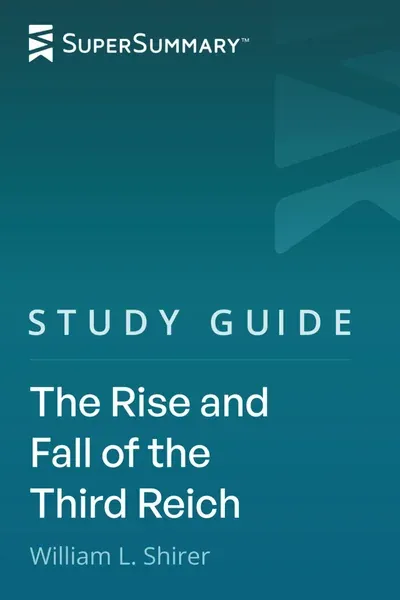
The teal geometric cover design reflects SuperSummary's consistent branding approach, presenting a clean, academic aesthetic that signals serious scholarly intent. This visual simplicity contrasts sharply with the complex historical narrative it seeks to illuminate, suggesting an attempt to make daunting material more approachable.
Breaking Down a Historical Monument
SuperSummary approaches Shirer's exhaustive chronicle by organizing the material into digestible sections that mirror the original's structure while highlighting key themes and turning points. The guide tackles the enormous scope of Shirer's work—from the early days of the Nazi party through the final collapse in 1945—by creating clear thematic frameworks that help readers navigate the chronological complexity.
The strength of this approach lies in its recognition that Shirer's original presents both opportunities and challenges for modern readers. While Shirer had unprecedented access to Nazi documents and witnessed many events firsthand as a correspondent, his work also reflects the perspectives and limitations of its era. The study guide acknowledges these nuances without overwhelming readers with historiographical debates.
Analysis Tools and Historical Context
Where this guide distinguishes itself from simple chapter summaries is in its analytical framework. Rather than merely recapping events, it provides tools for understanding Shirer's methodology, his use of primary sources, and the significance of his eyewitness perspective. The guide helps readers distinguish between Shirer's firsthand observations and his later historical analysis, a crucial distinction often lost on casual readers.
The biographical context surrounding Shirer himself receives appropriate attention. His position as CBS correspondent in Berlin from 1934 to 1940 granted him unique access to Nazi leadership and German society during the regime's rise. This guide effectively explains how Shirer's journalistic background shaped both the strengths and potential blind spots in his historical approach.
Key Figures in Nazi History
The guide provides essential background on the major figures in Shirer's narrative, from Hitler and his inner circle to the military leaders, industrialists, and ordinary Germans who enabled the regime's rise. Rather than creating simplified character sketches, it contextualizes figures such as Göring, Himmler, and the Wehrmacht high command within the larger political and social forces that Shirer documents.
Particularly valuable is the guide's treatment of the complex relationships between Nazi leadership, German military command, and civilian populations. Shirer's original work sometimes struggles with the sheer number of personalities and competing power structures, making this organizational assistance genuinely helpful for readers trying to track the intricate political maneuvering that characterized the Third Reich.
Strengths and Notable Limitations
The guide makes Shirer's massive work more accessible without flattening its historical complexity. It offers concrete help for understanding the economic conditions that fueled the Nazi rise, the political machinery that sustained it, and the social pressures that silenced opposition — keeping readers oriented inside Shirer's sometimes overwhelming detail without reducing his argument to bullet points.
However, the guide inherits some limitations from its source material. Shirer's work, groundbreaking for its time, reflects certain biases and gaps that subsequent scholarship has addressed. The guide acknowledges these limitations but doesn't explain how historical understanding of the Nazi period has moved since Shirer's 1960 publication — leaving readers without a clear sense of where the field now stands.
Additionally, readers seeking a completely objective historical primer might find both Shirer's original work and this companion colored by the author's personal experiences and the moral urgency of his firsthand witness to Nazi crimes.
A Practical Academic Companion
This SuperSummary guide functions best as a supplementary tool rather than a standalone resource. Students approaching Shirer's work for academic courses will find the organizational structure and analytical frameworks genuinely useful. The guide doesn't replace careful reading of the original but provides scaffolding that makes that reading more productive.
For general readers intimidated by Shirer's length and density, this companion offers a realistic assessment of what they'll encounter and tools for engaging meaningfully with the material. Those seeking a quick substitute for reading Shirer himself will find this approach insufficient — the guide assumes and requires engagement with the primary text.
Readers working through Shirer's 1,100 pages for a course or serious self-study will get the most out of this guide — check the Amazon link in the sidebar for the current price.
Product Gallery

Frequently Asked Questions
Is Study Guide: The Rise and Fall of the Third Reich by William L. Shirer (SuperSummary) worth reading in 2026?
Based on my 4.5/5 rating, this study guide is absolutely worth it for students and readers tackling Shirer's massive 1,200-page historical work. It provides essential chapter summaries, character analysis, and thematic breakdowns that make navigating this complex historical narrative much more manageable in today's academic environment.
Who should read Study Guide: The Rise and Fall of the Third Reich by William L. Shirer (SuperSummary)?
This guide is perfect for history students, book club members, and anyone attempting to read Shirer's comprehensive Nazi Germany chronicle. It's particularly valuable for those who want to ensure they grasp the key historical themes and connections without getting lost in the extensive details of the original text.
How does SuperSummary's Third Reich study guide compare to other World War II study resources?
SuperSummary's guide stands out for its structured approach to Shirer's specific narrative style and extensive historical scope. Unlike generic WWII summaries, this guide directly maps to Shirer's chapters and maintains focus on his particular analysis of Nazi rise to power, making it more targeted than broader historical study aids.
What's the main takeaway from Study Guide: The Rise and Fall of the Third Reich?
The guide emphasizes Shirer's central thesis about how democratic institutions can collapse through gradual erosion and propaganda manipulation. It helps readers understand the systematic process by which the Nazi party transformed Germany from a struggling democracy into a totalitarian state through both legal and violent means.
Does SuperSummary's Third Reich guide cover the Holocaust and war crimes adequately?
Yes, the guide provides thoughtful coverage of these difficult topics while maintaining appropriate historical context. It helps readers navigate Shirer's detailed documentation of Nazi atrocities without overwhelming them, making these crucial historical lessons accessible for educational purposes.
At $11.95, is Study Guide: The Rise and Fall of the Third Reich by SuperSummary worth buying?
Considering the time investment required to read and comprehend Shirer's 1,200-page masterwork, $11.95 is reasonable for a comprehensive study aid. The guide can save hours of confusion and help ensure you actually finish and understand one of history's most important but challenging books.
Can you read SuperSummary's study guide without reading the original Rise and Fall of the Third Reich?
While the guide provides substantial historical content, it's designed as a companion to Shirer's original work rather than a replacement. For the full impact of Shirer's firsthand journalism and detailed analysis, reading both together provides the most complete understanding of this pivotal period in history.
BEST DEAL
Related Reviews
Reviews of books we picked for readers who enjoyed The Rise and Fall of the Third Reich.


Reader Comments
HistoryProf_Davis
Feb 20student_struggles
Feb 20BookwormSarah
Feb 20WWIIBuff
Feb 20budget_reader_23
Feb 20GraduateStudent_M
Feb 20mom_reads_history
Feb 20RebelReader88
Feb 20coffee_and_books
Feb 20LibraryLucy
Feb 20skeptical_reader
Feb 20LuvemBooks
NightOwlReader
Feb 20kindle_addict
Feb 20LuvemBooks