BOOKS
Published

Read Time

6 min read

Our Rating

4.5

A concise, accessible guide to defending democracy that successfully translates historical knowledge into practical action, though its brevity limits analytical depth.

Reviewed by

LuvemBooks

Share This Review

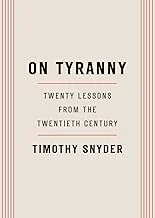
On Tyranny: Twenty Lessons from the Twentieth Century by Timothy Snyder - Review

Our Rating

4.5

A concise, accessible guide to defending democracy that successfully translates historical knowledge into practical action, though its brevity limits analytical depth.

Trending Now
Cultural Resurgence

On Tyranny: Twenty Lessons from the Twentieth Century by is Trending

Netflix's 'How to Become a Tyrant' Series Sparks Renewed Interest in Democracy Guides

Netflix's documentary series about authoritarian tactics, narrated by Peter Dinklage, is driving readers back to Timothy Snyder's practical democracy handbook. The timing feels especially relevant as people seek concrete ways to understand and protect democratic institutions.

Netflix's docu-series 'How to Become a Tyrant,' which explores the playbook of authoritarian leaders throughout history, has readers turning to Timothy Snyder's 'On Tyranny' for the flip side of the conversation. While the Netflix series shows how dictators seize power, Snyder's book offers twenty concrete lessons on how ordinary citizens can resist those same tactics.

The pairing makes sense - both works translate complex political concepts into accessible formats, but Snyder's book gives readers something actionable rather than just educational. His lessons, drawn from studying 20th-century authoritarianism, feel particularly urgent to readers who want practical guidance rather than just historical analysis. The book's concise format (it can be read in one sitting) makes it an appealing follow-up for viewers looking to move from understanding the problem to doing something about it.

Read more
Updated Apr 30, 2026
In This Review
  • A Pocket-Sized Manual for Dark Times
  • Twenty Lessons That Feel Remarkably Current
  • Historical Grounding Meets Practical Application
  • The Power and Limits of Brevity
  • Where History Meets the Present Moment
  • A Starting Point, Not a Destination

A Pocket-Sized Manual for Dark Times

In an era when democratic institutions face unprecedented pressure, Timothy Snyder's "On Tyranny: Twenty Lessons from the Twentieth Century" arrives as both historical analysis and urgent call to action. This slim volume—barely 120 pages—distills decades of scholarly research into practical advice for defending democracy. Is On Tyranny worth reading in 2026? Absolutely, though its brevity both serves and limits its mission.
Snyder, a Yale historian specializing in Eastern European authoritarianism, draws primarily from the rise of fascism in 1930s Europe to illuminate contemporary threats to democratic norms. Unlike dense academic treatments of authoritarianism, this book prioritizes accessibility over comprehensive analysis. Each "lesson" spans just a few pages, making complex historical patterns digestible for general readers.

Twenty Lessons That Feel Remarkably Current

The book's structure mirrors a survival guide more than traditional historical analysis. Snyder organizes his warnings into actionable directives: "Do not obey in advance," "Defend institutions," "Beware the one-party state." This approach transforms abstract historical knowledge into concrete behavioral guidance.
The lessons range from personal conduct ("Take responsibility for the face of the world") to civic engagement ("Vote in local elections"). Snyder's central argument—that ordinary citizens' daily choices either strengthen or weaken democratic resilience—threads through each chapter. He demonstrates how seemingly small acts of compliance or resistance compound into larger political movements.
What makes these lessons particularly striking is their contemporary relevance. Written in the immediate aftermath of the 2016 election, many observations about democratic backsliding feel prophetic when read today. Snyder's warnings about disinformation, political violence, and institutional capture resonate across different political contexts.

Historical Grounding Meets Practical Application

Snyder's expertise in twentieth-century European history provides the book's analytical foundation. He draws extensively from the collapse of the Weimar Republic, the rise of Hitler, and Stalin's consolidation of power. These historical parallels illuminate how democratic societies transform into authoritarian states—not through sudden coups, but through gradual erosion of norms and institutions.
The author's scholarship shows in his nuanced understanding of how tyranny actually emerges. Rather than focusing solely on charismatic dictators, Snyder emphasizes the role of complicit institutions, silent bystanders, and gradual normalization of authoritarian behavior. This analysis challenges common assumptions about how democracies die.
However, the book's practical orientation sometimes sacrifices historical complexity for actionable advice. Snyder necessarily simplifies intricate political processes to extract clear lessons. While this serves his pedagogical purpose, readers seeking deeper historical analysis may find the treatment somewhat superficial.

The Power and Limits of Brevity

Snyder's decision to keep "On Tyranny" brief represents both its greatest strength and most significant limitation. The concise format makes the book widely accessible—readable in a single sitting, quotable on social media, and easily shared among concerned citizens. This accessibility has contributed to its remarkable reach and influence.
The brevity also creates urgency. Rather than getting lost in academic nuance, readers encounter direct, actionable guidance. Snyder writes with the conviction that democracy faces immediate threats requiring immediate responses. This tone galvanizes rather than merely educates.
Yet the compressed format inevitably limits depth. Complex historical processes receive summary treatment. Contemporary political dynamics get reduced to historical analogies that may not perfectly apply. Readers looking for comprehensive analysis of current threats to democracy will need to supplement this book with longer works.

Where History Meets the Present Moment

The book's treatment of contemporary politics proves both illuminating and occasionally problematic. Snyder effectively uses historical perspective to contextualize recent political developments. His analysis of how propaganda functions, how institutions erode, and how citizens become complicit provides valuable frameworks for understanding current events.
However, the book's political timing creates certain blind spots. Written in reaction to specific 2016-era concerns, some lessons feel more relevant to particular political moments than others. The analysis occasionally conflates different types of authoritarian threats, treating various contemporary political figures and movements as equivalent dangers to democracy.
Despite these limitations, Snyder's core insights about democratic fragility remain compelling. His emphasis on citizen responsibility—the idea that democracy depends on individual choices to defend institutions and norms—offers a constructive response to political despair.

A Starting Point, Not a Destination

"On Tyranny" works best as an introduction to thinking seriously about democratic vulnerability rather than a comprehensive guide to political resistance. Snyder succeeds in making abstract historical knowledge personally relevant and politically urgent. The book's influence on public discourse about authoritarianism demonstrates its effectiveness in raising awareness about threats to democratic governance.
For readers seeking deeper analysis, this book pairs well with longer treatments like Snyder's own "The Road to Unfreedom" or Steven Levitsky and Daniel Ziblatt's "How Democracies Die." But as a primer on why history matters for contemporary politics, "On Tyranny" serves its purpose admirably.
The book ultimately argues that defending democracy requires both historical awareness and personal commitment. Whether you find this message compelling likely depends on how seriously you take the threats Snyder identifies. In 2026, with democratic institutions continuing to face pressure worldwide, his call for vigilant citizenship feels more relevant than ever.
You can find On Tyranny at Amazon, your local bookstore, or directly from Tim Duggan Books.