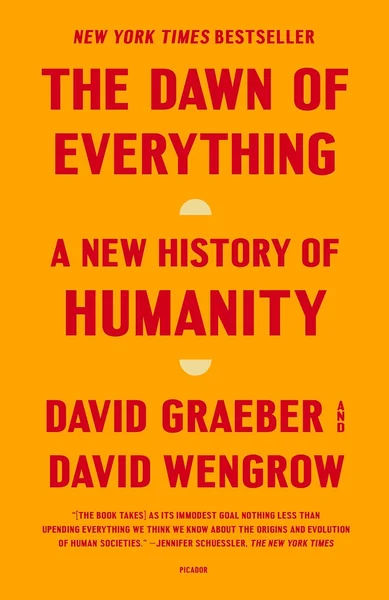
A Radical Departure from Standard Histories
The book's central thesis runs counter to everything taught in introductory world history courses. Instead of societies inevitably progressing from hunter-gatherers to farmers to city-dwellers, David Graeber and David Wengrow present evidence for remarkable social experimentation throughout human history. They argue that our ancestors consciously chose their political arrangements, often switching between different organizational systems seasonally or generationally.
This isn't merely academic contrarianism. The authors ground their arguments in extensive archaeological evidence and ethnographic records, particularly drawing from Indigenous American societies that European colonizers encountered. Their research reveals complex civilizations that deliberately rejected aspects of what we consider "advanced" social organization—sometimes abandoning cities, sometimes maintaining egalitarian structures despite large populations.
The writing successfully bridges the gap between scholarly rigor and public accessibility, though this balance occasionally tilts toward academic density. David Graeber's background in radical anthropology combines with Wengrow's archaeological expertise to create arguments that feel both methodologically sound and politically charged.
Collaborative Scholarship at Its Best
The partnership between David Graeber and David Wengrow proves essential to the book's success. Graeber brings theoretical sophistication and ethnographic breadth, while Wengrow contributes archaeological precision and material culture analysis. Neither author could have written this anthropology book alone, and their collaboration produces insights that transcend disciplinary boundaries.
The authors excel at connecting seemingly disparate evidence—archaeological remains from ancient sites, colonial-era accounts of Native American societies, and contemporary ethnographic studies. They demonstrate how Indigenous critiques of European society, recorded by missionaries and traders, influenced Enlightenment political philosophy in ways that standard intellectual histories ignore.
Their method involves careful attention to what evidence actually supports and what represents scholarly assumption. They repeatedly show how conclusions about ancient societies often reflect contemporary biases rather than historical reality. This skeptical approach extends to their own arguments, with frequent acknowledgments of uncertainty and calls for additional research.
Key Arguments That Challenge Everything
The book's most provocative claim involves the origins of inequality. Rather than emerging inevitably from agriculture or population growth, social hierarchies developed through specific historical processes that could have unfolded differently. David Graeber and Wengrow document societies that maintained egalitarian structures despite agricultural economies, and others that developed complex hierarchies without farming.
They argue for three fundamental types of social power—control over violence, information, and charismatic politics—and show how different societies combined or separated these elements in various ways. Some civilizations deliberately prevented any individual from accumulating multiple types of power, while others concentrated all three in ruling classes.
The authors also challenge the notion that cities necessarily produce social stratification. They present evidence for urban centers that maintained egalitarian decision-making processes and others that periodically dismantled hierarchical structures. These examples suggest that our current political arrangements represent choices rather than inevitabilities.
Where Ambition Meets Accessibility Issues
The main weakness lies in the book's overwhelming scope and density. At over 500 pages, The Dawn of Everything demands significant intellectual commitment from readers. The authors pack each chapter with evidence, arguments, and theoretical frameworks that reward careful attention but can exhaust casual readers.
The writing occasionally lapses into academic jargon, particularly when discussing theoretical concepts from anthropology and archaeology. Terms like "schismogenesis" and "seasonal dual sovereignty" appear without sufficient explanation for general audiences. David Graeber and David Wengrow assume familiarity with scholarly debates that many readers won't possess.
Additionally, the book's structure sometimes feels meandering. While individual chapters contain fascinating insights, the overall argument develops through accumulation rather than clear progression. Readers may struggle to identify the central thesis amid the wealth of supporting evidence and theoretical discussions.
A Paradigm Shift Worth Wrestling With
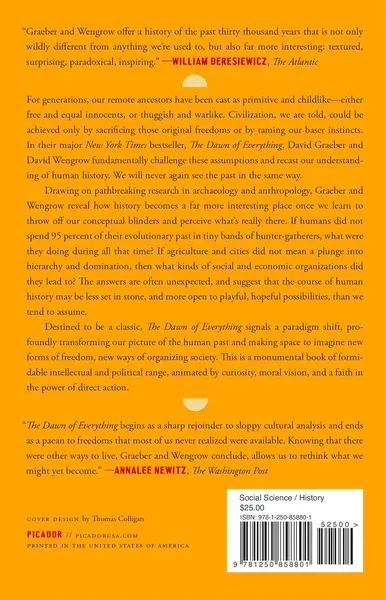
Despite its demanding nature, The Dawn of Everything succeeds in fundamentally altering how readers think about human societies and their possibilities. This history book doesn't just critique existing narratives—it provides compelling alternatives based on rigorous scholarship. The authors demonstrate that our ancestors possessed far more agency and creativity than standard histories acknowledge.
The political implications resonate powerfully in contemporary discussions about inequality, governance, and social change. If human societies experimented with radically different organizational forms throughout history, then our current arrangements become choices rather than natural laws. This perspective offers both hope and responsibility for addressing contemporary challenges.
For readers interested in anthropology, archaeology, or political theory, this non-fiction work provides essential insights that will influence future scholarship. The collaborative methodology alone offers a model for interdisciplinary research that transcends traditional academic boundaries.
Who Should Tackle This Intellectual Journey
The Dawn of Everything works best for readers already interested in history, anthropology, or political philosophy. Those seeking light popular history should look elsewhere—this David Graeber book demands active intellectual engagement throughout. Graduate students and academic researchers will find it invaluable, while general readers need patience and commitment.
Fans of authors like James C. Scott or Anna Tsing will appreciate the theoretical sophistication and political implications. The book rewards readers familiar with debates about state formation, social complexity, and Indigenous knowledge systems. However, determined general readers willing to work through challenging passages will discover genuinely transformative ideas about human possibilities.