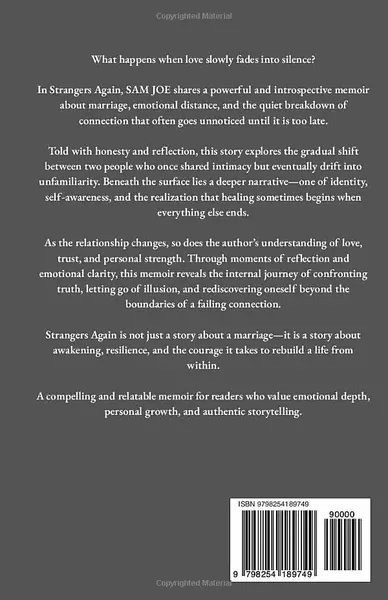
The Landscape of a Marriage's End
SAM JOE structures the narrative around the before, during, and after of relationship breakdown, creating a roadmap through emotional terrain that feels both intensely personal and universally recognizable. The memoir opens not with the dramatic moment of discovery but with the subtle erosions that preceded it—the gradual drift, the unspoken resentments, the growing sense of living with a stranger who once felt like home.
The author's approach to chronicling betrayal avoids sensationalism, instead focusing on the psychological impact and the slow-motion collapse that follows revelation. This isn't a revenge narrative or a victim's manifesto; it's an examination of how people become strangers to each other and, sometimes more importantly, to themselves.
Prose That Cuts Deep
SAM JOE writes with the precision of someone who has spent considerable time examining their own wounds. The prose moves between lyrical reflection and stark documentation, particularly effective when describing the disorienting experience of recognizing that the person you married has become fundamentally unknowable.
The memoir's greatest strength lies in its refusal to rush toward redemption. SAM JOE allows readers to sit in the discomfort of uncertainty, the messiness of conflicting emotions, and the reality that some betrayals fundamentally alter not just relationships but one's understanding of their own judgment and intuition.
The pacing reflects the actual timeline of recovery—slow, non-linear, with setbacks that feel as significant as breakthroughs. This authentic rhythm distinguishes it from memoirs that package trauma into neat narrative arcs.
The Supporting Cast in Crisis
The people surrounding SAM JOE during this period emerge as complex figures rather than simple allies or antagonists. Family members struggle with their own responses to the divorce, friends choose sides or retreat entirely, and new relationships form in the space left by old ones.
Particularly compelling is SAM JOE's portrayal of how divorce ripples through social networks, forcing everyone to recalibrate their understanding of a couple they thought they knew. The author captures the awkwardness of explaining your situation repeatedly, the exhaustion of being treated as either victim or cautionary tale, and the strange experience of discovering who remains when the dust settles.
The children in this narrative, when they appear, are handled with appropriate protection of their privacy while still acknowledging their central role in complicating any simple exit from a failed marriage.
Rebuilding From the Ground Up
The memoir's most valuable sections deal with the practical and emotional work of reconstruction. SAM JOE doesn't promise that healing leads to forgiveness or that understanding leads to reconciliation. Instead, the focus remains on the more challenging work of becoming whole as an individual rather than as half of a partnership.
This includes confronting personal patterns that contributed to relationship dysfunction, learning to trust one's instincts after they've been proven fallible, and navigating the complex emotions that arise when the person who hurt you most was also once your closest companion.
The author's honesty about setbacks—moments of wanting to reconcile, periods of rage, times when moving forward felt impossible—creates space for readers experiencing similar struggles to recognize their own experience as normal rather than pathological.
Where It Stumbles
The memoir occasionally veers toward repetition, particularly in the middle sections where the cyclical nature of grief work, while authentic, can feel tedious on the page. Some readers may find the pace too deliberate, especially those seeking more concrete advice or faster resolution.
The book's narrow focus on heterosexual marriage dissolution may limit its relevance for readers dealing with other types of relationship endings, though many of the emotional insights translate across different partnership structures.
Additionally, the memoir's resolution feels somewhat incomplete—perhaps reflecting the reality that healing remains ongoing rather than achieved, but potentially leaving readers wanting more definitive closure or wisdom.
Our Take
Strangers Again succeeds as both personal testament and practical companion for anyone navigating relationship dissolution. SAM JOE's willingness to remain in uncertainty rather than rushing toward false comfort makes this particularly valuable for readers in the early stages of divorce or separation, when well-meaning advice about "moving on" feels premature or impossible.
This memoir works best for readers who prefer psychological exploration over step-by-step recovery programs. Those seeking concrete action plans or spiritual frameworks for healing might find it less immediately useful, though the emotional insights provide important foundation work for any recovery approach.
The book proves especially relevant for people discovering that their marriage ended long before the official dissolution—readers who recognize the gradual transformation from partners to strangers that SAM JOE documents with such precision.