A provocative and intellectually challenging examination of rare, high-impact events that reshapes how we think about prediction and risk, though Taleb's combative style and limited practical guidance prevent it from being universally accessible.
A provocative and intellectually challenging examination of rare, high-impact events that reshapes how we think about prediction and risk, though Taleb's combative style and limited practical guidance prevent it from being universally accessible.
Trending Now
Cultural Resurgence
The Black Swan: The Impact of the Highly Improbable by Nassim Nicholas Taleb is Trending
Market Volatility and Global Uncertainty Are Sending Readers Back to The Black Swan
With financial markets swinging wildly and geopolitical shocks piling up in 2025-2026, readers are revisiting Taleb's argument that unpredictable, catastrophic events aren't flukes — they're the rule. It's one of those books that always finds its moment when the world feels unstable.
If you've been watching the news lately — trade war escalations, banking scares, AI disruptions upending entire industries — you're basically living inside a Taleb case study. The Black Swan, which argues that rare, high-impact events drive far more of history than our tidy models predict, keeps getting rediscovered every time the world reminds people that 'expert forecasts' have a lousy track record. That cycle is very much happening right now.
Taleb's core idea is that humans are wired to underestimate the likelihood of outlier events and overestimate how much we can predict. Given how many 'nobody saw that coming' moments have stacked up over the past few years — from supply chain collapses to sudden market swings — his framework resonates in a way that feels less theoretical and more uncomfortably practical. Investors, economists, and just generally anxious people are picking this one back up.
Fair warning: Taleb is not exactly a warm and fuzzy writer. He's combative, he's dismissive of people he disagrees with, and the book is heavier on big ideas than on actionable advice. But if you're trying to make sense of why the world keeps surprising everyone, it's worth the ride.
Read more
Updated May 20, 2026
In This Review
Taleb's Intellectual Pugilism
The Architecture of Unpredictability
Where Theory Meets Reality
The Robustness Revolution
Intellectual Rewards and Limitations
A Necessary Discomfort
Where to Buy
A rigorous and genuinely unsettling challenge to how we think about risk — essential reading, despite its author's relentless combativeness. Nassim Nicholas Taleb's The Black Swan remains one of the most provocative examinations of how we think about probability, prediction, and the profound impact of rare events. In a world increasingly shaped by unexpected disruptions—from financial crashes to global pandemics—is The Black Swan by Nassim Taleb worth reading for modern audiences? The answer depends largely on your tolerance for Nassim Nicholas Taleb's intellectual combativeness and whether you're seeking practical wisdom or theoretical frameworks.
The book's central thesis revolves around "Black Swan" events—occurrences that are outliers, carry extreme impact, and possess retrospective predictability. Nassim Nicholas Taleb argues that we live in a world dominated by these rare, unpredictable events while foolishly focusing on the predictable and ordinary. The second edition enhances this argument with additional material on robustness and fragility, concepts that have become increasingly relevant in our interconnected global systems.
Taleb's Intellectual Pugilism
Nassim Nicholas Taleb writes with the confidence of someone who has witnessed multiple financial crises and emerged vindicated. His prose style is simultaneously erudite and combative, peppered with references to philosophy, literature, and mathematics while delivering sharp critiques of conventional wisdom. The author doesn't merely present ideas—he wages intellectual war against what he sees as dangerous delusions in academia, finance, and popular thinking.
This approach can be both illuminating and exhausting. Taleb's background as a former trader and risk analyst gives weight to his practical observations about markets and human behavior, but his tendency toward intellectual arrogance can alienate readers seeking measured analysis. The writing often feels like attending a brilliant but irascible professor's lecture—you'll learn tremendously, but you'll also endure considerable ego along the way.
The Architecture of Unpredictability
The book's strength lies in its systematic deconstruction of how we think about rare events. Nassim Nicholas Taleb introduces readers to concepts like "Mediocristan" versus "Extremistan"—domains where different rules of probability apply. In Mediocristan, outliers have limited impact; in Extremistan, a single observation can dramatically skew everything we think we know.
These frameworks prove remarkably useful for understanding everything from wealth distribution to technological innovation. Readers familiar with Fooled by Randomness will recognize Taleb's continued exploration of human cognitive biases, but The Black Swan expands the scope from individual decision-making to civilizational blind spots.
The second edition's addition on robustness and fragility introduces concepts that would later evolve into Taleb's Antifragile. This material examines how systems can be designed to benefit from disorder rather than merely survive it—a prescient framework given subsequent global disruptions.
Where Theory Meets Reality
Taleb supports his arguments with examples ranging from the rise of Google to the outbreak of World War I, demonstrating how retrospective narratives make these events seem more predictable than they actually were. His critique of economic forecasting and risk management models has proven particularly insightful in light of various market disruptions and financial crises.
However, the book's practical applications remain somewhat limited. While Nassim Nicholas Taleb effectively dismantles conventional approaches to prediction and risk assessment, he offers fewer concrete alternatives beyond general principles of positioning oneself to benefit from positive Black Swans while protecting against negative ones.
The Robustness Revolution
The new material on robustness and fragility represents the book's most actionable content. Taleb explores how certain systems—from the human body to political structures—can withstand shocks while others collapse spectacularly. This analysis feels particularly relevant in an era of supply chain disruptions and systemic vulnerabilities exposed by recent global events.
Yet even here, Taleb's insights lean more toward diagnostic than prescriptive. He excels at identifying fragility but provides less guidance on building robust alternatives beyond avoiding over-optimization and maintaining optionality.
Intellectual Rewards and Limitations
The Black Swan succeeds as a profound critique of human overconfidence in prediction and control. Nassim Nicholas Taleb weaves together statistics, philosophy, and evolutionary biology to make a compelling case for intellectual humility in the face of complexity.
The book's limitations stem partly from its ambitions. Taleb attempts to revolutionize how we think about probability while also settling scores with academic economists and risk managers. This dual agenda sometimes obscures the core insights beneath layers of intellectual combat.
Additionally, readers seeking actionable investment advice or risk management strategies may find the book frustratingly abstract. Taleb is more interested in changing how you think than in providing specific tools for decision-making.
A Necessary Discomfort
For all its provocations and limitations, The Black Swan offers something increasingly rare: a fundamental challenge to how we understand uncertainty and prediction. Taleb's skepticism toward mathematical models and expert predictions cuts against the confidence baked into algorithmic decision-making and big-data forecasting — and that challenge has only sharpened with time.
The second edition's enhanced focus on fragility provides additional value, offering an approach to system vulnerability that extends well beyond finance into technology, politics, and personal decision-making. While Nassim Nicholas Taleb's personality can overwhelm his insights, the core ideas remain powerful enough to justify wrestling with his intellectual combativeness.
This isn't light reading, nor is it a practical handbook. Instead, it's an intellectual vaccine against overconfidence in prediction—uncomfortable but ultimately beneficial for anyone making decisions under uncertainty.
Where to Buy
If you make decisions under uncertainty — in markets, policy, or everyday life — this belongs on your shelf; the Amazon link in the sidebar has the current price.
Product Gallery
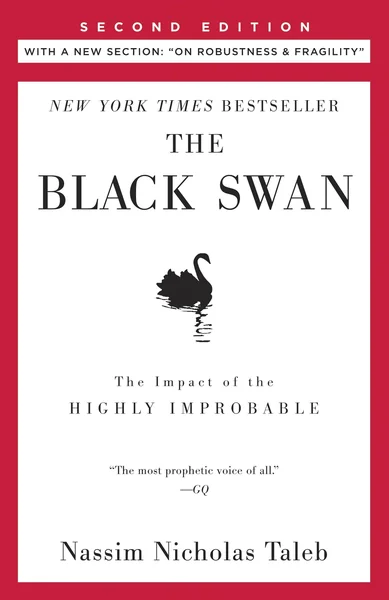
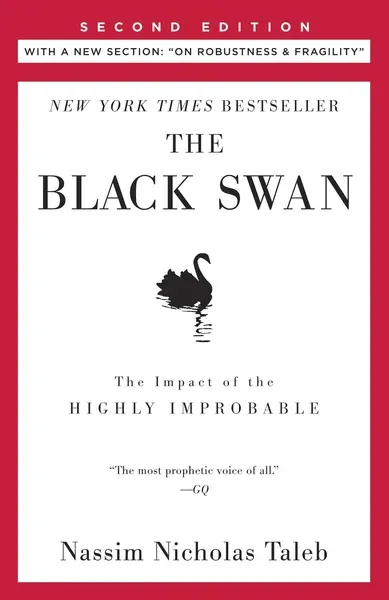
The Black Swan: Second Edition: The Impact of the Highly Improbable: With a new section: "On Robustness and Fragility" by Nassim Nicholas Taleb front cover
The Black Swan: Second Edition: The Impact of the Highly Improbable: With a new section: "On Robustness and Fragility" by Nassim Nicholas Taleb back cover
Related Reviews
Reviews of books we picked for readers who enjoyed The Black Swan.