BOOKS
Published

Read Time

4 min read

Curated & edited by

LuvemBooks Editorial

How we create our reviews →
Share This Review

A Voice in the Wind by Francine Rivers Review: Enduring Christian Historical Fiction at Its Finest

First published in 1993 and now a cornerstone of the Christian fiction genre, Francine Rivers's A Voice in the Wind opens the Mark of the Lion series with the story of Hadassah — a young Jewish-Christian slave navigating the brutality, decadence, and spiritual emptiness of first-century Rome — and it remains one of the most celebrated novels in its category decades after its debut.

LuvemBooks Verdict

Best for

Readers of Christian historical fiction who want a dramatically serious, emotionally demanding story — one in which faith is tested at real cost — set against the Roman Empire of the first century AD.

Worth it if

You want Christian fiction that refuses to sanitise its world: a protagonist whose courage is earned through fear and grief, moral stakes that are never cheaply resolved, and a richly rendered ancient setting spanning a Roman household and the gladiatorial arena.

Skip if

You prefer historical fiction in which religious themes remain implicit or peripheral — the novel's Christian worldview is structural rather than incidental, and readers seeking theology at a distance are better served elsewhere.

What readers & critics say

Booklist (starred review, as cited on francinerivers.com) calls the novel "compelling…emotionally charged," and Liz Curtis Higgs, New York Times bestselling author, is quoted on the same source saying Rivers "redefined Christian fiction — honest, unflinching, powerful, life-changing" and that "every Christian novelist writing today owes a debt of gratitude to Francine Rivers for lighting the way." Virtue Harvest describes the Mark of the Lion series as its personal "gold standard, the measure to which I compare all other works of fiction," while Library of Clean Reads concludes that Rivers is "truly an amazing storyteller" whose ending left the reviewer immediately wanting the next volume.

Compelling…Emotionally charged.

Booklist (starred), via francinerivers.com

Every Christian novelist writing today owes a debt of gratitude to Francine Rivers for lighting the way.

Liz Curtis Higgs, NYT bestselling author, via francinerivers.com

This series is my 'gold standard,' the measure to which I compare all other works of fiction.

Virtue Harvest

The author is truly an amazing storyteller… it has struck a chord with me.

Library of Clean Reads
Sources: Francine Rivers Official Site (francinerivers.com), Virtue Harvest (virtue.harvest.org), Library of Clean Reads (libraryofcleanreads.com), Instill Hope Blog (instillhopeblog.wordpress.com)
4.7from 77 Amazon ratings— reader ratings, not a LuvemBooks score
In This Review
  • What Works & What Doesn't
  • What the Novel Is and What It Contains
  • The Central Conflict and Its Stakes
  • Significance and Standing in the Genre
  • Genuine Strengths
  • Considerations for Prospective Readers

What Works & What Doesn't

What Works
  • Credited by major authors in the genre with redefining Christian fiction as honest, unflinching, and dramatically serious
  • Hadassah is written as a flawed, fearful protagonist whose faith is tested and earned across the narrative rather than assumed
  • The parallel storylines of Hadassah and the gladiator Atretes give the novel historical breadth beyond a single household's drama
  • The central conflict — Hadassah's choice between love for Marcus and fidelity to her faith — carries genuine moral and emotional stakes
  • Published by Tyndale House Publishers and the opening volume of a complete trilogy, giving readers an extended world to explore
What Doesn't
  • The novel's Christian worldview is structural, not incidental — readers who prefer faith themes handled implicitly will find this book's priorities incompatible with their preferences
  • The dual-narrative structure, while broad in scope, means the gladiatorial arc involving Atretes competes for space with the Hadassah storyline, and some readers may find one thread more compelling than the other
Few novels in Christian fiction have earned the standing that A Voice in the Wind holds among readers and writers alike — a reputation built over three decades and still growing.

What the Novel Is and What It Contains

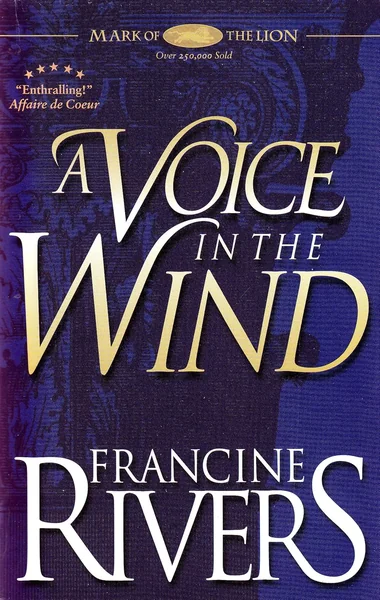
A Voice in the Wind (Mark of the Lion by Francine Rivers front cover
A Voice in the Wind, the first book in Francine Rivers's Mark of the Lion series, is a work of Christian historical fiction set in the Roman Empire of the first century AD. Its central figure is Hadassah, a young Jewish-Christian woman whose entire family perishes when Jerusalem falls to Roman forces in AD 70. Taken to Rome as a slave, she is purchased by the wealthy Valerian family to serve as a handmaid to their teenage daughter, Julia — described as rebellious and willful, hungry for every pleasure Rome can offer. Julia's initial hostility toward Hadassah gradually gives way to dependence on her gentleness and unconditional care.
A second major storyline follows Atretes, a young German tribesman captured by Roman soldiers and forced into the gladiatorial arena. His fierce pride and hatred of Rome sustain him through combat, but the novel traces how that same fury curdling into bitterness and despair. Running through both narratives is a central tension the novel frames explicitly: the quest for peace and meaning inside a civilization built on spectacle, excess, and power.

The Central Conflict and Its Stakes

The novel's emotional and spiritual core turns on Hadassah's relationship with Marcus Valerian, the family's eldest son. Marcus is drawn to Hadassah's innocence and her unwavering faith — and, as the story progresses, falls in love with her. Hadassah is equally attracted to Marcus but recognizes that a future with a man who does not share her Christian faith could pull her away from God. When Marcus proposes marriage, Hadassah is forced into a choice the novel refuses to resolve cheaply: devotion to her faith or love for a man who cannot offer it the same loyalty.
This conflict gives the book its lasting dramatic weight. Rivers structures the narrative so that faith is not a backdrop but an active, costly force — something Hadassah must fight to hold onto rather than a comfort she passively possesses. Her arc from a frightened, grief-stricken survivor to a woman with the courage to speak openly about her belief in Jesus is the spine around which the wider Roman world is built.

Significance and Standing in the Genre

A Voice in the Wind is widely credited as a transformative work for Christian fiction. New York Times bestselling author Liz Curtis Higgs has written that the Mark of the Lion trilogy demonstrated why storytelling is "the most effective way to communicate God's truth," and that Rivers "redefined Christian fiction — honest, unflinching, powerful, life-changing." Fellow New York Times bestselling author Debbie Macomber has called Rivers "without a doubt one of the finest storytellers of our generation." RT Book Reviews noted that Rivers "puts readers right into the history of the moment." Rivers is also the author of Redeeming Love and The Masterpiece, and the Mark of the Lion series was the work that introduced many readers to her writing. The novel is published by Tyndale House Publishers.

Genuine Strengths

The novel's chief strength, as the record consistently reflects, is Rivers's willingness to portray the ancient world without sanitizing it. The fall of Jerusalem, the gladiatorial arena, and the moral corruption of Roman aristocratic life are rendered in terms that reviewers have described as honest and unflinching rather than softened for a faith-based audience. Hadassah herself is written as a character marked by fear as well as faith — her courage is earned across the narrative rather than assumed from the outset, which gives her arc genuine dramatic credibility. The parallel structure, alternating between Hadassah's world inside the Valerian household and Atretes's brutal path through the arena, broadens the novel's scope and keeps the central spiritual themes from feeling insular.

Considerations for Prospective Readers

Because faith and spiritual transformation are not incidental but structural to everything in this novel, readers who prefer religious themes to remain implicit or peripheral will find the book's priorities are different from theirs. The novel is explicitly Christian in its worldview — Hadassah's faith in Jesus is the lens through which the entire narrative is filtered — and the emotional stakes are consistently tied to that framework. Readers seeking historical fiction that keeps theology at a distance are better served elsewhere. Within its intended audience, however, the novel operates at a level of moral and dramatic seriousness that distinguishes it from lighter entries in the genre, and its decades-long readership reflects that distinctiveness.

Sources & Further Reading

The key facts and claims in this review are grounded in the retrieved, verified sources listed below.

  1. 1

    Francine Rivers, Wikipedia

  2. 2
  3. 3
  4. 4
  5. 5
  6. 6
  7. 7
  8. 8
  9. 9