BOOKS
Published

Read Time

4 min read

Curated & edited by

LuvemBooks Editorial

How we create our reviews →
Share This Review

The Gifts of Imperfection by Brené Brown Review: A Wholehearted Guide to Authentic Living

Brené Brown's The Gifts of Imperfection is a self-help book built around the concept of "wholehearted living" — the practice of releasing fear, shame, and the need for external approval in order to embrace vulnerability, authenticity, and self-worth. Originally published in 2010 and later reissued in an updated anniversary edition, the book has become a touchstone in the personal-development genre, cementing Brown's reputation as one of the field's most recognized voices. Its central argument — that courage, compassion, and connection are the daily tools required for a meaningful life — is straightforward and consistently stated, making it accessible to a broad audience while raising reasonable questions about depth for readers already fluent in Brown's ideas.

LuvemBooks Verdict

Best for

Readers at an early or re-entry point in thinking about perfectionism, shame, and self-worth — especially those who thrive with a clear, values-based framework and an encouraging voice, or anyone looking for a well-structured book-club selection on wholehearted living.

Worth it if

You're new to Brené Brown's work or returning to it after time away, and want a clear, consistently argued introduction to wholehearted living that also works as a springboard into her broader body of work.

Skip if

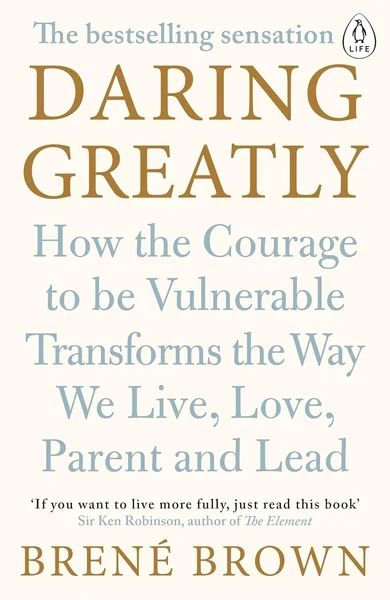
You've already read Brown's later, more expansive books — such as Daring Greatly or Atlas of the Heart — or you prefer self-help that is research-dense and analytically rigorous rather than motivational and prescriptive in tone.

What readers & critics say

Shortform notes the book was an instant bestseller following Brown's lauded 2010 TEDxHouston talk, but cautions that bestseller status doesn't make it free from flaws. Critical reader voices are mixed: several bloggers praise its clarity and accessibility, while reviewers at hushyourmind.com and shelfreflection.com find it lacking in substance — the former citing "vague terms" and "bland writing," the latter describing it as "empty" on its central questions of fear, identity, and worth.

Sources: Shortform, Hush Your Mind, Shelf Reflection, Forward Fitness STL

Look inside the book

Preview the actual pages, via Google Books
In This Review
  • What Works & What Doesn't
  • What the Book Is and What It Argues
  • Publication History and Brown's Broader Platform
  • Core Strengths: Clarity of Message and Accessibility
  • Limitations: Breadth Over Depth and Audience Fit
  • Who This Book Is For

What Works & What Doesn't

What Works
  • Clarity of central argument — the case for wholehearted living is consistently and accessibly stated throughout
  • Structured around named guideposts that give readers concrete frameworks rather than vague inspiration
  • Broad utility as a book-club or group-study text, supported by companion resources including a free online inventory
  • The anniversary edition audiobook is narrated by Brown herself, adding authorial context
  • Functions as an effective entry point into Brown's larger body of work on vulnerability, shame, and belonging
What Doesn't
  • Readers already familiar with Brown's later, more expansive books may find the conceptual treatment here less developed
  • The motivational, prescriptive tone prioritizes accessibility over analytical depth, which may not satisfy readers seeking a more research-dense approach
Brown's self-help book is a measured, widely-read entry in the personal-development genre that rewards readers new to her work more than those already familiar with it.

What the Book Is and What It Argues

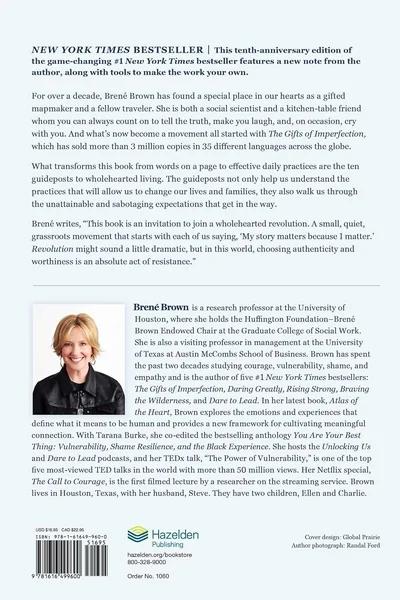
Back cover with synopsis, author biography, publisher details, and barcode.
The Gifts of Imperfection is a self-help book in which Brené Brown makes the case for what she calls wholehearted living — a way of engaging with life that begins with the conviction that one is worthy of love and belonging exactly as one is, imperfections included. Brown defines wholehearted living not as a destination but as an ongoing, daily practice. Her own framing, quoted directly on her website, describes the book as "an invitation to join a wholehearted revolution. A small, quiet grassroots movement that starts with each of us saying, 'My story matters because I matter.'" The book's argument rests on three interconnected values — courage, compassion, and connection — which Brown positions as the practical instruments for letting go of perfectionism, fear, and the need for approval. These are not presented as occasional choices but as habitual orientations that must be cultivated over a lifetime.

Publication History and Brown's Broader Platform

First published in 2010, The Gifts of Imperfection predates the full scope of Brown's public profile but is widely credited as the book that launched her to mainstream prominence. It is her second book. A later anniversary edition was released with updated content, and Brown narrates the audiobook version of that edition herself. By the time most readers encounter the title today, Brown's platform has expanded considerably — her TED Talk on vulnerability is among the most-viewed in that format, she has a Netflix special (The Call to Courage), and she hosts the podcast Unlocking Us, on which she and her sisters devoted an extended series to discussing The Gifts of Imperfection chapter by chapter. That multimedia ecosystem means the book does not stand in isolation; it functions as an entry point into a larger body of work and a companion to resources Brown has built around it, including a free "wholehearted inventory" available on her website.
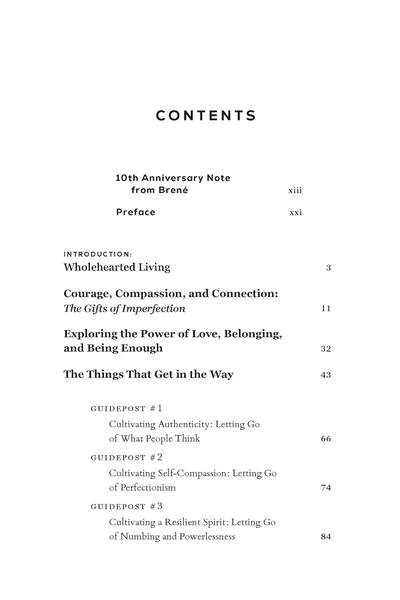
Contents page listing introduction on wholehearted living and three guideposts on vulnerability, authenticity, and resilience.

Core Strengths: Clarity of Message and Accessibility

The book's most frequently noted strength is the clarity and consistency of its central message. Brown organizes her argument around concrete, named practices and "guideposts" — a structural choice that gives readers clear frameworks rather than abstract encouragement. The prose is written in a direct, conversational register, and the core thesis — that embracing vulnerability and imperfection is the path to a fulfilling life, not an obstacle to it — is stated early and reinforced throughout. For readers encountering these ideas for the first time, that consistency functions as genuine reassurance rather than repetition. The book also arrives with a well-documented cultural footprint: it has been used widely in book clubs, academic study guides, and personal reflection contexts, which attests to its utility as a discussion text as much as a solo read.

Limitations: Breadth Over Depth and Audience Fit

The book's accessibility is also the source of its primary limitation. Readers who come to The Gifts of Imperfection after engaging with Brown's later, more expansive works — Daring Greatly, Braving the Wilderness, or Atlas of the Heart — may find that the conceptual territory here is covered at a higher altitude than those volumes. Because the book is structured as an introduction to wholehearted living rather than a granular exploration of any single dimension of it, readers seeking sustained intellectual development of Brown's research on shame resilience or belonging may find the guideposts format more declarative than analytical. Additionally, the book's framing is unapologetically optimistic and prescriptive in tone; readers who prefer their self-help more equivocal or research-dense may find the register more motivational than evidential, even though Brown's background is in qualitative research.

Who This Book Is For

The Gifts of Imperfection is best suited to readers who are at an early or re-entry point in thinking seriously about perfectionism, shame, and self-worth — particularly those who respond well to a clear, values-based framework delivered in an encouraging voice. It has demonstrated particular resonance as a book-club selection, given its structured guideposts and the discussion materials Brown has built around it. Readers already deep in the Brown canon will still find the anniversary edition a useful refresher — especially in the audiobook format, where Brown's own narration adds context — but the book's greatest value lies in its role as a threshold text: a clear, well-organized invitation into a way of thinking that Brown has spent her career elaborating.

Sources & Further Reading

The key facts and claims in this review are grounded in the retrieved, verified sources listed below.

  1. Cited in this review
  2. 1
  3. Further reading
  4. 2
    Brené Brown — author profileHigh-authority source

    Brené Brown, Wikipedia

  5. 3
  6. 4
  7. 5
  8. 6
  9. 7
  10. 8
  11. 9
  12. 10
  13. 11