BOOKS
Published
Read Time
6 min read
Our Rating
4.2
An excellent foundation for understanding cooking principles through four elements, though better suited for intermediate cooks than complete beginners.
Reviewed by
LuvemBooks
Share This Review
Salt, Fat, Acid, Heat by Samin Nosrat - Cookbook Review
Our Rating
4.2
An excellent foundation for understanding cooking principles through four elements, though better suited for intermediate cooks than complete beginners.
In This Review
- What Works & What Doesn't
- The Four Elements Explained Simply
- Wendy MacNaughton's Visual Storytelling
- Beyond Basic Technique
- Where the Method Falls Short
- Our Take on This Culinary Philosophy
What Works & What Doesn't
What Works
- Clear framework that builds genuine cooking intuition
- Beautiful illustrations that enhance learning
- Global perspective on fundamental techniques
- Teaches adaptable skills rather than rote recipes
- Scientific approach without being overly technical
What Doesn't
- Limited recipe selection compared to comprehensive cookbooks
- May overwhelm absolute beginners
- Personal anecdotes sometimes interrupt instructional flow
- Illustrated style less practical than step-by-step photos
The Four Elements Explained Simply
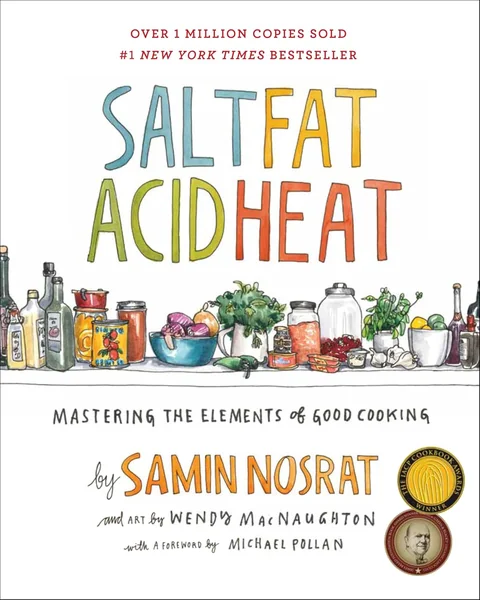
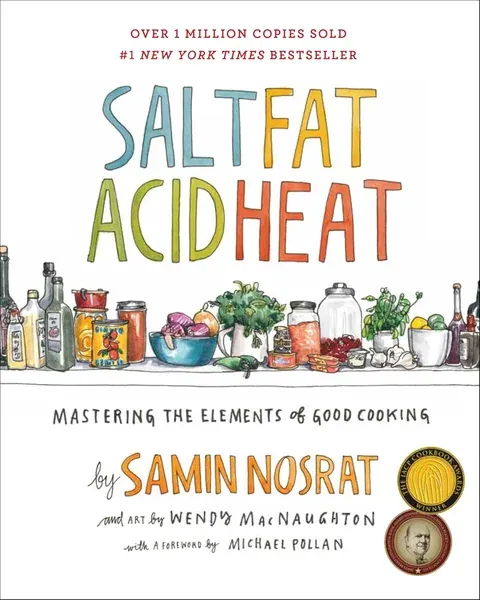
Nosrat dedicates substantial sections to each element, building a comprehensive framework for understanding flavor and technique. Salt enhances and balances, she explains, going beyond basic seasoning to explore timing, types, and application methods. The fat section reveals how different fats create texture and carry flavor, while acid brightens and balances dishes in ways many home cooks never consider.
Heat receives the most technical treatment, covering everything from gentle poaching to high-temperature roasting. Nosrat explains not just what temperature to use, but why different proteins and vegetables respond to various heating methods. This scientific foundation makes the book valuable for experienced cooks looking to understand their techniques better.
The strength lies in how these elements interconnect. Rather than treating them as separate concepts, Nosrat demonstrates how balancing all four creates memorable dishes. A simple vinaigrette becomes a lesson in acid balance, fat emulsification, and salt enhancement.
Wendy MacNaughton's Visual Storytelling
The illustrations by Wendy MacNaughton transform this from a standard cookbook into something more engaging. The visual elements aren't just decorative - they serve as educational tools that reinforce Nosrat's concepts. Hand-drawn diagrams show proper knife techniques, while colorful charts illustrate salt types and their applications.
MacNaughton's work shines particularly in the technique sections, where complex processes like bread-making or sauce preparation become visually accessible. The illustrations capture the joy and messiness of real cooking in ways that sterile photography cannot match.
However, the artistic approach has limitations. Some readers expecting traditional step-by-step photos may find the illustrated style less practical for following along during active cooking.
Beyond Basic Technique
What sets this book apart from typical cooking instruction is Nosrat's emphasis on developing palate and intuition. She encourages readers to taste constantly, adjust seasonings, and trust their senses rather than blindly following measurements. This philosophy requires more engagement than recipe-following but builds genuine cooking skills.
The book includes recipes, but they serve as applications of the principles rather than the main attraction. A roast chicken recipe becomes a vehicle for understanding how salt penetration, fat rendering, acid brightness, and heat control work together. This approach is perfect for cooks who want to improvise rather than depend on exact instructions.
The global perspective adds depth without being overwhelming. Nosrat draws examples from Italian, French, Persian, and other traditions, showing how the four elements manifest across cultures. This breadth prevents the book from feeling narrow or dogmatic.
Where the Method Falls Short
The main weakness is accessibility for absolute beginners. While Nosrat explains her principles clearly, applying them requires practice and confidence that newcomers may lack. Someone who struggles with basic knife skills or timing might feel overwhelmed by the emphasis on intuitive cooking.
The recipe selection, while thoughtful, feels limited compared to comprehensive cookbooks. Readers seeking extensive recipe collections will need to supplement this book with others. The focus on principles over quantity is intentional but may frustrate cooks wanting more immediate options.
Some sections drag, particularly when Nosrat recounts lengthy personal anecdotes. While these stories add personality, they sometimes interrupt the instructional flow and make finding specific information more difficult.
Our Take on This Culinary Philosophy
Salt, Fat, Acid, Heat succeeds brilliantly at its stated goal of teaching cooking fundamentals. Nosrat's four-element framework provides a memorable structure that genuinely improves kitchen confidence. The book works best for intermediate cooks ready to move beyond recipe dependence, though patient beginners will also benefit.
This isn't the cookbook for someone wanting 200 dinner recipes. Instead, it's for cooks who want to understand why techniques work and how to adapt them. The investment in learning Nosrat's method pays dividends in long-term cooking improvement, even if the initial learning curve feels steep.
The book's lasting value lies in changing how readers approach cooking entirely. Rather than collecting recipes, you develop skills that apply to countless dishes across cuisines.
Product Gallery