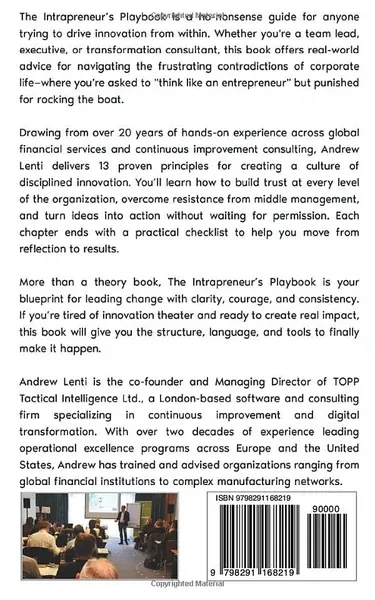
Is The Intrapreneur's Playbook worth it for corporate innovators? Lenti's methodical approach to internal innovation tackles the fundamental challenge that stymies countless corporate initiatives: organizational resistance. Rather than offering theoretical frameworks, this practical guide dissects the political and structural barriers that kill promising ideas before they reach implementation.
The book's geometric cover design—featuring clean lines intersecting with organic lightbulb imagery—perfectly captures Lenti's core thesis: innovation requires both systematic thinking and creative breakthrough moments. Unlike broader innovation texts such as The Innovator's Dilemma, Lenti focuses specifically on the unique constraints facing employees who must champion change from within established hierarchies.
The Framework for Internal Innovation
Lenti structures his thirteen strategies around three fundamental phases: preparation, execution, and institutionalization. The preparation phase emphasizes understanding corporate DNA—the unwritten rules, power structures, and decision-making patterns that determine whether initiatives succeed or fail. This analytical foundation distinguishes the book from generic innovation advice that ignores organizational realities.
The execution strategies center on building coalitions and managing stakeholder relationships. Lenti argues that corporate resistance isn't inherently malicious; it stems from legitimate concerns about risk, resource allocation, and operational disruption. His approach involves addressing these concerns proactively rather than circumventing opposition through stealth or executive mandate.
The institutionalization phase tackles the challenge of making innovations sustainable beyond their champions. This section proves particularly valuable, as many corporate innovation efforts collapse when their original advocates move to different roles or leave the organization entirely.
Where many business books remain abstract, Lenti provides concrete methodologies for each strategic principle. The stakeholder mapping exercises help readers identify hidden influencers and potential allies across organizational levels. The risk assessment frameworks translate entrepreneurial concepts into corporate-friendly language that resonates with traditional managers.
The communication templates prove especially useful for crafting proposals that address executive concerns while maintaining innovative vision. Lenti demonstrates how to frame disruptive ideas in terms of competitive advantage and operational efficiency—the metrics that drive corporate decision-making.
However, the book's practical focus creates some limitations. The frameworks work best within large, hierarchical organizations with established processes. Startups or rapidly scaling companies may find the methodologies overly structured for their dynamic environments.
Navigating the Corporate Innovation Paradox
Lenti addresses a central contradiction in corporate innovation: organizations simultaneously demand breakthrough thinking while maintaining systems designed for predictable execution. His strategies for managing this tension include creating "innovation sandboxes"—controlled environments where new approaches can be tested without threatening core operations.
The author's discussion of timing and organizational readiness provides crucial insights often overlooked in innovation literature. He argues that even brilliant ideas fail when introduced during periods of leadership transition, budget constraints, or strategic uncertainty. The book includes diagnostic tools for assessing organizational receptivity and adjusting implementation timelines accordingly.
The political navigation strategies acknowledge that corporate innovation requires influence and relationship-building skills beyond technical expertise. Lenti provides frameworks for identifying key stakeholders, understanding their motivations, and crafting value propositions that align with their objectives.
Where the Approach Falls Short
Despite its practical value, the book suffers from some notable weaknesses. The thirteen-strategy structure occasionally feels arbitrary, with overlapping concepts distributed across separate chapters. Some readers may find the methodical approach overly cautious for breakthrough innovation that requires bold, disruptive action.
The case studies rely heavily on technology and manufacturing examples, limiting applicability for service industries or creative organizations. Additionally, the strategies assume relatively stable corporate environments—conditions that may not exist in rapidly changing markets or crisis situations.
The book's focus on working within existing systems may frustrate readers seeking more transformative approaches to corporate change. While Lenti's methods reduce risk and increase implementation odds, they may also constrain the scope of possible innovation.
Strategic Value for Corporate Innovators
The Intrapreneur's Playbook serves as an essential resource for employees tasked with driving innovation within established organizations. The systematic approach to stakeholder management and resistance mitigation provides actionable guidance for navigating corporate complexity. Project managers, product development teams, and internal consultants will find particularly relevant applications.
The book works best for readers who understand that corporate innovation requires patience and political acumen alongside creative thinking. Those seeking rapid transformation or entrepreneurial-style disruption may find the methodical approach constraining. However, for professionals committed to creating sustainable change within existing organizational structures, Lenti's frameworks offer proven pathways to implementation success.
Where to Buy
You can find The Intrapreneur's Playbook at Amazon, major bookstores, or through business book retailers specializing in corporate strategy and innovation resources.