

In This Article
- What the Research Found — and Why Tocqueville Surfaced
- The Book and Its Origins
- Why the Work Carries Analytical Weight
- What to Watch
Political scientists are pointing to Alexis de Tocqueville's Democracy in America as a framework for understanding the current state of American democracy, following research published by The Guardian on 24 March 2026 that found the United States had "settled into a diminished state" of democratic health. The near-two-century-old text, scholars argue, anticipated many of the structural and cultural pressures now bearing down on American democratic institutions.
What the Research Found — and Why Tocqueville Surfaced
The Guardian's research, published in late March 2026, documented a broad deterioration in the condition of American democracy, using the language of "autocratization" to describe the direction of change. In that context, commentators and political scientists began drawing on Tocqueville's observations about the cultural prerequisites of self-governance — specifically his argument, detailed in the original French text De la démocratie en Amérique, that democratic revolution must be accompanied by "concomitant change in laws, ideas, customs, and manners" to be durable. Without that cultural transformation, as Tocqueville warned in the work preserved at Project Gutenberg, the material structures of democracy alone would prove insufficient.
The Book and Its Origins
Democracy in America was published in two volumes, the first in 1835 and the second in 1840, and grew out of an official French government mission with a notably different stated purpose. In 1831, Tocqueville and his colleague Gustave de Beaumont were dispatched to study the American prison system; according to Wikipedia's entry on the work, Tocqueville's own later letters acknowledge that he and Beaumont used that official mandate as a pretext to study American society more broadly. The two men arrived in New York City in May 1831 and spent nine months travelling the country, examining its religious, political, and economic character before returning to France in February 1832. Their formal prison report was submitted the following year, and Tocqueville subsequently expanded his observations into the book.
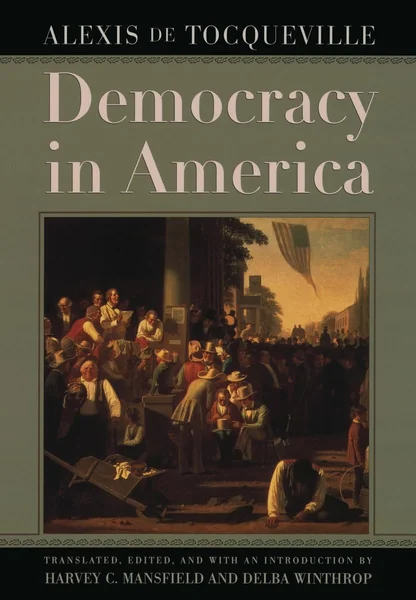
The University of Chicago Press, which publishes what it describes as "the most faithful and nuanced translation" of the work, notes that Tocqueville arrived in 1831 to observe "what a great republic was like" — framing that underscores the book's foundational status in American political thought. Scholars have long credited the text with cementing the association between democracy as a concept and the American system specifically; Wikipedia notes that it was Tocqueville's work, and its title, that "strongly associated the notion of democracy with the American system and, ultimately, with representative government and universal suffrage."
Why the Work Carries Analytical Weight
Tocqueville's approach was distinctive in that he did not confine himself to institutions. According to Wikipedia, he held a critical lens to the socioeconomic conditions of early 19th-century America, noting the influence of Puritan religious history and American government on an entrepreneurial and relatively egalitarian culture — while also criticising the moral, spiritual, and interpersonal costs of a society organised around social mobility and restlessness. That dual register — admiring of democratic energy, wary of its corrosive byproducts — is what makes the text useful to analysts examining democratic backsliding rather than simply democratic failure.
A February 2026 essay published by the Enciclopedia repository characterised Tocqueville as a "liberal aristocrat" whose North American project formed the core of his intellectual output, shaped by the months he spent travelling the continent alongside Beaumont. The work has since had, in Wikipedia's assessment, "a dramatic impact on American — as well as broader Western — thought and education," particularly across history, political science, and the social sciences.
What to Watch
The renewed scholarly attention to Democracy in America arrives at a moment when the language of democratic fragility has moved from academic journals into mainstream political reporting. Whether the current wave of interest produces new editions, updated translations, or formal curriculum changes remains to be documented. For an assessment of the book itself, see our review.
Frequently Asked Questions
Is Democracy in America by Alexis de Tocqueville worth reading in 2026?
Yes, especially given current concerns about democratic decline. Tocqueville's insights into civic engagement and democratic culture remain remarkably relevant, though the 19th-century prose requires patience. His analysis of how democracies can fail from within speaks directly to contemporary American political challenges.
What is the main message of Democracy in America?
Tocqueville argues that democracy's success depends on active civic participation rather than just formal institutions. He emphasizes how voluntary associations, local governance, and cultural habits of cooperation sustain democratic society, while warning that excessive individualism can undermine these foundations.
Who should read Democracy in America today?
Political science students, policy makers, and anyone concerned about democratic governance will find value in Tocqueville's work. It's particularly relevant for readers seeking to understand the cultural foundations of democracy beyond institutional analysis, though it requires commitment due to its length and 19th-century style.
How long is Democracy in America and is it difficult to read?
The complete work runs nearly 900 pages across two volumes. While Tocqueville's observations are profound, the 19th-century prose style can be challenging for modern readers. The book rewards careful study but isn't casual reading—consider starting with key chapters on civic associations and local democracy.



Reader Discussion
No comments yet
Be the first to share your thoughts!