
In This Article
- What the US Right to Know analysis claims
- Who is involved and what the book established
- Why the science lends weight to the book's argument now
- What to watch
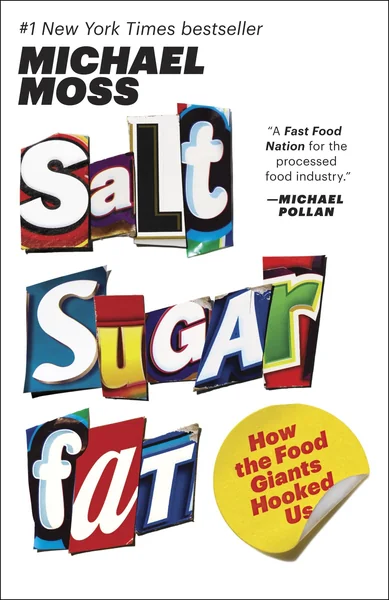
Michael Moss's Salt Sugar Fat: How the Food Giants Hooked Us has been cited by a US Right to Know analysis arguing that ultra-processed foods are as addictive as cigarettes and cocaine — more than a decade after the book first documented how food corporations deliberately engineered products to drive compulsive eating. The analysis, published by the public health research group, invoked Moss's 2013 exposé as foundational evidence in a widening scientific and policy debate over processed food addiction.
What the US Right to Know analysis claims
The US Right to Know report draws a direct line between the practices Moss documented — the calculated manipulation of salt, sugar, and fat to maximise consumption — and contemporary claims that ultra-processed foods trigger dependency comparable to controlled substances. The group argues that the food industry's decades-long effort to identify what Moss called the "bliss point," the precise formulation guaranteed to drive repeat consumption, is not merely a commercial strategy but a public health crisis warranting the same scrutiny applied to tobacco.
Who is involved and what the book established
Moss, a former New York Times journalist, spent approximately three and a half years interviewing hundreds of current and former food industry insiders — including chemists, nutrition scientists, behavioural biologists, marketing executives, and lobbyists — according to The Guardian's review of the book. What he found, the Guardian reported, was an industry that views consumers not as customers but as potential "heavy users," and that employs scientists who, in Moss's framing, "know very well what they are doing" when they engineer formulations to stimulate the brain's reward pathways.
The book, published by Random House, named specific companies including Kraft, Coca-Cola, Frito-Lay, and Nestlé, and examined products such as Oreos, Cheetos, Lunchables, and Capri Sun, according to Wikipedia's entry on the title. It went on to become a number-one New York Times bestseller and won the James Beard Foundation Award for Writing and Literature in 2014.
The concept of "conditioned hypereating" that Moss explored had also been raised earlier by former FDA commissioner David A. Kessler, the same Wikipedia entry notes. For a full assessment of the book's argument and reporting, see LuvemBooks' review.
Why the science lends weight to the book's argument now
The citation of Salt Sugar Fat comes amid a body of research that has grown substantially since the book's publication. A landmark randomised controlled trial conducted by researchers at the National Institutes of Health — reported by NPR — found that participants on an ultra-processed diet consumed an average of 508 more calories per day and gained an average of two pounds over a two-week period, while those on an unprocessed diet lost roughly two pounds over the same span.
Crucially, both diets were matched for total calories, fats, protein, sugar, salt, carbohydrates, and fibre — meaning participants ate more not because ultra-processed food was rated tastier, but because of something specific to its processing. Dariush Mozaffarian, then dean of Tufts University's Friedman School of Nutrition Science and Policy, described the findings as striking, according to NPR.
Separately, a large prospective study flagged by NCBI found that a 10% increase in the share of ultra-processed foods in a person's diet was associated with a greater than 10% increase in related health risks. Johns Hopkins' Bloomberg School of Public Health has also noted that the combination of sugar, fat, and salt in ultra-processed products stimulates the brain's reward system in ways that make stopping difficult — an observation that maps closely onto Moss's original thesis.
What to watch
The US Right to Know analysis positions Salt Sugar Fat as a precursor to regulatory arguments, not merely a journalistic one — suggesting the book may be drawn into ongoing policy debates about how ultra-processed foods are classified, marketed, and regulated. Stanford Medicine has noted that ultra-processed foods tend to be higher in saturated fat, salt, and sugar — the three things public health guidance consistently advises eating less of — reinforcing the overlap between Moss's framework and current nutritional science.
Whether regulators move to act on the addiction framing advanced by US Right to Know remains an open question, but the explicit invocation of a decade-old book as supporting evidence signals how durable Moss's reporting has proved to be.
Frequently Asked Questions
Is Salt Sugar Fat: How the Food Giants Hooked Us worth buying in 2026?
Yes, especially given recent validation of Moss's findings by health organizations. The book's insights into engineered food addiction remain highly relevant as ultra-processed foods dominate the American diet.
What is the main message of Salt Sugar Fat?
The book reveals how food corporations deliberately engineer products using salt, sugar, and fat to create addictive 'bliss points' that drive compulsive eating, treating consumers more like addicts than customers.
Who should read Salt Sugar Fat by Michael Moss?
Anyone interested in food policy, public health, or understanding why processed foods are so hard to resist. Parents, educators, and health professionals will find the scientific explanations particularly valuable.
Should I read Salt Sugar Fat or watch food documentaries instead?
Read the book. While documentaries provide visual impact, Moss's detailed investigative reporting and access to internal company documents offer depth that films can't match. The book provides the full scientific and corporate context.
How accurate are the claims in Salt Sugar Fat about food addiction?
Recent research increasingly validates Moss's findings. A 2024 US Right to Know report specifically cited his work while comparing ultra-processed foods to addictive substances like cigarettes and cocaine.
Does Salt Sugar Fat offer solutions to processed food addiction?
The book is stronger on exposing problems than providing solutions. Moss focuses primarily on documenting how food addiction is engineered rather than offering detailed strategies for breaking free from processed foods.


No Discussion Yet
Be the first to share your thoughts on this news article.