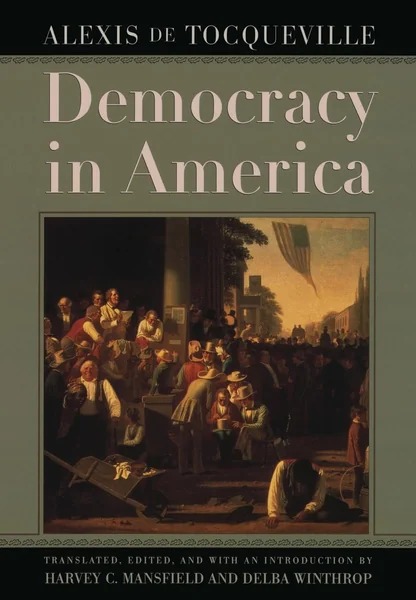
- Title: Democracy in America
- Author (full name): Alexis de Tocqueville
- Genre: Political Science/Sociology/Non-Fiction
- Sub-genre or series: Classic political observation/analysis
- Fiction or Non-Fiction: Non-Fiction
- Publication year: Originally 1835-1840 (this edition 2010)
- Setting: 1830s America, observations of American democratic society
- Democracy in America themes explained
- Tocqueville observations still relevant
- Democracy in America reading difficulty
- best translation Democracy in America
- why read Democracy in America 2026
Is Democracy in America worth reading today? Nearly two centuries after its publication, Tocqueville's masterful analysis of American democratic society remains one of the most penetrating examinations of democracy ever written. This French aristocrat's observations of 1830s America continue to illuminate the tensions and contradictions within democratic systems that persist in modern political discourse.
Tocqueville arrived in America in 1831 ostensibly to study the prison system, but his true mission became far grander: understanding how democracy actually functions in practice. The resulting work stands as both historical document and prophetic analysis, offering insights that feel startlingly contemporary. Where other political theorists dealt in abstractions, Tocqueville grounded his observations in the lived reality of American democratic culture.
A Foreign Eye on American Exceptionalism
Tocqueville's outsider perspective proves crucial to his analytical power. Writing as a French aristocrat observing a young republic, he identified patterns and tendencies that Americans themselves might have missed. His famous concept of "democratic despotism" - the idea that democracy could evolve into a soft tyranny of conformity - anticipated concerns about mass society that wouldn't become widespread until the 20th century.
The author's methodology combines systematic observation with philosophical reflection. He doesn't merely describe American institutions; he analyzes their deeper logic and potential consequences. His discussion of American individualism, for instance, goes beyond surface-level observations to examine how democratic equality shapes social relationships and civic engagement.
The Enduring Power of Tocqueville's Insights
Democracy in America themes explained reveal the book's continued relevance. Tocqueville's analysis of the "tyranny of the majority" resonates in our era of polarized politics and social media echo chambers. His observations about American materialism and the pursuit of prosperity feel remarkably contemporary, as does his concern about the potential for democratic societies to become absorbed in private interests at the expense of civic participation.
The work's treatment of religion in democratic society remains particularly insightful. Tocqueville argued that religion serves as a crucial counterbalance to democratic individualism, providing shared moral frameworks that prevent society from fragmenting entirely. This tension between individual liberty and social cohesion continues to shape American political debates.
His examination of voluntary associations as the foundation of American civil society anticipated modern discussions about social capital and civic engagement. Tocqueville observations still relevant include his recognition that democracy requires active citizen participation to remain healthy - a concern that echoes in contemporary worries about declining civic involvement.
Wrestling with Dense but Rewarding Prose
Democracy in America reading difficulty stems not from complex vocabulary but from the work's comprehensive scope and analytical depth. Tocqueville writes with the measured cadence of 19th-century scholarship, requiring patience from modern readers. The text demands active engagement; this isn't a book to skim casually.
The translation quality significantly affects readability. Various English editions exist, and choosing the right one matters. The Mansfield and Winthrop translation strikes an effective balance between accuracy and accessibility, preserving Tocqueville's analytical precision while making his arguments clear to contemporary readers.
Tocqueville's method involves building complex arguments through accumulated observations and examples. He rarely states conclusions directly, instead guiding readers through his reasoning process. This approach rewards careful reading but can frustrate those seeking quick insights or simple answers.
The Limitations of Historical Perspective
While Tocqueville's insights remain valuable, the work reflects the limitations of its era. His observations about race and slavery, though more progressive than many contemporaries, feel inadequate by modern standards. His analysis focuses primarily on white male political participation, reflecting the restricted democracy of his time.
The author's aristocratic background, while providing useful analytical distance, also introduces certain blind spots. His concerns about democratic equality sometimes reflect class anxieties rather than objective analysis. Modern readers must distinguish between Tocqueville's enduring insights about democratic governance and his specific 19th-century prejudices.
Some sections feel dated in their specific focus on institutions and practices that have evolved significantly. The detailed discussions of local government structures, while historically valuable, may feel less immediately relevant to contemporary readers seeking broader insights about democratic society.
A Foundation for Understanding Democracy
Why read Democracy in America 2026 becomes clear when considering how few works offer such comprehensive analysis of democratic culture. Unlike purely theoretical treatments of democracy, Tocqueville's work examines how democratic ideals translate into daily social and political practice. His insights about the relationship between equality and freedom remain central to contemporary political philosophy.
The book serves as essential preparation for understanding American political development. Later observers from James Bryce to Robert Putnam build explicitly on Tocqueville's framework, making familiarity with his arguments crucial for serious students of American democracy.
Perfect for readers interested in political philosophy, American history, or contemporary democratic theory, though it requires commitment and patience. The work rewards those willing to engage seriously with complex ideas rather than seeking easy answers to political questions.