BOOKS
Published

Read Time

8 min read

Our Rating

4.2

Curated & edited by

LuvemBooks Editorial

How we create our reviews →
Share This Review

Horus Rising by Dan Abnett Review: Where an Empire Begins to Crack

Our Rating

4.2

A disciplined, surprisingly literary series opener, Horus Rising establishes the Horus Heresy with genuine craft and tragic weight — though its deliberate pacing and commitment to setup over payoff require patient readers.

In This Review
  • What Works & What Doesn't
  • The Weight of a Galaxy on the Brink
  • Dan Abnett's Craft: Military Prose With Mythic Undertones
  • Horus, the Imperium, and the Men Between Them
  • Themes of Loyalty, Hubris, and the Cost of Empire
  • Content Warnings and Audience Fit
  • Where It Falls Short
  • The Bottom Line

What Works & What Doesn't

What Works
  • Abnett writes unusually literary prose for tie-in fiction, with strong dialogue and controlled pacing
  • Horus is rendered as a genuinely sympathetic, complex figure rather than a simple villain-in-waiting
  • The thematic exploration of empire, loyalty, and constructed heroism is sophisticated and sustained
  • Accessible to Warhammer newcomers without sacrificing depth for existing fans
  • The Whisperhead Mountains campaign builds atmosphere and dread effectively in its early stages
What Doesn't
  • Middle sections feel repetitive, particularly during extended battle sequences
  • Several supporting figures are underdeveloped, serving the plot more than the story
  • The ending prioritizes series setup over standalone satisfaction, which may frustrate some readers

The Weight of a Galaxy on the Brink

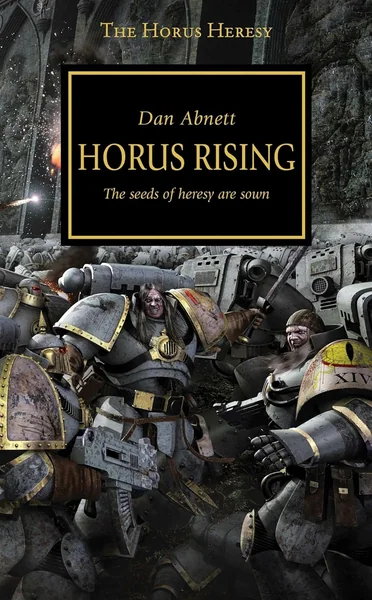
Horus Rising (The Horus Heresy) by Dan Abnett front cover
Is Horus Rising worth reading if you've never opened a Warhammer novel before? That's the question most newcomers ask, and the answer is more layered than a simple yes or no. The short verdict: it is one of the rare tie-in novels that earns genuine literary respect — a tragedy with weight, not just lore. Published in 2006, Dan Abnett's Horus Rising launches one of the most ambitious shared-universe fiction projects in modern genre publishing — The Horus Heresy series. Set in the 31st Millennium, it chronicles the early events that will eventually tear the Imperium apart, beginning with the campaigns of Horus, Warmaster of the Emperor's armies.
As a Dan Abnett book, Horus Rising will appeal to readers who enjoy sprawling military science fiction. The scale is epic, the mythology deep, and the political tension slow-burning. But Horus Rising is also something more specific: it is a prequel to catastrophe, and Abnett writes it with that tragic weight in every scene.
The cover art (note: varies by edition) has become iconic in Warhammer 40K circles, signaling the book's blend of grandeur and darkness through its martial imagery — a visual language that mirrors the narrative's tone.

Dan Abnett's Craft: Military Prose With Mythic Undertones

Dan Abnett has a long reputation as one of the sharpest writers working in the Warhammer fictional universe, and this novel demonstrates why. His prose is clean, purposeful, and surprisingly literary for tie-in fiction. He resists the temptation to front-load exposition, instead trusting readers to absorb the world's terminology organically, the way a soldier might absorb the language of a foreign campaign.
The pacing in the novel's first half is deliberate. Dan Abnett establishes the culture of the Space Marines — their brotherhood, their rituals, their relationship with mortality — before destabilizing it. This structural patience pays off. By the time ideological fractures begin to appear, the reader has a genuine investment in what is being lost.
The dialogue is often excellent. Characters speak with a militaristic formality that occasionally breaks into something more human, and those moments of vulnerability are among the book's most effective. Abnett also handles action sequences with clarity, avoiding the chaotic noise that bogs down lesser military fiction.
That said, the book's pacing can feel uneven. Some readers find the sections focused on the campaign in the Whisperhead Mountains more dutiful than thrilling. Abnett is building toward something, and he knows it, but patience is required.

Horus, the Imperium, and the Men Between Them

The central figures here are Horus himself and the vast institution of the Imperium he serves. Abnett's great achievement is making Horus genuinely sympathetic — noble, charismatic, and burdened. This is not a villain's origin story told cheaply. It is a portrait of a great man in the last moments before greatness becomes something else entirely.
The novel also populates itself with soldiers, remembrancers (embedded civilian observers), and officers whose perspectives give the world texture. These supporting figures ground the cosmic scale in something human. The remembrancers in particular serve a clever narrative function: they are outsiders to the military culture, and through their eyes, readers who are themselves outsiders to this universe find a point of entry.
The relationship between individual loyalty and institutional faith runs through every interaction. Soldiers don't just follow orders; they believe in the order of things. Abnett understands that the most devastating betrayals are always ideological before they are personal.

Themes of Loyalty, Hubris, and the Cost of Empire

The Horus Heresy series is, at its core, a story about how empires devour their best servants. Horus Rising establishes that theme with precision. The Imperium is presented not as unambiguously heroic but as a machinery of conquest — efficient, vast, and indifferent to the individuals it grinds up.
The book's most interesting tension lies in the gap between the Emperor's vision and the reality of how that vision is implemented. Horus is the instrument of a power he both reveres and quietly questions. Abnett never makes this subversion crude or obvious. It accumulates in glances, in half-formed doubts, in the things soldiers say around campfires far from Terra.
This is also a novel about the constructed nature of heroism. The remembrancers are there to document glory — and their presence raises uncomfortable questions about who controls the narrative of conquest. For a tie-in novel rooted in a tabletop gaming franchise, this is genuinely sophisticated territory.

Content Warnings and Audience Fit

Horus Rising contains significant military violence, including battle scenes with considerable brutality. There is no sexual content, but the thematic material — genocide framed as civilizing mission, ideological radicalization, the psychological cost of endless war — is adult in a serious sense. This is not a novel for younger readers, despite the cover's surface resemblance to action-figure aesthetics.
For readers new to Warhammer 40,000 lore, the novel is more accessible than most entry points into this universe. Dan Abnett avoids drowning newcomers in terminology, and the emotional core is universal enough to carry readers who know nothing about the franchise's mythology.
Those already embedded in Warhammer lore will find this novel richly rewarding — a canonical foundation rendered with genuine craft rather than mere competence.

Where It Falls Short

Horus Rising is not a perfect novel. The sheer weight of worldbuilding occasionally pulls against narrative momentum. Some secondary figures feel thinly sketched, present more to populate scenes than to develop meaningfully. And because this is a series opener, the novel's ending is more arrival than resolution — it closes a chapter but refuses to close the story, which can feel unsatisfying to readers who prefer self-contained arcs.
There is also a sameness to some of the battle sequences. Abnett writes action well, but repetition sets in across the Whisperhead Mountains campaign, and the tactical clarity that serves earlier scenes can become routine as the engagements accumulate.

The Bottom Line

Horus Rising is a remarkable achievement in tie-in fiction — literary in ambition, disciplined in execution, and genuinely moving in its portrait of loyalty on the edge of collapse. It makes Horus a protagonist worth mourning, while planting the seeds of a tragedy the reader already knows is coming.
Abnett writes science fiction that takes its genre seriously without apologizing for it. For readers willing to invest in the long game, Horus Rising is one of the strongest series openers in modern military SF — not because it checks genre boxes, but because it makes Horus's fall feel earned before it even begins.
If you want military SF that earns its tragedy — and you're ready to commit to a series — Horus Rising belongs on your shelf.

Sources & Further Reading

Key facts and claims in this review are grounded in retrieved, verified sources. Each numbered source matches the reference marker shown beside that fact in the review above.

  1. 1
    Dan Abnett — author profileHigh-authority source

    Dan Abnett, Wikipedia