BOOKS
Published

Read Time

7 min read

Reader rating

4.6

· 313 Amazon ratings
reader ratings, not a LuvemBooks score
Curated & edited by

LuvemBooks Editorial

How we create our reviews →
Share This Review

The Overthinker's Guide to Making Decisions by Joseph Nguyen Review: A Practical Companion for Decision-Paralyzed Readers

A New York Times bestseller from the author of the international bestseller Don't Believe Everything You Think, The Overthinker's Guide to Making Decisions is a self-help guide designed to move chronic overthinkers from mental paralysis to clear, intuitive decision-making through a structured framework and a series of trust-building exercises — reviewed here on the basis of its content and published reception, not hands-on application.
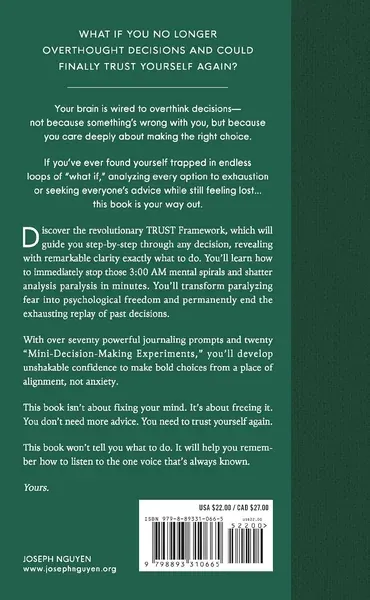
Back cover with synopsis, book description, journaling prompts section, author name, and barcode.Tap to enlarge

LuvemBooks Verdict

Best for

Readers who already identify with decision paralysis and overthinking, particularly those who connected with Nguyen's Don't Believe Everything You Think and are looking for a more operationally focused, framework-driven companion to help them build everyday decision confidence.

Worth it if

You're drawn to accessible, self-trust-oriented personal development tools — a named framework plus graduated exercises — rather than clinically or empirically grounded decision-making theory.

Skip if

You prefer decision-making approaches rooted in cognitive behavioural psychology, behavioural economics, or peer-reviewed science, as this guide's intuition-centred philosophy operates in a fundamentally different register.

Publisher and bookseller descriptions retrieved from Barnes & Noble and Joseph Nguyen's own site confirm the book debuted as a New York Times Bestseller, positioning it as a companion guide to Nguyen's international bestseller Don't Believe Everything You Think, with the central promise of transforming "the paralyzing cycle of overthinking into clear, intuitive decision-making." Simon & Schuster's listing emphasises the book's practical core — 20 Mini Trust Experiments designed to "build decision confidence in just days" — framing the guide's goal as freeing rather than fixing the reader's mind.

Sources: Barnes & Noble, Simon & Schuster, josephnguyen.org
4.6from 313 Amazon ratings— reader ratings, not a LuvemBooks score

Look inside the book

Preview the actual pages, via Google Books
In This Review
  • What Works & What Doesn't
  • What the Book Is and Does
  • The Core Framework and Exercises
  • Nguyen's Standing and the Book's Reach
  • What the Book Claims to Address — and Its Limitations
  • Who This Book Is For

What Works & What Doesn't

What Works
  • A New York Times bestseller with proven broad appeal, building on Nguyen's already internationally successful body of work
  • Offers a concrete, named decision-making system (the TRUST framework) alongside 20 graduated practical exercises, giving the guide clear structural scaffolding
  • Accessible in scope — designed to be approachable rather than academically demanding, suiting readers who want tools they can apply without specialized background knowledge
  • Squarely focused on a single, widely relatable problem: decision paralysis from overthinking, making it easy for readers to self-identify as the intended audience
What Doesn't
  • The book's philosophy centers on rebuilding self-trust and listening to one's inner voice, an orientation that readers who prefer clinically or empirically grounded decision-making frameworks may find insufficiently rigorous
  • Positioned explicitly as a companion to Don't Believe Everything You Think, meaning readers less aligned with Nguyen's broader philosophical worldview may find the approach less resonant
This review covers the book's content and published reception from available sources; it does not reflect hands-on use or application of its methods.

What the Book Is and Does

Published by Authors Equity in November 2025, The Overthinker's Guide to Making Decisions is a self-help guide positioned explicitly as a companion to Joseph Nguyen's previous work, the international bestseller Don't Believe Everything You Think. Where the earlier book addressed the nature of thought itself, this follow-up narrows its focus to one of overthinking's most common and costly expressions: the inability to make decisions with confidence. The publisher's description frames the book's central argument plainly — that the brain is wired to overthink decisions not because something is wrong with the reader, but because they care deeply about getting things right. The book's stated aim is not to fix the mind but, in its own words, to free it.

The Core Framework and Exercises

The book's structure is built around two main offerings. The first is the TRUST framework, described by the publisher as a step-by-step process designed to walk readers through any decision and arrive at what the book calls "absolute clarity." The second is a set of 20 "Mini Trust Experiments" — low-stakes, everyday exercises intended to build decision confidence incrementally over the course of days by using routine choices to gradually dismantle patterns of self-doubt. The combination of a named, repeatable framework alongside concrete, graduated practice exercises gives the guide a scaffolded quality: it moves from conceptual understanding toward applied habit formation, which is a recognizable and deliberate structural choice in the self-help genre.

Nguyen's Standing and the Book's Reach

Nguyen arrives at this title with significant credibility in the popular self-help space. Don't Believe Everything You Think became a New York Times bestseller and an international bestseller, establishing him as a writer with demonstrated reach across a broad, non-specialist readership. The Overthinker's Guide to Making Decisions has itself debuted as a New York Times bestseller, suggesting that his audience followed him into this companion volume. For readers already familiar with his earlier work, the guide offers a more operationally focused entry point — less philosophical in scope, more structured around actionable tools.
Back cover with synopsis, book description, journaling prompts section, author name, and barcode.

What the Book Claims to Address — and Its Limitations

The guide's stated intellectual grounding includes identifying what it calls the "neurological root of overthinking" — the claim that there is a specific, identifiable brain-based mechanism behind decision paralysis that, once understood, allows readers to interrupt mental spirals before they escalate. This kind of neuroscience-adjacent framing is common in popular self-help, and readers who prefer frameworks rooted in clinical psychology or peer-reviewed behavioral science may find the book's approach too intuition-centered. The book's philosophy is overtly self-trust oriented: it positions the reader's own inner voice as the primary decision-making resource, which is a perspective that resonates strongly with some audiences and reads as insufficiently rigorous to others. Those seeking decision-making tools grounded in formal cognitive behavioral frameworks or economic decision theory will find this guide operates in a different register entirely.

Who This Book Is For

At 192 pages, The Overthinker's Guide to Making Decisions is designed to be accessible rather than exhaustive — a guide that can be moved through without the time investment of a densely academic text. It is best suited to readers who already identify with the experience of overthinking and are looking for a structured, approachable path toward greater self-trust, particularly those who responded to Nguyen's earlier work and want more applied tools. Readers new to Nguyen who are drawn to accessible, framework-driven personal development writing — rather than data-heavy behavioral science — are its natural audience. Its companion-guide positioning means it builds on a worldview already established in Don't Believe Everything You Think, and while it is not necessary to have read that book first, readers who share Nguyen's philosophical orientation will get the most from it.

Sources & Further Reading

The key facts and claims in this review are grounded in the retrieved, verified sources listed below.

  1. Cited in this review
  2. 1
  3. 2
  4. Further reading
  5. 3
  6. 4
  7. 5
  8. 6
  9. 7