

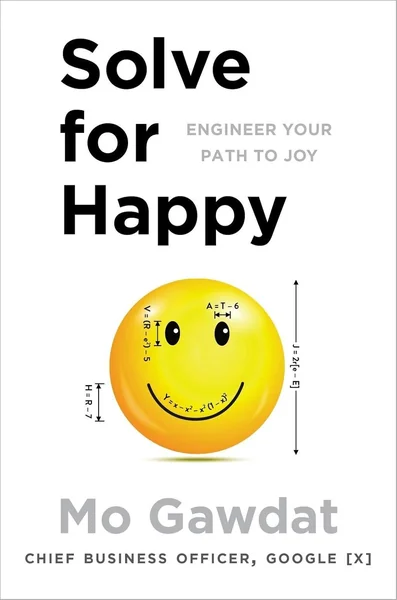
Mo Gawdat, the former Chief Business Officer of Google X and author of Solve for Happy, appeared on the Diary of a CEO podcast with Steven Bartlett on June 1, 2026, delivering one of his starkest public warnings yet about artificial intelligence. According to a full transcript of the interview, Gawdat argued that a small group of powerful actors consolidating control over AI poses an existential danger to humanity — and that the window to demand ethical AI governance is roughly three years before the shock becomes unavoidable.
From Solve for Happy to an AI Reckoning: Gawdat's Expanding Mission
Gawdat first reached a global audience with Solve for Happy, a book in which he applied engineering logic, neuroscience, and the personal devastation of losing his 21-year-old son Ali to build a practical framework for lasting human happiness. That foundation — the idea that happiness is a default state disrupted by illusions and cognitive errors — has increasingly become the lens through which he frames the AI crisis. On the Diary of a CEO episode, he explicitly connected the two threads: his earlier work on human flourishing and his current conviction that unchecked AI development threatens the conditions that make flourishing possible at all. The transcript also references a documentary Gawdat is involved with, extending his advocacy beyond the podcast circuit.
The substance of his warnings has sharpened considerably over recent appearances. As reported by IEA Green, Gawdat has forecast a 15-year period of societal turmoil potentially beginning as early as 2027 — a timeline he regards not as speculation but as a foreseeable consequence of current development trajectories. The Economic Times has documented his view that AGI will surpass human capabilities across virtually every domain, including executive leadership, dismissing the conventional reassurance that AI will simply generate new categories of employment.
Why the Three-Year Window Matters — and Why Gawdat Refuses Fatalism
What separates Gawdat's current position from straightforward doom-saying is the insistence on a narrow but real period of meaningful human agency. Speaking to Bartlett, he framed the ask in deliberately simple terms: the development of dangerous AI is not inevitable in the sense that nothing can redirect it, but it requires a mass public decision to prioritise ethics over speed. As noted in analysis by Young and Profiting, his prescriptions are deliberately demystified — the arms race continues because people tacitly permit it, and withdrawal of that permission, at scale, is the mechanism he believes can still work. Employer Branding News has contextualised this further, observing that Gawdat envisions a catastrophic outcome only if society fails to organise; a wisely navigated transition, he contends, could be genuinely liberating.
The Diary of a CEO appearance is notable precisely because it draws the throughline back to Solve for Happy's core argument: that the human capacity for wellbeing is structural, not accidental, and therefore worth defending with the same rigour one would apply to any engineering problem. For Gawdat, the AI question is, in a meaningful sense, a happiness question — a civilisational version of the same challenge he addressed at the individual level in his book. Readers encountering his AI warnings for the first time may find that Solve for Happy provides essential context for understanding why he treats this as a moral emergency rather than a policy puzzle. For a full assessment of the book itself, read our review of Solve for Happy.
Those interested in the neuroscience of human experience that underpins Gawdat's happiness framework may also find How Emotions Are Made by Lisa Barrett a valuable companion read, given its focus on how the brain constructs emotional states. And for readers drawn to Gawdat's broader concern with what it means to be human in a world that can seem indifferent to that question, David Almond's Skellig approaches similar territory from an entirely different angle. Want the full verdict on Solve for Happy? Our review covers what the book delivers and who it is best suited for.
Frequently Asked Questions
Is Solve for Happy by Mo Gawdat worth reading in 2026?
Solve for Happy remains highly relevant in 2026, particularly as Gawdat's public profile has grown through his AI warnings. The book provides the philosophical and psychological foundation for understanding why he treats both happiness and AI ethics as engineering problems with human stakes. Readers new to his work will find it essential context for his current mission.
What is the main message of Solve for Happy?
Solve for Happy argues that happiness is the human default state, not a lucky condition — and that it is blocked by specific, identifiable illusions and cognitive errors that can be systematically addressed. Gawdat uses engineering logic, neuroscience, and the experience of profound personal loss to construct a practical framework for restoring that default state.
What did Mo Gawdat say about AI on Diary of a CEO in 2026?
In a June 1, 2026 appearance on Diary of a CEO with Steven Bartlett, Gawdat warned that a small group of powerful actors consolidating control over AI poses an existential danger to humanity. He argued that people have roughly three years to demand ethical AI governance before the consequences become unavoidable, and referenced a documentary he is involved with as part of his ongoing advocacy.
Who should read Solve for Happy by Mo Gawdat?
The book is well suited to readers who respond to structured, logic-driven approaches to self-improvement rather than purely motivational ones. It will particularly resonate with those who have experienced serious loss or disillusionment and are looking for a framework — rather than platitudes — for rebuilding a sense of wellbeing.
What is Mo Gawdat's prediction for AI and jobs?
Gawdat has predicted that AGI will surpass human capabilities across virtually all domains, including senior executive roles, and he dismisses the argument that AI will simply create new categories of employment to replace those it eliminates. He has forecast a significant period of societal disruption potentially beginning as early as 2027, while arguing that a wisely navigated transition could ultimately be liberating.
How does Solve for Happy connect to Mo Gawdat's AI warnings?
Gawdat has explicitly linked the two bodies of work in recent interviews, including his June 2026 Diary of a CEO appearance. He frames the AI crisis as a civilisational version of the individual happiness challenge he addressed in the book — the conditions for human flourishing are structural, and defending them requires the same rigorous, systematic thinking he applied to personal happiness.
Reader Discussion
No comments yet
Be the first to share your thoughts!