BOOKS
Published

Read Time

8 min read

Reader rating

4.7

· 54 Amazon ratings
reader ratings, not a LuvemBooks score
Curated & edited by

LuvemBooks Editorial

How we create our reviews →
Share This Review

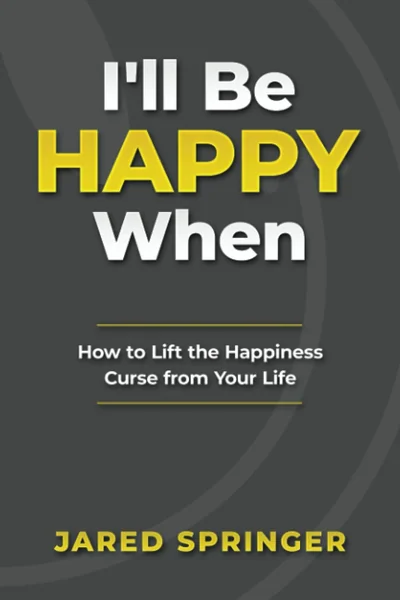
I'll Be Happy When... by Jared Springer Review: A Self-Help Journey Beyond Entrepreneurial Success

Jared Springer's I'll Be Happy When...: How to Lift the Happiness Curse from Your Life is a self-help book rooted in the author's own entrepreneurial story — a candid account of achieving financial success only to discover that happiness remained elusive, and a practical guide designed to help readers break the cycle of conditional happiness. This review is based on the book's content and available published sources, not hands-on application.
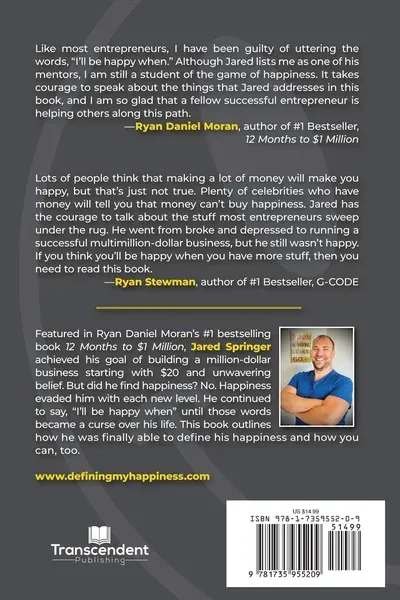
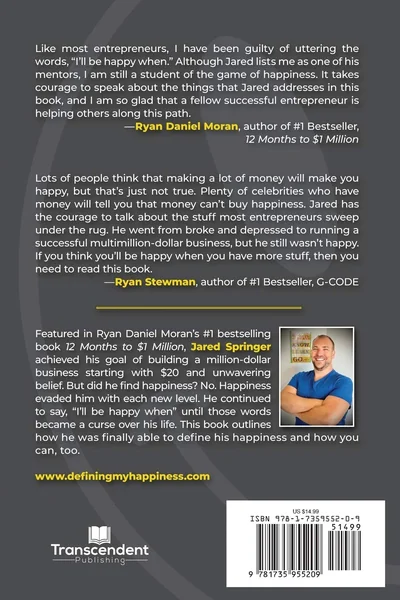
Back cover with synopsis, author endorsements from business authors, book details, and author photo.Tap to enlarge

LuvemBooks Verdict

Best for

Entrepreneurially minded readers who recognise the habit of deferring happiness to the next milestone and want a concise, story-led guide to breaking that cycle without abandoning their ambition.

Worth it if

You connect best with lived experience as a vehicle for insight — particularly if you're building a business and want permission to pursue contentment and drive simultaneously rather than sequentially.

Skip if

You're looking for a research-cited, clinically structured self-help program with deep-dive frameworks, as the book's 190-page, memoir-heavy approach functions more as an accessible introduction than an exhaustive practical manual.

Independent critical coverage from major publications is absent from the verified record for this title. The primary reception signals come from Springer's own platform (jaredspringer.com and book.jaredspringer.com), which describes the book as a bestseller that has changed lives across a global coaching audience — claims that should be read in that context.

Sources: jaredspringer.com, book.jaredspringer.com
4.7from 54 Amazon ratings— reader ratings, not a LuvemBooks score

Age & Reading Level

Recommended age

Adult

Reading level

Adult

Skip if you prefer heavily research-cited or clinically structured self-help methodology over narrative and experiential frameworks.

In This Review
  • What Works & What Doesn't
  • What the Book Is and What It Argues
  • The Entrepreneurial Backstory That Drives It
  • Design and Intended Audience
  • Reception and Reach
  • Who Will Get the Most From It — and Who May Want More

What Works & What Doesn't

What Works
  • Grounded in a compelling, specific personal narrative — Springer's journey from a nine-year-old detailing cars to building a million-dollar business gives the central argument authentic weight.
  • Addresses a genuinely widespread psychological pattern — the habit of deferring happiness to future milestones — that resonates across professional and personal contexts.
  • Positioned as a complement to ambition rather than a rejection of it, making it accessible to entrepreneurially minded readers who don't want to choose between drive and contentment.
  • At 190 pages, the book is concise and designed for accessibility, lowering the barrier for readers who might not engage with longer self-help titles.
  • Has reached a broad audience through both print and audiobook formats, with Springer's profile amplified by his inclusion in Ryan Daniel Moran's bestselling *12 Months to $1 Million*.
What Doesn't
  • The framework is primarily experiential and narrative-driven; readers who prefer research-backed, clinically structured self-help may find the approach less rigorous than they'd like.
  • Independent critical coverage from major publications is limited in the verified record, making it harder to assess the book's reception beyond the author's own platform and audience.
  • Its brevity, while an accessibility strength, means the book functions more as an introduction to the concept than an exhaustive practical program — readers seeking comprehensive tools may need to supplement it.
A self-help book grounded in the author's firsthand reckoning with a common human trap: deferring happiness until the next milestone, only to find the finish line keeps moving.

What the Book Is and What It Argues

I'll Be Happy When... centers on a deceptively simple but deeply ingrained pattern of thinking — the habit of telling oneself that contentment is conditional on reaching a future goal. Jared Springer frames this pattern as a "curse," and the book's stated mission is to help readers lift it. Springer's argument, as the publisher describes it, is that even when people arrive at their long-awaited "I'll be happy when" moment, happiness still doesn't follow — unless they have first done the inner work of understanding what genuinely makes them tick. The book is designed to guide readers through that inner work, moving from diagnosis of the problem to a framework for finding happiness in tandem with ambition rather than in place of it.
those words became a curse over his life.

The Entrepreneurial Backstory That Drives It

The book's foundation is Springer's own biography, which gives the argument its credibility and texture. He began his entrepreneurial path at the age of nine, working alongside his father detailing cars at dealerships after school and into the night. He later built a million-dollar business starting, as the publisher notes, with twenty dollars and a YouTube education — a journey detailed in Ryan Daniel Moran's bestselling 12 Months to $1 Million. Yet, as the publisher's description makes plain, financial achievement brought no lasting happiness. Springer found himself repeating "I'll be happy when" at each new level of success until, as the description states, "those words became a curse over his life." That turning point — the realization that the formula was broken — is what prompted both the personal transformation and the book itself.

Design and Intended Audience

The book is structured to serve a dual audience: entrepreneurs and ambitious individuals who have tied their sense of self-worth to external outcomes, as well as anyone stuck in a cycle of deferred joy. Springer positions it not as a rejection of ambition but as a recalibration — the publisher's materials indicate his subsequent work has involved coaching and teaching people to find happiness while growing their businesses and incomes, rather than instead of it. The book is written in the first person and draws heavily on memoir, but its explicit design intent is instructional: readers are meant to recognize their own patterns in Springer's story and extract applicable lessons. At 190 pages, it is a concise, accessible read rather than an exhaustive academic treatment of positive psychology.
Back cover with synopsis, author endorsements from business authors, book details, and author photo.

Reception and Reach

Springer's author website describes the book as having become a bestseller and as having changed lives across a global coaching audience, though these claims come from the author's own platform and should be read in that context. The book has also appeared in audiobook form, with an unabridged edition noted as available through Apple Books. Independent critical reviews from major publications are not part of the verified record for this title, so the primary reception signal available comes from Springer's own account of its impact. Readers approaching this book from a research-backed psychology standpoint may find the framework more experiential and narrative-driven than empirically documented.

Who Will Get the Most From It — and Who May Want More

The book is most squarely aimed at readers who recognize the "I'll be happy when" pattern in themselves and are open to a personal-story-led approach to breaking it. Those who prefer a heavily research-cited or clinically structured self-help methodology may find Springer's narrative style less aligned with their expectations. Conversely, readers who connect best with lived experience as a vehicle for insight — particularly those in the entrepreneurial or business-building world — are the audience this book was clearly written for. Its brevity makes it an entry point rather than a comprehensive program, which is a strength for accessibility but means readers seeking deep-dive frameworks may wish to pair it with additional resources.

Sources & Further Reading

The key facts and claims in this review are grounded in the retrieved, verified sources listed below.

  1. Cited in this review
  2. 1
  3. 2
  4. 3
  5. Further reading
  6. 4

    jaredspringer.com

  7. 5
  8. 6
Related Reviews

Reviews of books we picked for readers who enjoyed I'll Be Happy When ....