
8 min read
4.7
· 24,777 Amazon ratingsShare This Review
Get Out of Your Head by Jennie Allen Review: A Faith-Based Guide to Reclaiming Your Mind
Jennie Allen's Get Out of Your Head is a New York Times bestseller and ECPA bestseller that has sold over one million copies, blending biblical teaching with neuroscience to help readers identify and disrupt toxic thought patterns such as victimhood, anxiety, and distraction. Published by WaterBrook on January 28, 2020, it is Christian nonfiction designed for readers who want practical, spiritually grounded tools for transforming how they think — and, by extension, how they live.
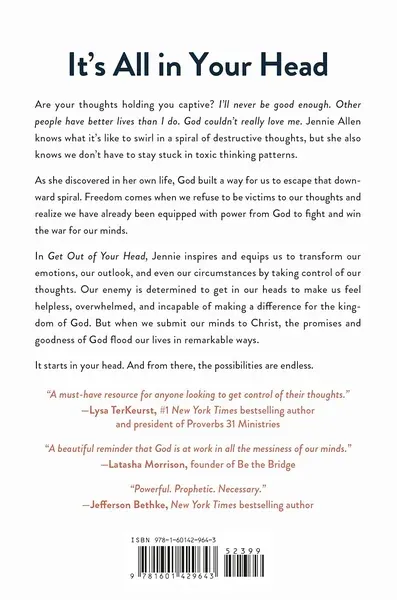 Tap to enlarge
LuvemBooks Verdict
Best for
Christian readers — particularly those inside a faith community — who recognise specific thought traps like unworthiness, comparison, or anxious rumination in themselves and want a structured, biblically grounded framework for breaking those patterns in everyday life.
Worth it if
The book rewards readers who want more than passive devotional reading: its combination of named toxic-thought categories, neuroscience framing, and interactive exercises like the thought-mapping worksheet gives the spiritual argument a repeatable, practical shape.
Skip if
Readers outside a Christian worldview, or those seeking clinical depth on the order of cognitive-behavioural therapy, will find that the neuroscience component serves the theological argument rather than standing independently — and the book's core solution simply does not translate beyond a faith framework.
What readers & critics say
Baptist Messenger describes the book as "life-changing" and highlights Allen's central contention that "the greatest spiritual battle of our generation is being fought between our ears," praising her passion for helping readers capture false, destructive thoughts. ChristPulse notes that readers praise it as a life-changing resource for confronting negative thinking, and specifically commends how Allen equips readers to identify the toxic thought patterns that hold them captive.
Sources: Baptist Messenger, ChristPulseLook inside the book
Preview the actual pages, via Google BooksIn This Review
- What Works & What Doesn't
- What the Book Actually Is and Argues
- Scope, Structure, and Practical Design
- Reception and Cultural Standing
- Genuine Strengths
- Limitations and Who May Find It Frustrating
What Works & What Doesn't
What Works
- New York Times and ECPA bestseller with over one million copies sold, reflecting wide resonance in Christian nonfiction
- Addresses specific, named toxic thought patterns — unworthiness, comparison, anxiety, victimhood — rather than speaking in vague generalities
- Combines biblical teaching with neuroscience, giving the framework broader accessibility as a dual-lane entry point
- Includes structured, interactive exercises (such as a thought-mapping worksheet) designed to make practice repeatable, not just theoretical
- Endorsed by prominent voices across the evangelical world, including Lysa TerKeurst and Jefferson Bethke, signaling its standing in mainstream Christian life-change literature
What Doesn't
- Firmly rooted in Christian theology — readers outside a faith framework will find the core solution does not translate to a secular or clinical worldview
- The neuroscience component primarily serves to support the spiritual argument rather than standing as independent clinical or psychological depth, which may disappoint readers seeking rigorous therapeutic grounding
What the Book Actually Is and Argues

Scope, Structure, and Practical Design
Reception and Cultural Standing
Genuine Strengths
Limitations and Who May Find It Frustrating
Frequently Asked Questions
Sources & Further Reading
The key facts and claims in this review are grounded in the retrieved, verified sources listed below.
- Cited in this review
- 1
- 2
- Further reading
- 3
- 4
- 5
- 6
- 7
Related Reviews
Reviews of books we picked for readers who enjoyed Get Out of Your Head.

Reader Comments
No comments yet
Be the first to share your thoughts!