Skip to content
Reviewed

Read Time

7 min read

Our age bandAdult
Reader rating
4.6 · 4,274 Amazon ratings, as of Nov 2026
reader ratings, not a LuvemBooks score
Curated & edited by

LuvemBooks Editorial

How we create our reviews →
Share This Review
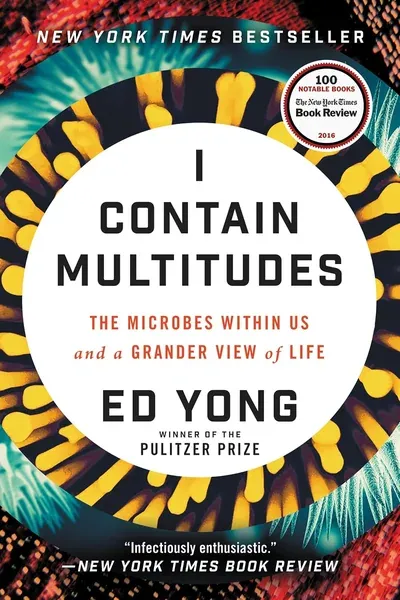
I Contain Multitudes: The Microbes Within Us and a Grander View of Life ― A Popular Science Look at Microbes and Life by Ed Yong front cover

Our review

I Contain Multitudes

I Contain Multitudes by Ed Yong Review: Microbial Foundations

I Contain Multitudes by Ed Yong reframes biology through the lens of the microbiome, arguing that microbes are foundational to all life rather than mere pathogens. The text synthesizes decades of research to reveal how microscopic partnerships shape ecology and human biology. It stands as a rigorous, sweeping survey for readers ready to engage with dense scientific material.

Our age band: Adult

LuvemBooks Verdict

Best for

Readers fascinated by ecological networks seeking a comprehensive overview of scientific studies will appreciate this book.

Worth it if

Worth reading if you are willing to engage with dense scientific material and appreciate rigorous popular science that prioritizes broad evolutionary narratives over personal health advice.

Skip if

Skip it if you seek a casual introduction to the subject or practical advice on diet and hygiene, as the ambitious scope demands sustained attention and operates as a dense survey rather than a targeted guide.

Where reviewers agree and split

Readers rate it 4.6 on Amazon. The reviews we read that discuss it in depth agree:

  • Positive

    The Guardian · Press review: praises the book as masterful and life-changing

  • Positive

    Kirkus Reviews · Press review: highly praises its informative and beautiful writing

Overall verdicts are our summary of each review we read, from its headline, rating and conclusion.

The Guardian praises Yong's masterful storytelling that shifts the reader's cosmology, while Kirkus Reviews highlights the book's exceptionally informative and beautifully written prose that breaks down complex science for a wide audience.

“compels us look anew at the world.”

— The Guardian

“exceptionally informative, beautifully written book”

— Kirkus Reviews
Sources: The Guardian, Kirkus Reviews
4.6from 4,274 Amazon ratings, as of Nov 2026— reader ratings, not a LuvemBooks score

Ask LuvemBooks

Was this helpful?

I Contain Multitudes uses the microbiome to reshape our understanding of life, arguing that microscopic partnerships shape ecology and human biology. The Guardian and Kirkus praise its masterful synthesis of decades of research, making it highly recommended for serious readers. It stands as a rigorous, sweeping exploration for those who appreciate evolutionary history over casual introductions.
Is it worth reading?
It is highly recommended for readers seeking a comprehensive overview of scientific studies. Critics praise its ability to balance rigorous scientific accuracy with accessible narrative pacing, transforming abstract data into human stories. However, it may disappoint those seeking a casual introduction or guidance on hygiene.
Similar books
Readers looking for foundational scientific guides will appreciate An Immense World by Ed Yong, which explores how animals sense their hidden realms. The Body: A Guide for Occupants offers a similarly sweeping, accessible tour of human biology and its internal systems. For those interested in ecological networks, The Hidden Life of Trees examines the interconnected world of plants, while The Demon-Haunted World provides a masterclass in scientific literacy and skepticism.
Who should read this?
This book is tailored for readers fascinated by evolutionary history and ecological networks seeking a comprehensive overview of scientific studies. It rewards those who appreciate rigorous scientific writing. It is less suitable for casual readers or those seeking targeted medical applications.
What are the main themes?
The central argument pivots on precedence, noting that complex organisms evolved to coexist with microbes. It explores how microscopic organisms influence physiological development, educate immune systems, and affect survival strategies. The text also examines the evolution of scientific thought and how the immune system functions as an instrument for managing microbial co-existence.
How does this compare to other books by the author?
Like An Immense World, this book synthesizes vast scientific research into engaging prose. While An Immense World focuses on animal senses, I Contain Multitudes zooms into the microscopic scale to reveal how bacteria and viruses influence biological systems. Both works translate complex information into compelling narratives and highlight the hidden networks of the natural world.
What is the reading experience like?
The narrative balances factual precision with accessible pacing, highlighting the scientists who study them. The text requires focus and comfort with intricate scientific concepts. Readers will find the invisible microscopic world made visible and mighty, though the comprehensive format may overwhelm those seeking a light read.
Summarize this book

Summarize this book

Ed Yong dismantles the traditional view of individual organisms by positioning microbes as the architects of life. The text synthesizes decades of research to reveal how bacterial and viral partnerships shape ecology, guide behavior, and sculpt organs across the animal kingdom. It argues that multi-celled life had to accommodate a planet already ruled by microbes for billions of years.

Follow up

Is it a light read?
Does it focus only on human health?

Synthesized from verified book data & published reviews · How we review

Ask LuvemBooks

What would you like to know about I Contain Multitudes?

Answers come from our editorial notes on this book. If we haven't covered something, we'll say so.

Readers often ask

Our Review

We review the evidence: reader verdicts, gathered and weighed with AI assistance and edited by LuvemBooks, rather than one reader's first-hand take.
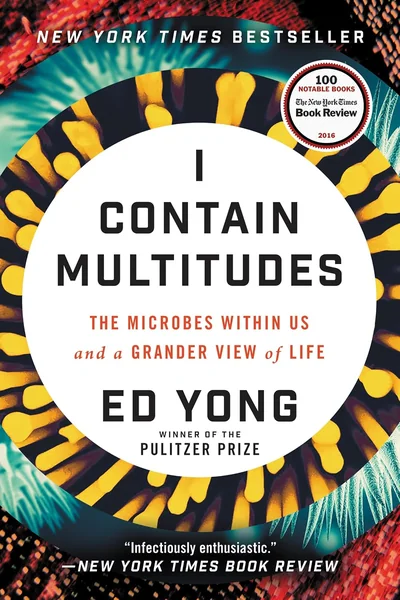
Ed Yong’s I Contain Multitudes successfully dismantles the traditional view of individual organisms by positioning microbes as the architects of life, drawing entirely on published scientific research and critical reception.
I Contain Multitudes: The Microbes Within Us and a Grander View of Life ― A Popular Science Look at Microbes and Life by Ed Yong front cover

The Microbial Thesis

The book challenges the longstanding cultural habit of treating microbes solely as pathogens to be eradicated. Yong expands the prevailing discussion beyond human health to encompass the entire animal kingdom.
He frames every creature, from humans to wasps, as an interconnected multitude shaped by bacterial and viral partnerships. The narrative traces how these microscopic organisms sculpt organs, educate immune systems, and guide behavior.
Yong illustrates these dynamics through specific biological cases, such as microbial transplants that save frogs in California. He also details how these partnerships allow cows to digest toxic plants in Australia or stop mosquitos from transmitting the dengue virus.
The central argument pivots on precedence, noting that multi-celled life had to accommodate a planet already ruled by microbes for billions of years. The text argues that disease often stems from dysbiosis rather than simple invasion.

A Grander View of Life

The work sits within a noble tradition of popular science that synthesizes scattered research journals to reshape public understanding. It joins the ranks of foundational texts like The Selfish Gene by reframing biology through a microbial lens.
The Guardian notes that the book tracks the historical trajectory of natural philosophy stripping away human dominion over creation. Yong demonstrates that the immune system functions more as an instrument for managing microbial co-existence than as a brute defense against intruders.
This perspective shifts the reader's cosmology by revealing that human history is merely a moment next to the evolutionary reign of bacteria. Economist, as quoted on edyong.me, noted that the author has no need for hype because the narrative bowls along wonderfully without it.
The book compels readers to look anew at the world through this microscopic framework.

Strengths in Storytelling and Scope

Yong achieves a rare balance between rigorous scientific accuracy and accessible narrative pacing. The Guardian highlights his ability to cover a huge amount of microscopic territory in clear, strong, often epigrammatic prose.
He actively introduces readers to the scientists studying these phenomena, transforming abstract data into human stories. Jeff VanderMeer praises Yong's brilliant gift for storytelling and precise writing about science.
This approach makes the invisible and tiny both visible and mighty for a general audience. The book maintains an infectious enthusiasm that prevents dense biological concepts from becoming sterile.
The author captures the wonder of Leeuwenhoek's discovery of tiny animalcules in a drop of pond water.

Limitations and Density

The ambitious scope of the project inevitably creates barriers for casual readers seeking a light introduction. The Guardian explicitly noted that the work is hardly a light read.
It demands sustained attention from readers who are not accustomed to synthesizing complex biological data. The text operates as a dense survey of microbiome research rather than a focused guide to personal health.
Readers expecting practical advice on diet or hygiene may find the breadth of the material overwhelming. The book prioritizes macroevolutionary narratives over granular medical applications.
The Prologue and subsequent chapters function as a broad survey rather than a targeted medical manual.

Is I Contain Multitudes Worth Reading?

Assessing the critical reception, the book stands as a definitive synthesis for readers who enjoy macroevolutionary narratives and ecological interdependence. It rewards those willing to engage with dense scientific material by offering a radically reconceived picture of life.
The work points directly to fans of foundational biology texts and readers fascinated by the hidden networks of ecology. It will likely frustrate audiences seeking straightforward health advice or a casual narrative pace.
The book remains a compelling argument for viewing the world through a microbial lens. Its lasting value lies in its ability to fundamentally alter how readers understand their own biological belonging.

Sources & Further Reading

The key facts and claims in this review are grounded in the retrieved, verified sources listed below.

  1. Cited in this review
  2. 1
  3. 2
  4. Further reading
  5. 3

    Ed Yong, LuvemBooks

  6. 4
  7. 5
  8. 6
  9. 7
  10. 8
  11. 9

    kirkusreviews.com

Age & Reading Level

Our age band

Adult

Our age band groups books for browsing; it isn't an age a review gave.

From our readers

Reader reviews

No LuvemBooks readers have answered yet.

Read it? Was it right for you?

Discussion

Reader comments