BOOKS
Published

Read Time

6 min read

Our Rating

3.5

The Minimalist Home offers a structured, accessible room-by-room decluttering guide with a clear Christian perspective on simplicity.

It serves beginners well but can feel repetitive and psychologically shallow for readers seeking deeper engagement with the subject.

Reviewed by

LuvemBooks

Share This Review

The Minimalist Home by Joshua Becker: Room-by-Room Review

Our Rating

3.5

The Minimalist Home offers a structured, accessible room-by-room decluttering guide with a clear Christian perspective on simplicity. It serves beginners well but can feel repetitive and psychologically shallow for readers seeking deeper engagement with the subject.

In This Review
  • What Works & What Doesn't
  • A Practical Blueprint for Owning Less
  • The Room-by-Room Framework in Practice
  • The Spiritual Dimension
  • Where the Argument Holds and Where It Strains
  • Who Gets the Most Value Here
  • Where to Buy

What Works & What Doesn't

What Works
  • Clear room-by-room structure makes the decluttering process feel manageable and actionable
  • Accessible, conversational writing style that suits a wide range of readers
  • Explicit Christian perspective on simplicity fills a gap left by most secular minimalism titles
  • Consistent focus on outcomes — not just tidiness, but meaning and intentional living
  • Well-suited as an entry point for readers new to minimalism
What Doesn't
  • Motivational framing becomes repetitive by the latter half of the book
  • Limited engagement with the psychological complexity of attachment to possessions
  • Room-based framework assumes a stable, conventional domestic situation not all readers share

A Practical Blueprint for Owning Less

The Minimalist Home: A Room-by-Room Guide to a Decluttered, Refocused Life_main_0
Is The Minimalist Home by Joshua Becker worth reading if you've already encountered Marie Kondo's spark-joy philosophy or absorbed the core ideas from The More of Less? That's the honest question any decluttering-curious reader should ask before picking this up. The answer is yes — but only for a specific reader, and knowing who that reader is will save everyone else the trip. Becker, who founded the widely-read Becoming Minimalist blog, published this room-by-room guide in 2018, and it arrives with a specific structural promise: rather than offering abstract philosophy, it walks you through your house one space at a time, suggesting what to keep, what to remove, and why the removal matters beyond tidiness.
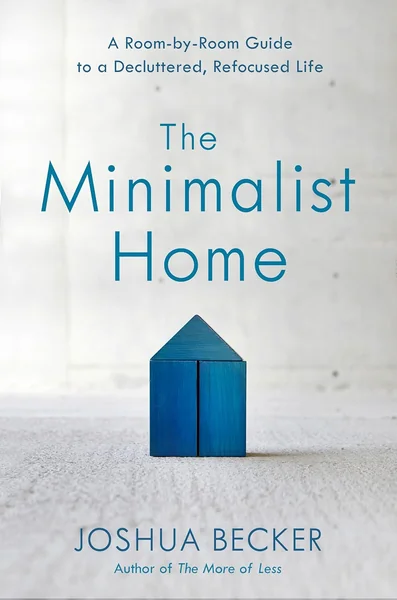
The cover design signals exactly that intent. Clean white space dominates, with spare, uncluttered typography — a visual argument for the book's thesis before you read a single word. It's deliberately calm rather than dramatic, and it sets an accurate tone for what follows: methodical, encouraging, and grounded in a clear worldview.
Where The Life-Changing Magic of Tidying Up by Marie Kondo operates through a single dramatic purge organized by category, Becker's approach is room-specific and incremental. That structural difference matters. Some readers respond better to tackling one room at a time rather than pulling every item of clothing from every closet simultaneously. The Minimalist Home is, in that sense, better suited for beginners or for those who attempted a whole-home overhaul and stalled.

The Room-by-Room Framework in Practice

The book's organizing logic is straightforward: each major living space gets its own dedicated treatment. Common areas, bedrooms, kitchens, garages, and storage spaces are addressed individually, with Becker offering targeted guidance on typical problem areas within each room. The approach acknowledges that clutter behaves differently in a kitchen than in a home office, and the advice adjusts accordingly.
This granular structure is the book's clearest strength. Practical room-by-room guidance makes the process feel manageable rather than overwhelming, and Becker consistently anchors his suggestions in outcomes — not just a tidier space, but a home that better reflects deliberate priorities. The argument is that our physical environment shapes attention, stress, and even relationships. Removing excess possessions, Becker contends, creates space for the things — and people — that actually matter.
The writing style is direct and accessible. Becker does not traffic in dense prose or academic language. Sentences move efficiently, and the tone resembles a thoughtful conversation rather than a lecture. Some readers may find this simplicity refreshing; others seeking more rigorous analysis of consumer psychology or habit formation may find it slightly thin. The book is persuasive rather than deeply evidential, relying more on practical reasoning and illustrative examples than on research citations.

The Spiritual Dimension

One aspect of The Minimalist Home that distinguishes it from most decluttering titles is its Christian underpinning. The verified subject classifications confirm this explicitly — the book addresses simplicity within a Christian framework, connecting the practice of owning less to values around contentment, generosity, and intentional living. For readers who share that worldview, this dimension will add meaningful resonance and motivation.
For secular readers, the religious framing is present but not overwhelming. Becker weaves his faith into the book's reasoning without turning it into devotional reading. Readers without a religious background can still extract considerable value from the practical framework. However, those specifically seeking a secular or evidence-based approach to minimalism may want to know this context going in — it shapes both the tone and the underlying "why" of the method.
This distinguishes Becker's work from similarly structured titles and makes it genuinely useful for a specific audience that larger decluttering books sometimes overlook.

Where the Argument Holds and Where It Strains

Becker's core thesis — that reducing possessions leads to a more focused, meaningful life — is presented with consistency and warmth. The room-by-room format ensures the book never becomes purely abstract; there is always a return to the concrete question of what to do with the spare bedroom or the overstuffed garage. That grounding is valuable.
However, the main weakness is the book's tendency toward repetition. Across chapters, the motivational framing recurs in ways that can feel redundant by the midpoint. Readers already persuaded by the premise may find themselves skimming passages that re-argue points already made. A tighter editorial hand could have sharpened the second half considerably.
There is also a noticeable gap in the book's engagement with the psychological complexity of attachment to objects. Becker acknowledges that letting go is difficult, but the treatment remains surface-level. Books like Goodbye, Things by Fumio Sasaki engage more directly with the emotional and identity-based dimensions of possessions. Readers dealing with hoarding tendencies, grief-related accumulation, or anxiety around discarding may need supplementary resources alongside this one.
The advice also assumes a degree of domestic stability — homeownership or at least a settled living situation — that not all readers share. The room-by-room framework is less applicable to those in transitional housing, shared spaces, or small urban apartments where the categories don't map cleanly onto their reality.

Who Gets the Most Value Here

The Minimalist Home works best as a practical entry point for beginners who want a structured, room-specific roadmap rather than a philosophical treatise. It works especially well for readers whose faith connects with Becker's Christian perspective on simplicity and contentment. Families navigating a cluttered household — particularly with children — will find the domestic focus more directly relevant than they might with other minimalism titles.
Those already deep in minimalist practice, or those seeking research-heavy arguments for owning less, will likely find it familiar ground. As an introduction to intentional living with immediate, actionable steps organized by room, it delivers what it promises.
The cover's visual restraint turns out to be an honest advertisement: this is a clean, calm, structured book with a clear purpose and a specific audience. It neither overpromises nor underdelivers for that audience.

Where to Buy

If you're a faith-oriented beginner looking for a room-by-room structure to finally get your home under control, this earns a place on the shelf — the Amazon link in the sidebar has the current price.