
At a glance
Pages590
First published1956
AudienceAdult — academic
ISBN0691018154
Readers who finished it
Be one of the first readers to answer.
Read it? Was it right for you?
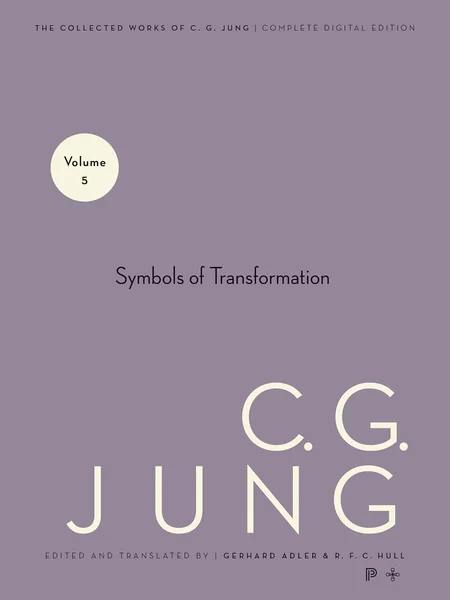
Symbols of Transformation
by C. G. Jung
LuvemBooks Verdict
Best for: Depth psychologists, Jungian analysts and trainees, scholars of mythology and comparative religion, and advanced students of the history of psychology who need a primary scholarly text documenting the theoretical and personal conditions of analytical psychology's break from Freudian orthodoxy.
Worth it? Skip it? Read the full verdict →Ask LuvemBooks
Was this helpful?
Symbols of Transformation (Volume 5 of the Collected Works of C. G. Jung) is Jung's thoroughgoing scholarly revision of his 1911–12 Psychology of the Unconscious, tracing the symbolic transformation of psychic energy through myth, dream, and comparative religion — and standing as the first major public declaration of Jung's independence from Freudian psychology. The R. F. C. Hull and Gerhard Adler translation, published by Princeton University Press, is the standard scholarly English rendering, building a sustained 590-page argument that rewards specialist readers already grounded in classical mythology, psychoanalytic history, and comparative religion. General readers new to Jung will find the referential density formidable and are better served by beginning elsewhere in the Collected Works before arriving here.
- Is it worth reading?
- For depth psychologists, Jungian analysts and trainees, scholars of mythology and religion, and advanced students of the history of psychology, Symbols of Transformation is essential reading — a primary document in the history of psychoanalytic thought that preserves, in annotated scholarly detail, the theoretical conditions under which analytical psychology separated from Freudian orthodoxy. The sustained, unified argument built across 590 pages rewards patient, close reading and carries the added authority of Jung's own revised foreword. For general readers or those new to Jung, however, the volume's referential density — presupposing familiarity with classical mythology, comparative religion, and early psychoanalytic history — makes it a demanding starting point, and foundational familiarity with Jung's core concepts is advisable before approaching it.
- Similar books
- Readers drawn to Symbols of Transformation are likely to find value in several closely related works. Psychological Types by C. G. Jung represents another foundational statement of Jung's mature independent framework. Erich Neumann's The Origins and History of Consciousness extends the Jungian symbolic method to the development of consciousness through myth. Joseph Campbell's The Hero with a Thousand Faces covers comparable territory in comparative mythology. Sigmund Freud's The Interpretation of Dreams provides the psychoanalytic context against which Jung's divergence in Symbols of Transformation is best understood. For those seeking a more accessible orientation to Jung before tackling the Collected Works, Jung: A Very Short Introduction by Anthony Stevens offers a compact scholarly overview. Note that none of these titles are currently in the LuvemBooks catalogue, so they are listed here for context only.
- Who should read this?
- Symbols of Transformation belongs on the shelves of depth psychologists, Jungian analysts and trainees, scholars of mythology and religion, and advanced students of the history of psychology. It functions as a primary text in the history of psychoanalytic thought, and its argument presupposes familiarity with classical mythology, comparative religion, and psychoanalytic history — it is not a text for readers new to Jung. General readers curious about Jungian ideas are advised to build foundational familiarity with his core concepts before approaching this volume.
- How does this compare to Psychology of the Unconscious?
- Symbols of Transformation is a complete scholarly revision of Psychology of the Unconscious, Jung's original 1911–12 text. Jung acknowledged in his foreword to the revised edition that the original was written 'at top speed, amid the rush and press of my medical practice,' and that he never felt 'happy about this book, much less satisfied with it' — making the revision both a scholarly and personal act of reckoning. While Jung confirmed that the core 'views and opinions' remain intact in substance and principle, the Princeton University Press edition adds revised bibliographical apparatus and editorial scholarship overseen by Gerhard Adler, Michael Fordham, and Sir Herbert Read, representing the mature, authoritative form of the argument. LuvemBooks has reviewed Psychology of the Unconscious separately for those wishing to compare the two texts directly.
- What is Jung's redefinition of libido in this book?
- In Symbols of Transformation, Jung redefines libido not narrowly as sexual energy in the Freudian sense but as generalized psychic energy undergoing symbolic transformation — a conceptual expansion central to his break with Freud. This redefinition is developed in a chapter titled 'The Transformation of Libido,' which signals the breadth of Jung's reach across comparative mythology and religion to map recurring symbolic patterns. The theoretical divergence is documented in scholarly, annotated detail throughout the volume, making it a primary source for understanding the specific conceptual disagreements that drove Jung's split from Freudian orthodoxy.
- Which edition and translation should I read?
- The standard scholarly English rendering is the Princeton University Press edition translated by R. F. C. Hull and Gerhard Adler, published as Volume 5 of the Collected Works of C. G. Jung. Hull's translation of the Collected Works is widely recognized in the field as the definitive English-language resource for Jung's German writings. The edition includes revised bibliographical citations and is editorially overseen by Gerhard Adler, Michael Fordham, and Sir Herbert Read, making it the authoritative text for scholarly and clinical use. The Princeton University Press paperback is currently available in its second printing.
Summarize this book
Is it worth reading?
Who should read this?
How does this compare to Psychology of the Unconscious?
What is Jung's redefinition of libido in this book?
Which edition and translation should I read?
Summarize this book
Symbols of Transformation is Volume 5 of the Collected Works of C. G. Jung and a complete scholarly revision of his earlier Psychology of the Unconscious, originally written in 1911–12. Jung builds his argument by closely reading a set of fantasies recorded by an American woman, using those unconscious productions to trace recurring symbolic patterns across dream symbolism, myth, and comparative religion. A pivotal reinterpretation runs throughout: Jung redefines libido not as narrowly sexual energy in the Freudian sense, but as generalized psychic energy undergoing symbolic transformation — the conceptual expansion that lay at the heart of his break with Freud. The Princeton University Press edition, translated by R. F. C. Hull and Gerhard Adler, adds revised bibliographical apparatus and is editorially overseen by Gerhard Adler, Michael Fordham, and Sir Herbert Read.
Follow up
How different is this from the 1911–12 original?
Who was the American woman whose fantasies Jung analyzes?
What are the Collected Works of C. G. Jung?
Synthesized from verified book data & published reviews · How we review
Press Enter to ask. Answers come from our editorial Q&A — start typing to see related questions.
Books like Symbols of Transformation
Curated picks for readers who enjoyed Symbols of Transformation, with our reasoning for each match.
If you liked Symbols of Transformation

