BOOKS
Published

Read Time

3 min read

Reader rating

4.4

· 7,416 Amazon ratings
reader ratings, not a LuvemBooks score
Curated & edited by

LuvemBooks Editorial

How we create our reviews →
Share This Review

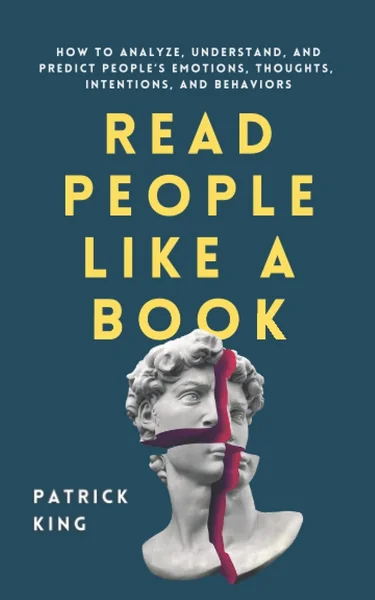
Read People Like a Book by Patrick King Review: Practical Guide to Decoding Human Behavior

Patrick King's Read People Like a Book is a self-help guide designed to teach readers how to analyze body language, detect deception, and interpret the unspoken intentions behind everyday human behavior — written for a general audience with no background in psychology or professional interrogation training.
LuvemBooks Verdict

Best for

Readers who want a single, accessible guide to improving social awareness — covering body language, lie detection, and behavioral prediction — in practical, everyday contexts like dating, workplaces, or managing social anxiety, without needing a psychology background.

Worth it if

You're drawn to applied social-skills content and want usable frameworks for reading people in real situations rather than a rigorously sourced survey of behavioural science.

Skip if

You need conclusions grounded in peer-reviewed psychological research — the book's frameworks rest on King's coaching observations rather than independently verified science, and critics recommend pairing it with academic literature to fill that gap.

The befreed.ai summary notes that King's approach is "particularly useful for those navigating dating, workplace dynamics, or social anxiety," praising its actionable, real-world focus, but flags that critics point out the book lacks peer-reviewed studies and recommend pairing it with scientific literature. The sonythebooklover.com review highlights that the book goes beyond a standard body-language manual, combining psychological insights with practical techniques for detecting lies and understanding motivations.

Sources: befreed.ai, sonythebooklover.com
4.4from 7,416 Amazon ratings— reader ratings, not a LuvemBooks score
In This Review
  • What Works & What Doesn't
  • What the Book Actually Is and Does
  • Scope and Positioning in the Genre
  • Strengths: Accessibility and Real-World Application
  • Limitations: Depth and Academic Rigor
  • Who This Book Is For

What Works & What Doesn't

What Works
  • Covers a broad range of interpersonal analysis skills — body language, lie detection, emotional intelligence, and behavioral prediction — within a single accessible guide
  • Written for a general audience with no prior psychology or professional training required, lowering the barrier to entry
  • Structured around real-world application in relatable contexts such as workplace dynamics, dating, and social anxiety
  • Reader summaries highlight clear, example-driven explanations designed to make subtle behavioral cues understandable and actionable
  • Part of a larger series by a prolific author, offering readers a broader ecosystem of related social-skills content
What Doesn't
  • Critics note the book does not cite peer-reviewed studies, meaning its frameworks are not grounded in independently verified scientific research
  • Readers seeking academic rigor or clinical accuracy in behavioral psychology will find the scope insufficient without supplementary scientific literature
Read People Like a Book is a self-help guide focused on practical interpersonal analysis, not a psychology textbook or academic study — a distinction that defines both its strengths and its limits.

What the Book Actually Is and Does

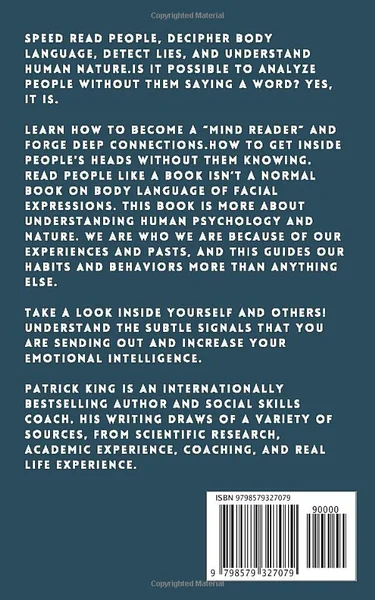
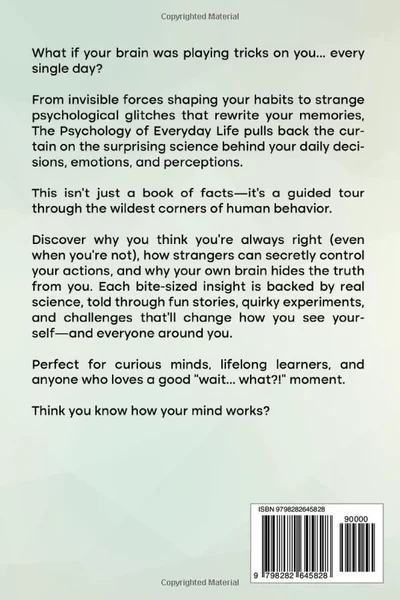
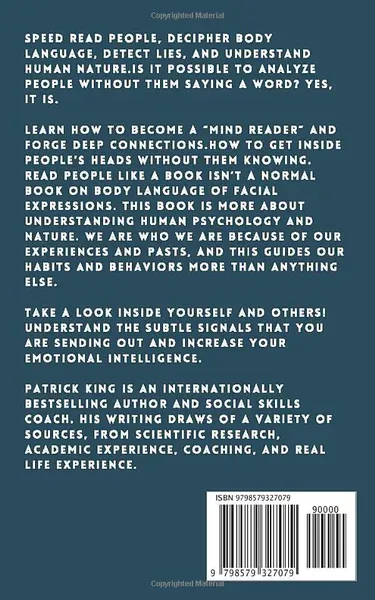
Back cover with synopsis, author bio, and barcode.
Published independently in December 2020, Read People Like a Book: How to Analyze, Understand, and Predict People's Emotions, Thoughts, Intentions, and Behaviors by Patrick King sets out to make the skill of reading people accessible to a general audience. The book's stated premise is that another person's inner world functions like a black box — all we have access to are external signals: "the words they say, their facial expressions and body language, their actions, our past history with them, their physical appearance, the tone and quality" of what they communicate. King, who is described by his publisher as an internationally bestselling author and social skills coach, frames the project explicitly: developing these skills requires neither a psychology degree nor experience as a trained interrogator. The book covers speed-reading people, deciphering body language, detecting lies, and understanding the broader mechanics of human nature.

Scope and Positioning in the Genre

King's book belongs to a crowded shelf of popular social-skills titles, but its full subtitle signals an ambition beyond basic body-language guides. Where many books in the genre focus narrowly on gestures or facial expressions, this one extends to predicting emotions, thoughts, intentions, and behaviors as a unified skill set. The publisher's description positions it as something closer to a practical psychology survey — with one passage in the book's own framing describing the art of reading people as "the art of understanding human nature," likening it to a cheat code for navigating interpersonal dynamics. King is identified across sources as a former attorney turned social interaction specialist and communication coach, a background that shapes the book's emphasis on applied, real-world contexts rather than theoretical frameworks.

Strengths: Accessibility and Real-World Application

The book's most consistently noted asset is its accessibility. One reader summary at Apple Books describes the explanations as "clear, relatable, and backed by real-life examples," specifically highlighting how the book breaks down body language, tone, and subtle cues in a way designed for everyday application. The befreed.ai summary notes that King's approach is "particularly useful for those navigating dating, workplace dynamics, or social anxiety," and characterizes the focus as actionable advice — centering real-world scenarios such as spotting incongruence between words and body language, rather than dwelling on abstract theory. The Barnes & Noble description echoes this by framing portions of the book as reading "like the most interesting and applicable psychology textbook you've ever read," a positioning that sets expectations for an engaging, readable register rather than a dense academic one. Readers drawn to self-improvement content who want direct, usable frameworks rather than scholarly apparatus are the audience this structure is designed to serve.

Limitations: Depth and Academic Rigor

The book's accessibility comes with a documented trade-off. Critics — as noted in the befreed.ai summary — point out that the text lacks peer-reviewed studies, which means its claims rest on King's coaching framework and applied observations rather than on independently verified scientific research. For readers who want conclusions grounded in controlled psychological literature, the book will fall short, and the same source recommends pairing it with scientific literature to address that gap. This is not a minor caveat: the topic — predicting emotions, detecting deception, analyzing character — touches on areas where popular claims and empirical findings frequently diverge. The book makes no claim to be an academic resource, but readers approaching it as a definitive guide to behavioral science rather than a practitioner's toolkit may find it underbuilt.

Who This Book Is For

Read People Like a Book is designed for a broad general audience: people who want to improve social awareness, communicate more effectively, or navigate specific high-stakes environments like professional settings, dating, or conflict-prone relationships. It is explicitly not pitched at trained professionals or researchers. King's background as a coach rather than a credentialed psychologist is consistent with the book's orientation toward applied social skills over clinical accuracy. Readers who enjoy popular social-science titles — the kind that translate behavioral concepts into usable frameworks without demanding prior expertise — will find the format familiar and approachable. Those seeking a rigorously sourced introduction to the psychology of human behavior would be better served by peer-reviewed material or academically grounded texts alongside it.

Sources & Further Reading

The key facts and claims in this review are grounded in the retrieved, verified sources listed below.

  1. Cited in this review
  2. 1
  3. 2
  4. 3
  5. Further reading
  6. 4
  7. 5
  8. 6
Related Reviews

Reviews of books we picked for readers who enjoyed Read People Like a Book.